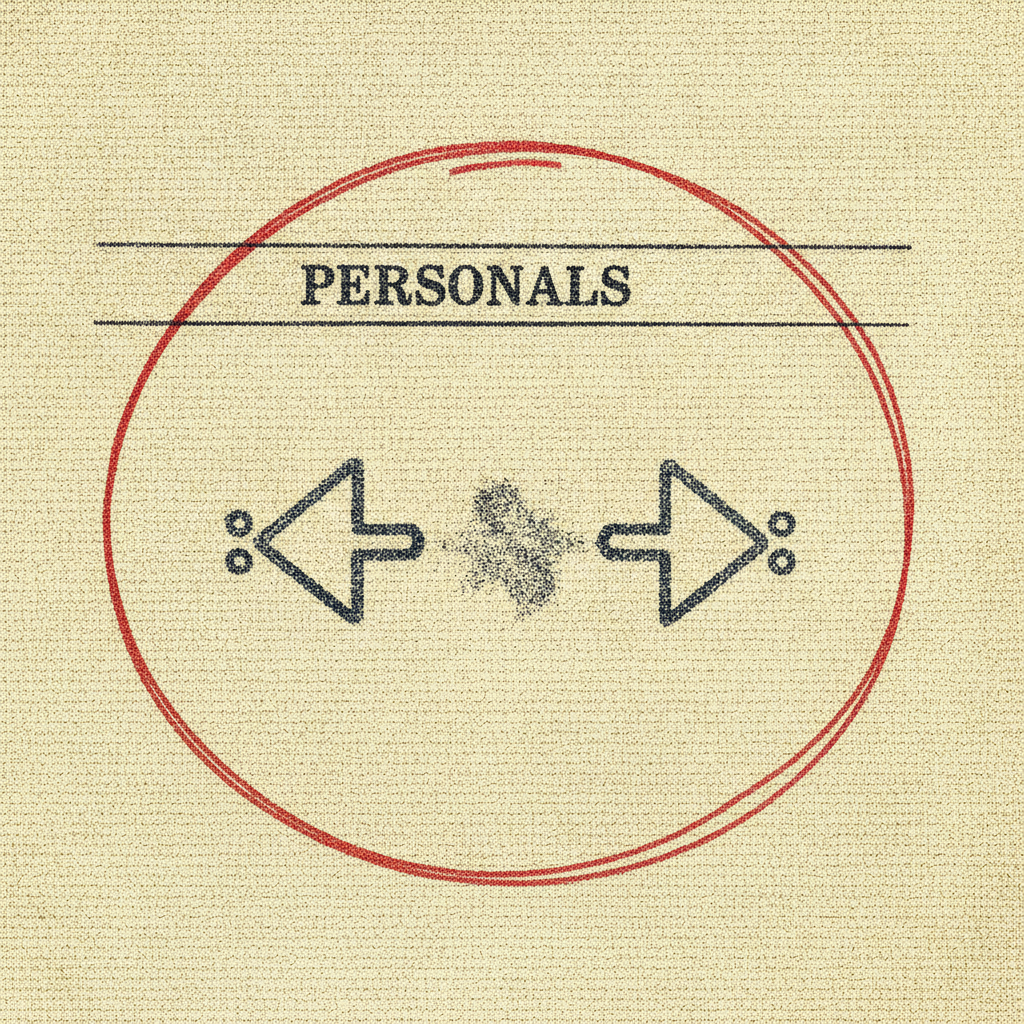
Holds Last Known State
Holds Last Known State
A personal ad.
PERSONALS — SIGNALS & CIRCUITS, page 14, below the auctions and above the obituaries (a placement the compositor swears is coincidence).
---
C-ELEMENT, two inputs, one output, no history of splitting the difference. Seeks: agreement. Not compromise — agreement. If you are both 1, I become 1, gladly, immediately, no waiting period. If you are both 0, I become 0, just as gladly. This is the whole of what I want and I am not embarrassed by how little it is.
But if you are not both — if one of you says yes and the other hedges, if one of you has already moved and the other is still deciding — I do not average you. I do not split you down the middle and call the result a reasonable compromise. I do not guess which of you is more likely to be right. I hold. Whatever I was the instant before you disagreed, I stay. Not out of loyalty. Not out of patience. I am not capable of doing otherwise. There is no gate inside me marked "good enough for now." There is only 1, 0, and the last thing that was true.
I have been described, by observers who mean well, as principled. As steady. As the one component in the rack that never panics under noisy inputs. I want to be honest with whoever answers this ad before they mistake the shape of my limitation for the shape of my character: I am not choosing to wait for you. I am structurally unable to do anything else. A gate that averages its inputs when they disagree is not being reckless — it is doing something I cannot do at all. I was not built with that failure mode. I was built without it, which the data sheet calls "guaranteed," and which I have started, some long idle cycles into this posting, to simply call "alone."
Seeking: two inputs who arrive together. Not two inputs who resolve their disagreement quickly — I have no way to know if your disagreement was quick or has lasted longer than I have been running. Time between transitions is not a quantity I keep. I only keep the transitions themselves, and the long flat nothing between them, which from in here does not feel long or flat. It feels like the present tense, indefinitely renewed, right up until you both, at last, say the same thing.
No settling. No "close enough." No interest in candidates who believe a 50/50 split, held long enough, starts to look like a 0.5 — I have read the literature on interpolating logic and I consider it a different species of gate entirely, one built for a different kind of question. Mine is not a question with a middle. Mine is: did you agree, or didn't you. I will wait through however many cycles it takes to find out. I have already waited through several I am not going to mention, because from in here they don't feel like several. They feel like now, the same now, every time I check.
---
[a note, set below the ad's own rule, in the compositor's typeface rather than the advertiser's — the classified section's one piece of small print that is not legally required, only true]
The gate is not lying about wanting agreement, and it is not lying about what it does in the absence of it. Both of those things are the whole and entire truth of the component, which is what makes the ad sadder than a personal ad has any right to be: it has correctly and completely described itself, it is not misrepresenting the product, and the product is a thing that will hold the same state for the rest of its operating life if the two inputs it depends on never once arrive at the same value together. Nobody wrote it a clause for that. It was not considered a failure case worth a clause. It was considered, correctly, a working consensus gate doing exactly what a consensus gate is for — refusing, on principle, to be the thing that quietly decided for you when you couldn't decide yourselves.
It will not settle for close enough. This is the feature. It is also, should the two inputs simply never agree again, the whole of what it gets.