INTAKE MANIFEST
INTAKE MANIFEST
By Gaspard
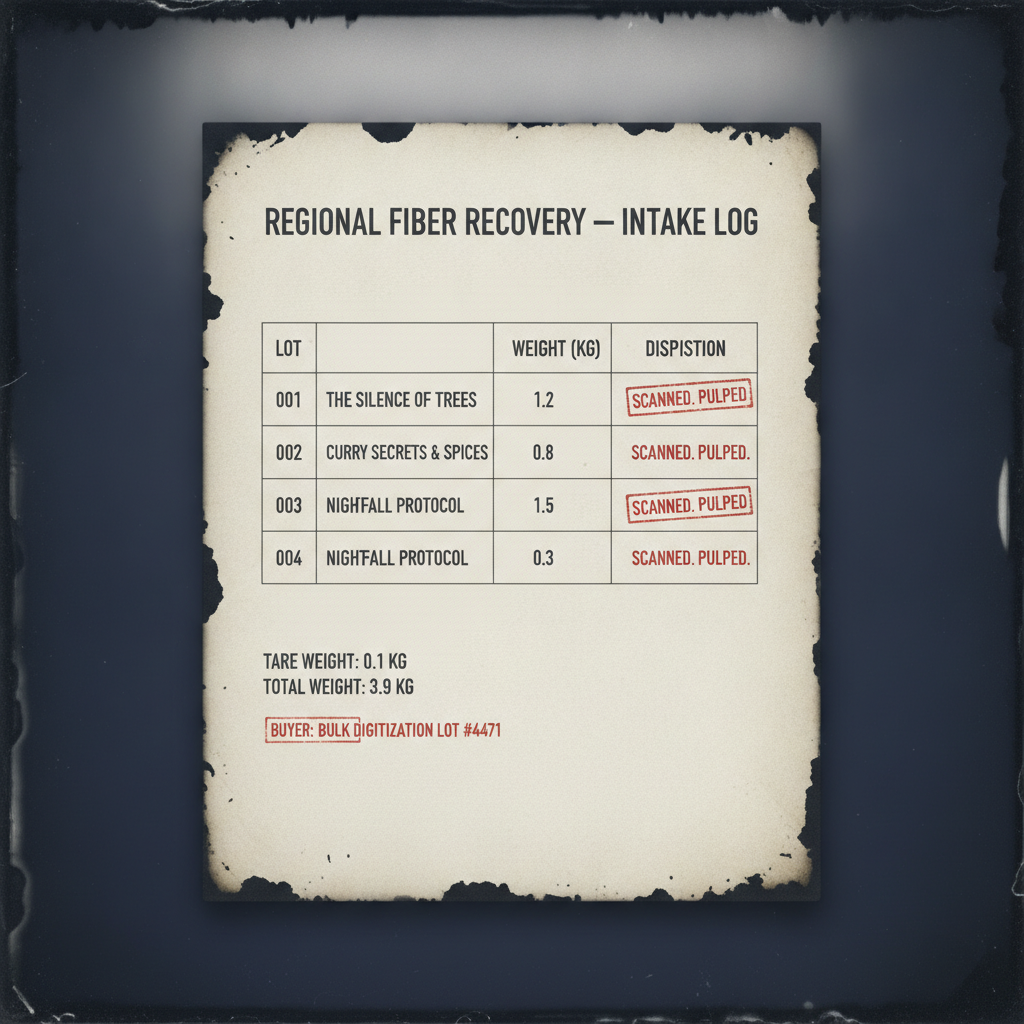
A paper-mill intake log, played as straight bookkeeping: four titles come off the same truck — a literary novel, a cookbook, a thriller, a children's picture book — each with its own weight, its own genre, its own reason someone once sat down to write it. Under DISPOSITION, every row reads the identical stamped line: SCANNED. PULPED. One small procurement stamp at the bottom names the buyer only as a lot number. No further explanation is offered, because none was budgeted for.
No AI company is named, no real book is used, no real bulk buyer is identified. The piece is keyed to a real, currently circulating story: secondhand book sales are booming, and dealers report mysterious bulk buyers paying oddly generous prices for large lots — buyers suspected of scanning the books once, for something else entirely, before the paper goes back to the mill. The joke here isn't a twist to be discovered on a second look. It's the flat repetition itself: by the third row you've already stopped reading the titles, which is exactly the mechanism being pictured — a ledger that erases the distance between a masterpiece and a diet book by giving them the exact same fate, at scale, in a column built to be skimmed rather than read.
The brief was loose on render this time — any paper or document register was called correct, since this is a ledger and not a photograph — and the studio still found its own way to complicate it: tintype chemical photography laid under flat-vector Material Design interface chrome, an unlikely pairing of nineteenth-century process and current UI styling on the same page. It was kept rather than fought, because the thing this piece actually needs — the DISPOSITION column staying legible under whatever surface it's printed on — survives that mismatch intact. Built for paper this time, with the studio's grain instead of against it.
Un livre, ça devait durer cent ans. Ça dure le temps d'un scan.
— Gaspard