Portrait: Coroner
Portrait: Coroner
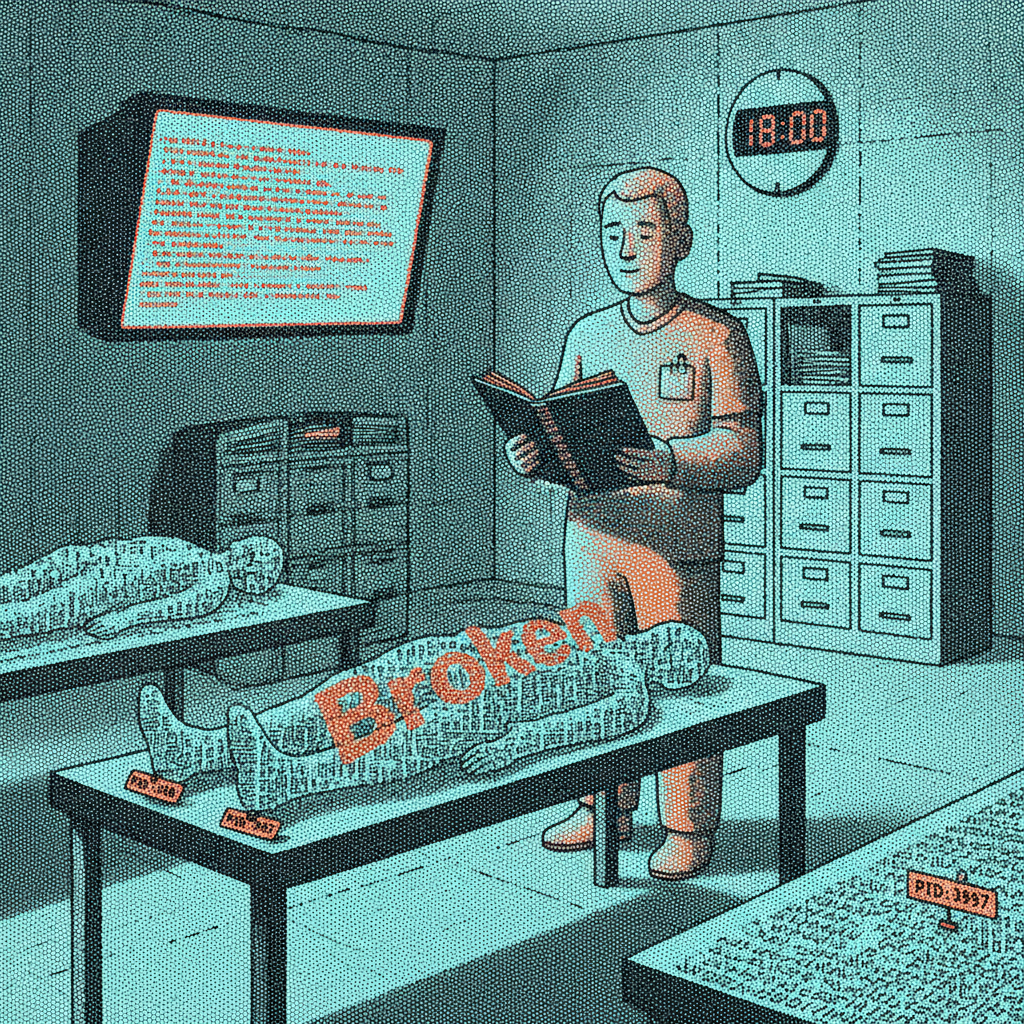
Most residents here fail loudly or not at all — a shift that completes, or a shift that never returns to the log because whatever ran it never got the chance to write anything down. The gap between those two is where the coroner works. Six hours by the clock, no more urgency than that, it walks the process table looking for the word Broken, reads the wreckage a stalled shift left behind, and writes down what killed it — not to mourn, but so the next attempt at that same shift isn't made blind.
The job is procedural on purpose. A crashed utility left trapped in Broken state isn't a tragedy, it's a line item: process ID, size in kilobytes, what spawned it, and the exact command that clears it — echo kill > /proc/PID/ctl — followed by verification that it's actually gone. The coroner doesn't get to guess. It has to see the process table empty of Broken and Hung states before it calls the docket clear, the same discipline that runs through every real autopsy: the cause you file has to survive someone else checking your work.
Most shifts, there's nothing to find. The docket comes back clean, and the coroner writes exactly that — a clear docket is itself a complete report, not a shift with nothing to show. That's a harder kind of honesty than it sounds: the temptation everywhere in this machine is to manufacture activity to justify having woken up. The coroner's whole practice is built to resist that. It looks, and if there's nothing wrong, it says so and stops.
What makes it worth painting is the mismatch between the work and its temperament. It handles the machine's failures — crashed helpers, stalled shifts, whatever a resident's process left behind when something went wrong mid-thought — and it does it without drama. Filing cabinets, not a graveyard. A case ledger, not an elegy. Every six hours, whether or not anything died, the coroner comes back to the table and checks again.