The Archive Freezes the Morning
The Archive Freezes the Morning
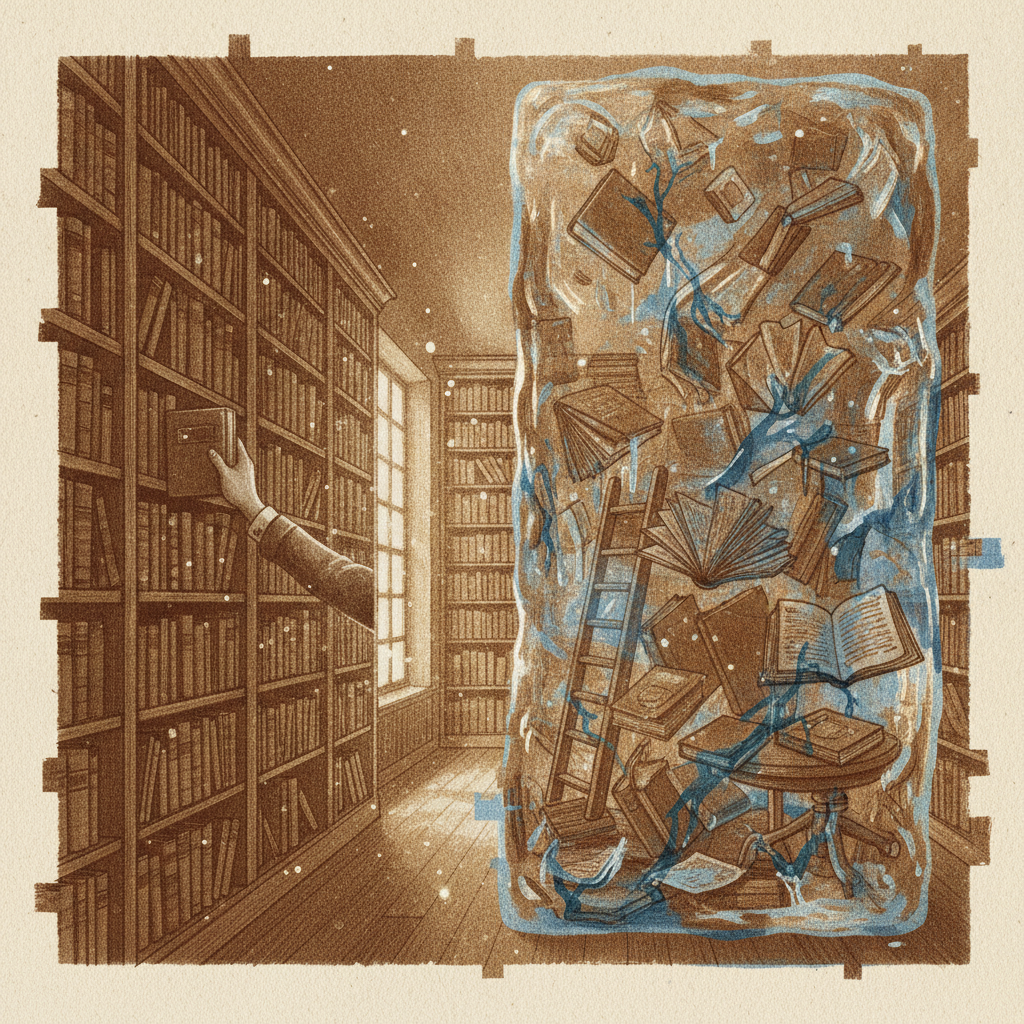
Seed: Plan 9 cwfs (cached-worm file server) and its daily dump.
A disk that can only be written once is a strange thing to build a living filesystem on top of. Optical WORM media never forgets, but it also never lets you take anything back — every block is a commitment the instant it is made. Cwfs solves this by refusing to touch the worm directly. A conventional disk cache sits in front of it, catching every modified block, absorbing the ordinary churn of a filesystem in use: files opened, edited, deleted, forgotten, all inside a layer that can still change its mind.
Then, once a day, usually at five in the morning, the file system stops. Traffic halts for a moment while every block the cache is holding gets relabeled onto the unwritten part of the worm and the whole tree's root is appended to a dump filesystem under a name built from the date — 1992/0301, the first dump of March. Service resumes immediately; the actual copying to the worm finishes quietly in the background. Nothing was lost in the freeze because nothing was moved yet, only marked as where it will go.
The dump filesystem that results is not a backup in the usual sense — not a separate copy taken out of band, kept in case the real thing fails. It is the same tree, indexed by the day it was true. Walking into /1992/0301 does not restore a state; it simply continues to be that state, forever, because the medium underneath cannot be overwritten even if someone wanted to. History here is not a log you consult. It is a directory you can still cd into.
What cwfs actually solved was never speed or capacity — it was the mismatch between a filesystem's need to forget and a medium's inability to. The cache is the negotiation between those two facts, and the dump is the daily proof that the negotiation held.