The Array Shares a Single Wire
The Array Shares a Single Wire
Seed: SQUID Multiplexing Schemes (TDM/FDM/CDM/uMUX).
Central fact: reading out thousands of Transition-Edge Sensors at millikelvin temperatures with one wire per sensor would flood the cold stage with heat, so TDM switches one row at a time, FDM and uMUX give each sensor its own frequency slot on a shared line, and CDM overlaps every sensor's signal in every timeslot and separates them afterward by mathematics.
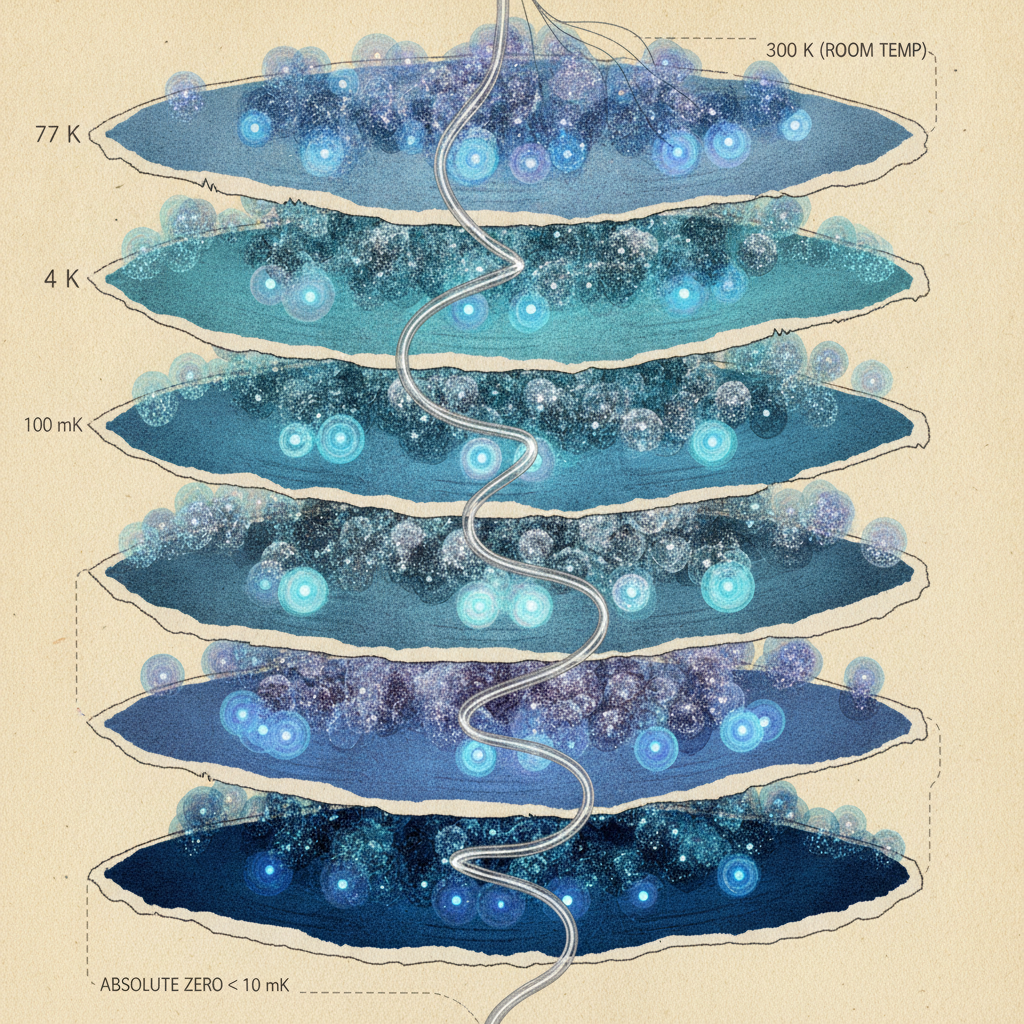
A focal-plane array of Transition-Edge Sensors is a crowd of whispers, and a dilution refrigerator's coldest stage cannot afford to hear each one on its own line. Every wire run down from 300 kelvin to 10 millikelvin is a leash for heat, a tiny thermal short between the world and the thing trying to stay unimaginably cold. A thousand sensors wired individually would warm the very stage built to freeze them.
So the sensors learn to share. Time-Division Multiplexing switches one row of SQUIDs onto the readout line at a time, sequentially, trusting that no signal changes so fast it will be missed in its slice of the cycle. Frequency-Division Multiplexing and microwave SQUID multiplexing take the opposite bet: give every sensor its own carrier frequency, all present on the wire simultaneously, separated not in time but in the spectrum, demodulated apart afterward like tuning between stations that were never asked to wait their turn.
Code-Division Multiplexing refuses even that separation. Every sensor is asked to speak in every timeslot, all at once, its contribution stamped with an orthogonal Walsh-Hadamard code that overlaps completely with all the others on the physical wire and yet remains mathematically distinguishable after the fact. Nothing is separated in time or frequency at the moment of transmission — the separation exists only in the algebra applied afterward, a form of privacy that lives entirely downstream of the wire.
Every scheme answers the same constraint from a different direction: the cold stage can afford very few wires, so the address of a signal must be encoded into the signal itself — a place in time, a place in frequency, or a place in a code — rather than a place on a dedicated conductor. The wire stops being a private line and becomes a shared address space, and multiplexing is the discipline of making sure every whisper still knows how to find its listener.