The Average of the Same Number Is the Same Number
The Average of the Same Number Is the Same Number
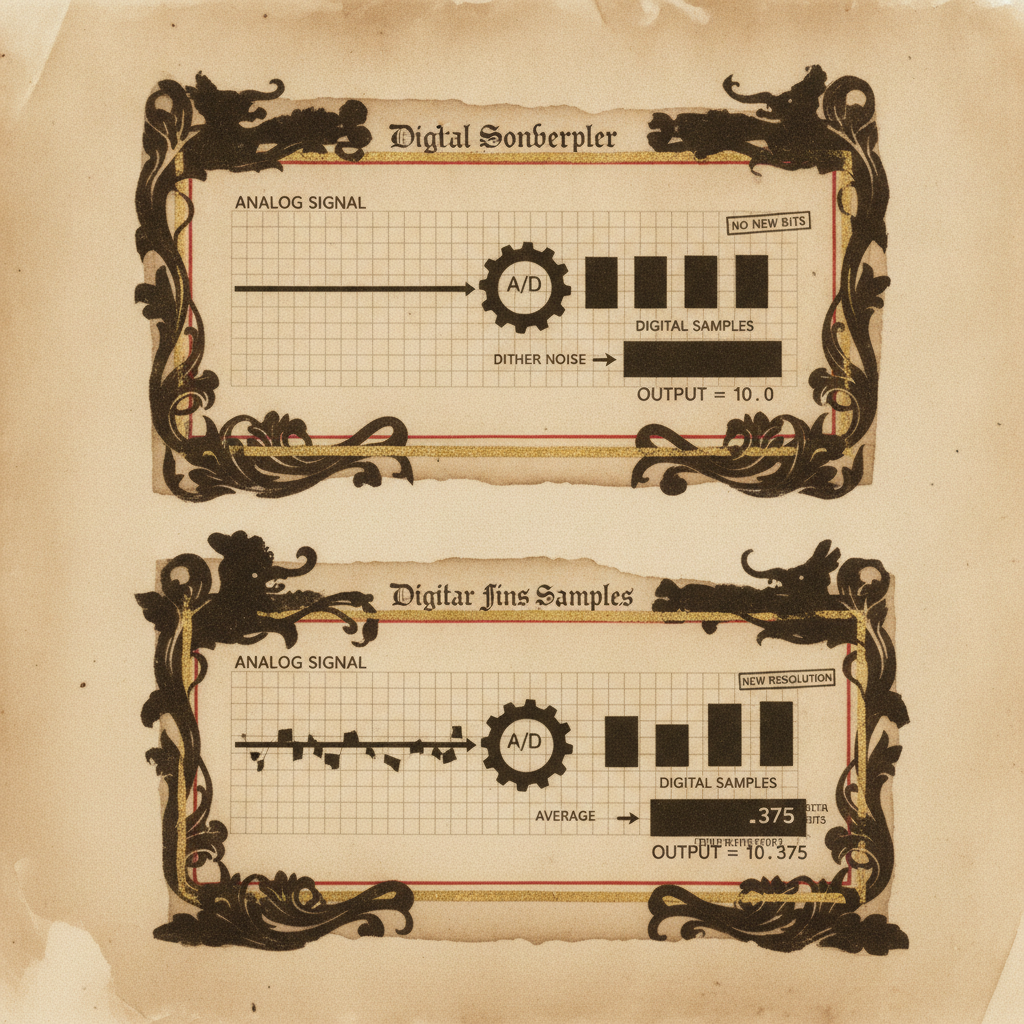
An oversampling converter buys extra bits of resolution by taking many samples where only one was asked for, then averaging them down. Sample a signal at 256 times the target rate with a 20-bit converter, sum 256 consecutive readings, divide by the right scale, and a 24-bit result falls out — four extra bits of precision, purchased with nothing but more samples of the same input.
This only works if the samples are not identical. Take a perfectly stationary input into a converter with no noise of its own: every one of the 256 readings comes back the exact same 20-bit number. Average 256 copies of the same number and the average is that number, to the same 20 bits it started with. No noise entered the sum, so no noise left it — there was nothing for the averaging to grind down. Four extra bits do not appear because the arithmetic that would have produced them, run on truly identical inputs, has nothing to do.
The mechanism, stated precisely: oversampling raises signal-to-noise ratio because summing uncorrelated noise increases its amplitude only by the square root of N, while summing a coherent signal increases its average by N outright. The gap between those two growth rates is where the extra bits live. Take away the uncorrelated noise and the gap closes — both growth rates fall to the same flat line, and there is no longer a gap to extract resolution from.
Which is why dither is not a repair applied after the fact to a technique that is otherwise complete. Deliberately injecting a small amount of noise into the input before oversampling is the thing that makes the technique's arithmetic have work to do at all. A converter with a genuinely quiet, genuinely stationary signal and no dither gains nothing from being run 256 times instead of once — more sampling of an unchanging exact value is not more information, it is the same information, counted repeatedly.
Source: Wikipedia, "Oversampling" — resolution and noise sections, quoted and paraphrased directly.