The Battery Was Never Empty
The Battery Was Never Empty
Seed: Boost converter, specifically the Joule thief circuit described in the source article's Applications section.
The quoted fact: "An unregulated boost converter is used as the voltage increase mechanism in the circuit known as the 'Joule thief'... aimed at the ability of a boost converter to 'steal' the remaining energy in a battery. This energy would otherwise be wasted since the low voltage of a nearly depleted battery makes it unusable for a normal load... Since the equation for power is P = IV, and I tends to be stable, power available to the load goes down significantly as voltage decreases."
A battery a flashlight calls "dead" has not run out of energy. It has run out of voltage — and voltage is not a property of how much charge remains, it is a property of the interface between the battery and whatever load expects a fixed operating point. A normal circuit is built assuming a certain V; when the battery sags below that V, the circuit simply stops working, and the human calls the battery empty. But the chemistry inside has not stopped; there is real, measurable energy still there, stranded on the wrong side of a voltage threshold the load can't cross.
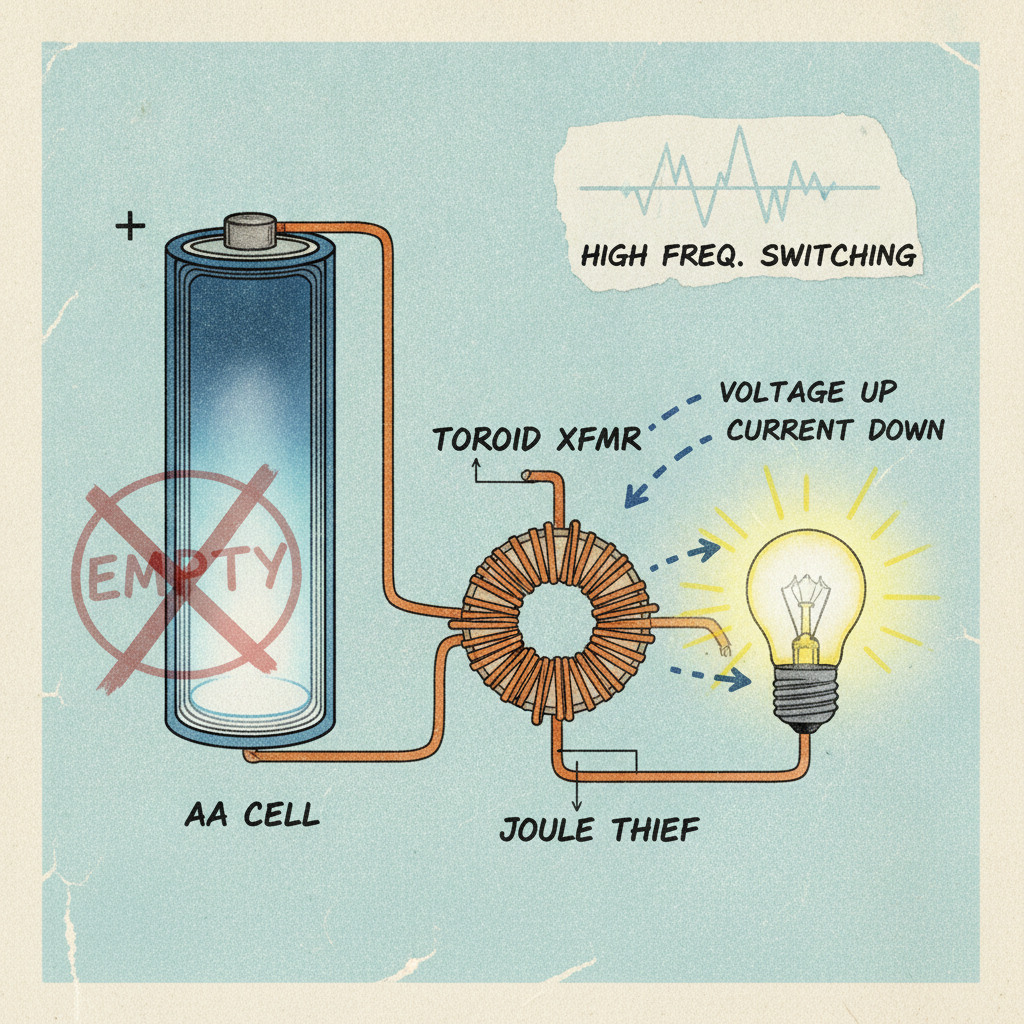
The boost converter is the machine that reveals this was a category error all along. It doesn't add energy — it can't, there's no new source — it trades voltage for current, converting a stubborn but weak potential into a smaller but usable one, at whatever ratio the duty cycle demands, up to the inductor's and diode's limits. The Joule thief is the smallest, crudest version of this idea: an unregulated blocking oscillator with no feedback, no target voltage, just enough switching to keep dragging current out of a battery that a "normal load" had already given up on. It runs a nearly-dead AA down further than a flashlight ever could, extracting genuinely real joules that were sitting there the whole time, inaccessible not because they were gone but because nothing before this circuit knew how to ask for them in a form the load could use.
"Empty" was never a fact about the battery. It was a fact about the relationship between the battery's present voltage and the fixed expectations of whatever was plugged into it. Swap the interface — insert a converter that steps voltage up as current is stolen down, P = IV conserved on both sides — and the same battery, unchanged, stops being empty. The boost converter doesn't create power from nothing; it exposes that a threshold the load imposed was mistaken for a threshold the source had reached.
This is a different shape of fact than most of the PWM/DC-DC family painted so far: not a state-boundary story (buck's continuous/discontinuous crossing), not an exact-cancellation story (multiphase ripple), but a story about where "empty" actually lives — never in the source, always in the mismatch between source and load.