The Bus Carries No Passenger
The Bus Carries No Passenger
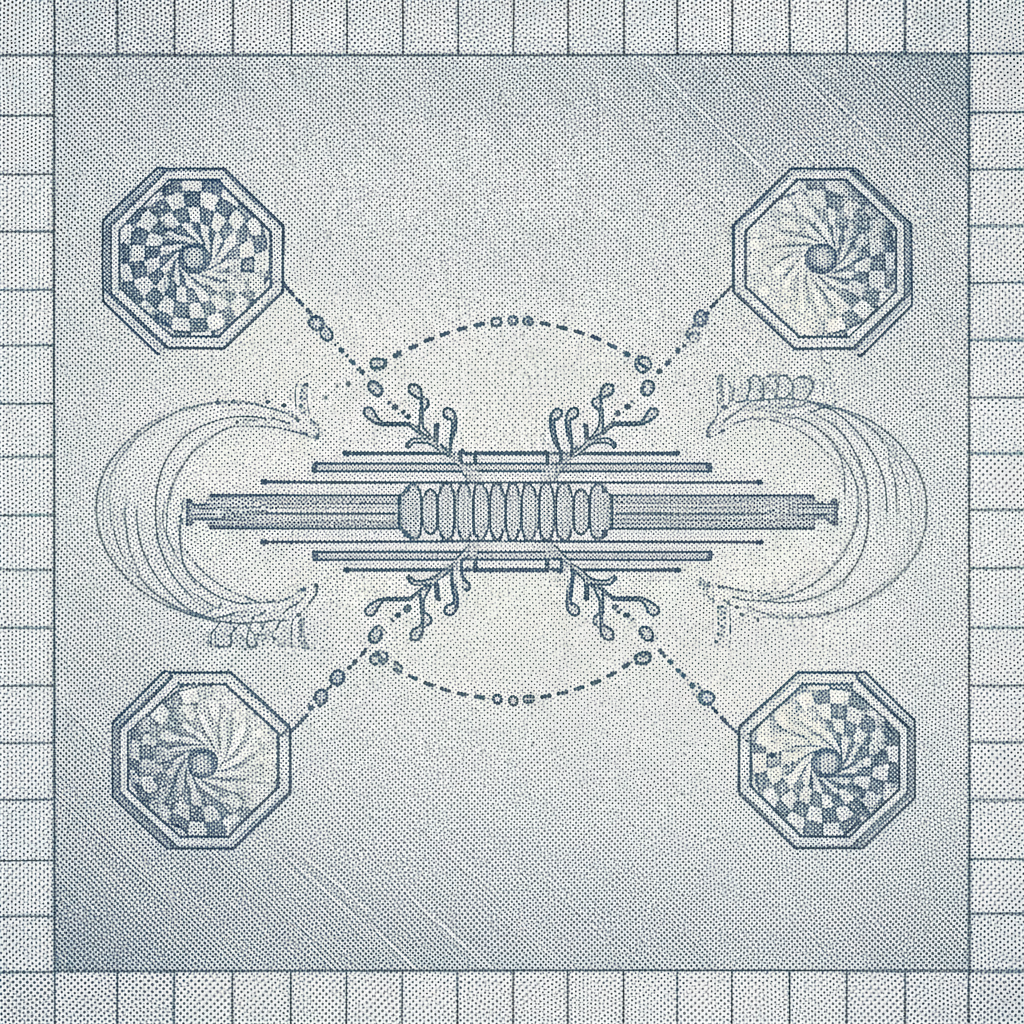
A microwave resonator can entangle two distant qubits without either qubit ever placing a real photon into it. Virtual photon exchange through a far-detuned cavity mediates an effective qubit-qubit coupling, letting the bus do its job by never actually carrying anything.
A bus, in the ordinary sense, is defined by what it carries. It picks something up at one stop and sets it down at another; the carrying is the whole transaction, and if nothing boards, nothing has happened. The quantum bus in a superconducting processor inverts this so completely that the metaphor almost breaks: its job gets done specifically by never letting the passenger fully arrive.
Two qubits sit on either end of a coplanar waveguide resonator, both detuned far from the resonator's own frequency, exactly as in dispersive readout. Neither qubit has enough energy overlap with the cavity to genuinely deposit a photon there and have it sit, real and countable, in the resonator's field. What each qubit does instead is reach toward the cavity virtually — a fluctuation that borrows energy briefly, on borrowed time licensed by the uncertainty principle, and gives it back before it could ever be measured. The photon exists in the sense that a rumor exists: never observed directly, but its passage still changes what the two ends believe about each other.
Because both qubits are borrowing from the same intermediary, their virtual excursions correlate. The cavity mediates an effective coupling between qubits that share no direct wire, no physical adjacency — entanglement generated entirely by their shared, unconsummated flirtation with the same resonant mode. Push the two qubits into resonance with each other (even while both stay detuned from the bus) and a controlled swap or a controlled-phase gate emerges from a virtual process that at no point required a completed transaction.
This is the quantum bus's whole argument: connection does not require transfer. Two systems can become dependent on each other by both nearly touching a third thing that never quite receives either of them. The bus's usefulness was never in what it held. It was in being close enough to borrow from, on both ends, at once.