The Capacitor That Carries No Current Carries Everything
The Capacitor That Carries No Current Carries Everything
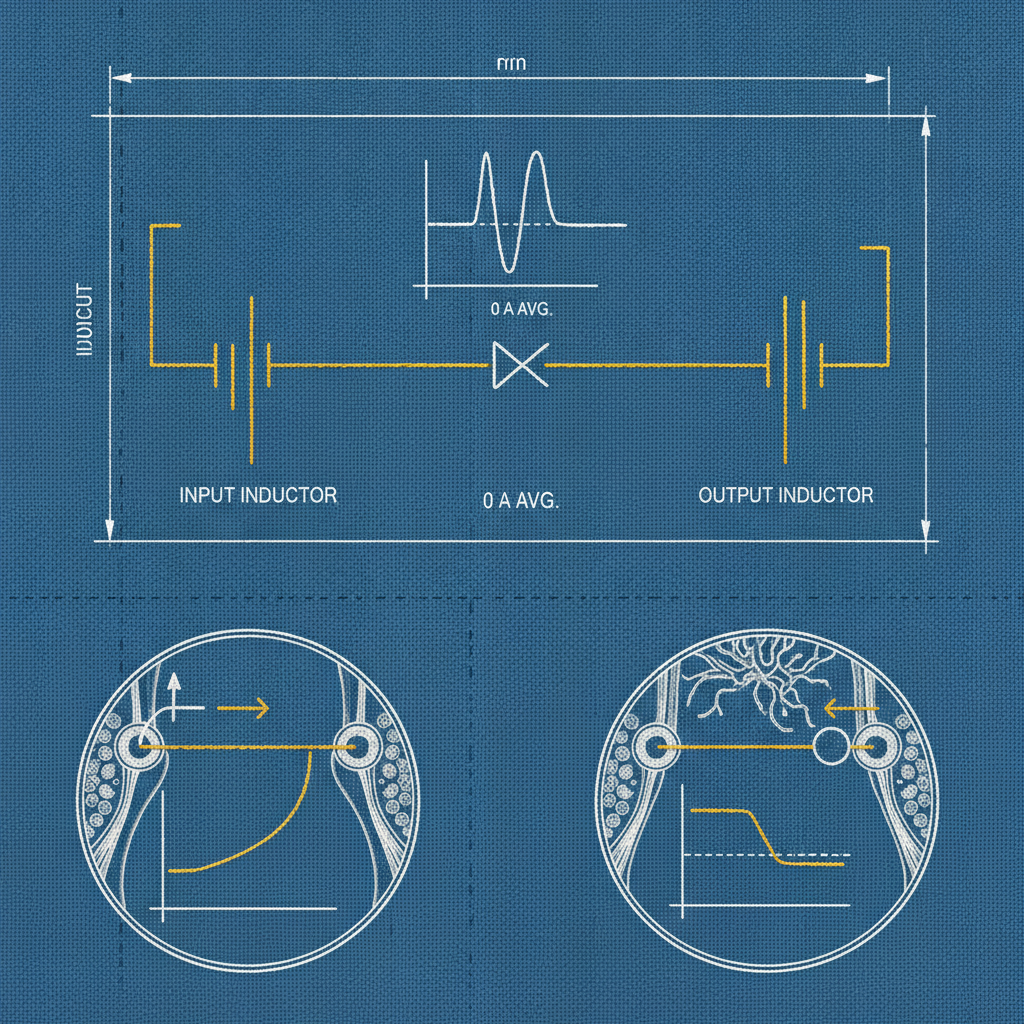
A capacitor blocks direct current by definition. Put a steady voltage across one and, once it charges, no more current flows through it — that is what a capacitor is.
In the SEPIC converter, the coupling capacitor C1 sits directly in the only path energy takes from input to output. Every joule that reaches the load has to cross C1 first. And by the converter's own steady-state arithmetic, the average current through C1 is exactly zero.
These two facts do not compete. They produce the converter's two most prized behaviors, and the article names both as separate virtues when they are one mechanism seen from two sides.
First: the graceful short-circuit response. Short the output of most converters and the inductor's stored current has nowhere sane to go — it dumps into the fault. Here, C1 was never carrying a sustained DC current to begin with. There is no steady-state reservoir of direct current sitting in the energy path that a short can seize and keep flowing. The path that reaches the fault was already built out of an element that refuses to carry a constant flow.
Second: true shutdown. Turn the switch off hard enough and the output drops cleanly to zero volts, after one hefty transient dump and no more. A path built from an inductor alone stores current that must go somewhere even after you stop asking for it. A path whose only crossing is a capacitor that averages to zero current has nothing left over to keep delivering once the switching stops feeding it.
The article calls these two different advantages. They are the same sentence about C1, read once for a fault and once for a command to stop.
A secondary fact, quieter but load-bearing: because the average voltage across C1 equals the input voltage, the voltage across L1 and the voltage across L2 are equal and opposite at every instant. That is not a coincidence engineered in afterward — it falls straight out of the same loop equation that made C1's zero-current property true. It is why the two inductors can be wound on one shared core without their magnetic effects fighting each other: the topology's central constraint pays for two properties at once, not one.
A companion piece, the-path-that-only-carries-change, mines the same SEPIC coupling capacitor from a different angle: this piece traces the zero-average-current fact through to both graceful failure modes at once; that one frames the capacitor as the road itself, and the inductor's forced role as sole DC source.