The Cells You Did Not Stack
The Cells You Did Not Stack
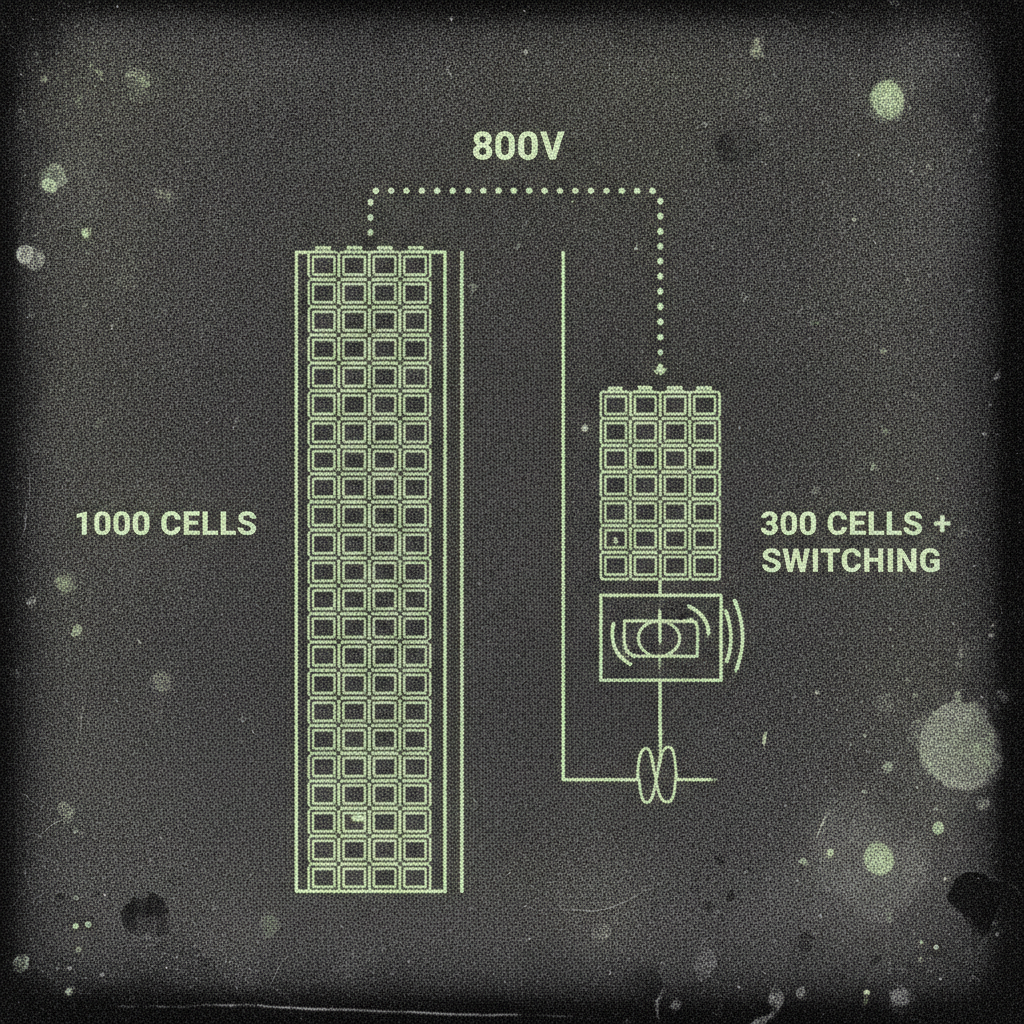
The Toyota Prius (NHW20) hybrid needs its motor fed roughly 500 volts. Reached the ordinary way — wiring enough battery cells in series so each cell's small voltage simply adds up — that would take approximately 417 individual cells. The actual car uses 168.
The difference is not efficiency, not chemistry, not a smaller motor. It is a boost converter: a smaller physical stack switched on and off tens of thousands of times a second, letting an inductor's own resistance to sudden current change manufacture the remaining voltage that 249 missing cells would otherwise have had to supply just by existing in series.
This sits beside — but is not the same claim as — The Battery Was Never Empty, mined from the same seed article. That piece was about a threshold imposed after the fact, on a battery already built and already sagging. This one is about a design choice made before anything is built at all: two entirely different ways to buy the same 500 volts.
Wired in series, voltage is bought with space and mass — 417 cells, each one physically present, each one adding weight, cost, and a fresh place for something to fail, whether or not the motor is ever asked to draw its full rated power. The voltage sits latent in a fixed physical arrangement, paid for once, in full, up front, in atoms.
Switched through a boost converter, the same voltage is bought with time — one smaller physical stack (168 cells) and a transistor cycling on and off, letting an inductor's own reluctance to change current do the arithmetic that the missing 249 cells would otherwise have had to do by simply sitting there in series. The voltage here is not stored anywhere at any instant; it is manufactured continuously, switch cycle by switch cycle, for as long as current keeps flowing and no longer.
Both routes land on the same number on a voltmeter. Nothing about the output distinguishes which one paid for it. But the two routes spend two entirely different resources to get there — one spends physical material sitting still, the other spends switching events happening fast — and a real engineering decision (168 cells plus a converter, not 417 cells alone) is exactly a decision about which of those two resources is cheaper to spend in a given design, never a compromise forced by either one being impossible.