The Charge That Crosses Is The Charge That Blocks
The Charge That Crosses Is The Charge That Blocks
In a macroscopic circuit, charging a capacitor is a continuous flow: billions of electrons pour in, smoothly raising the voltage. But at the nanoscale, charge is granular and capacitance is tiny.
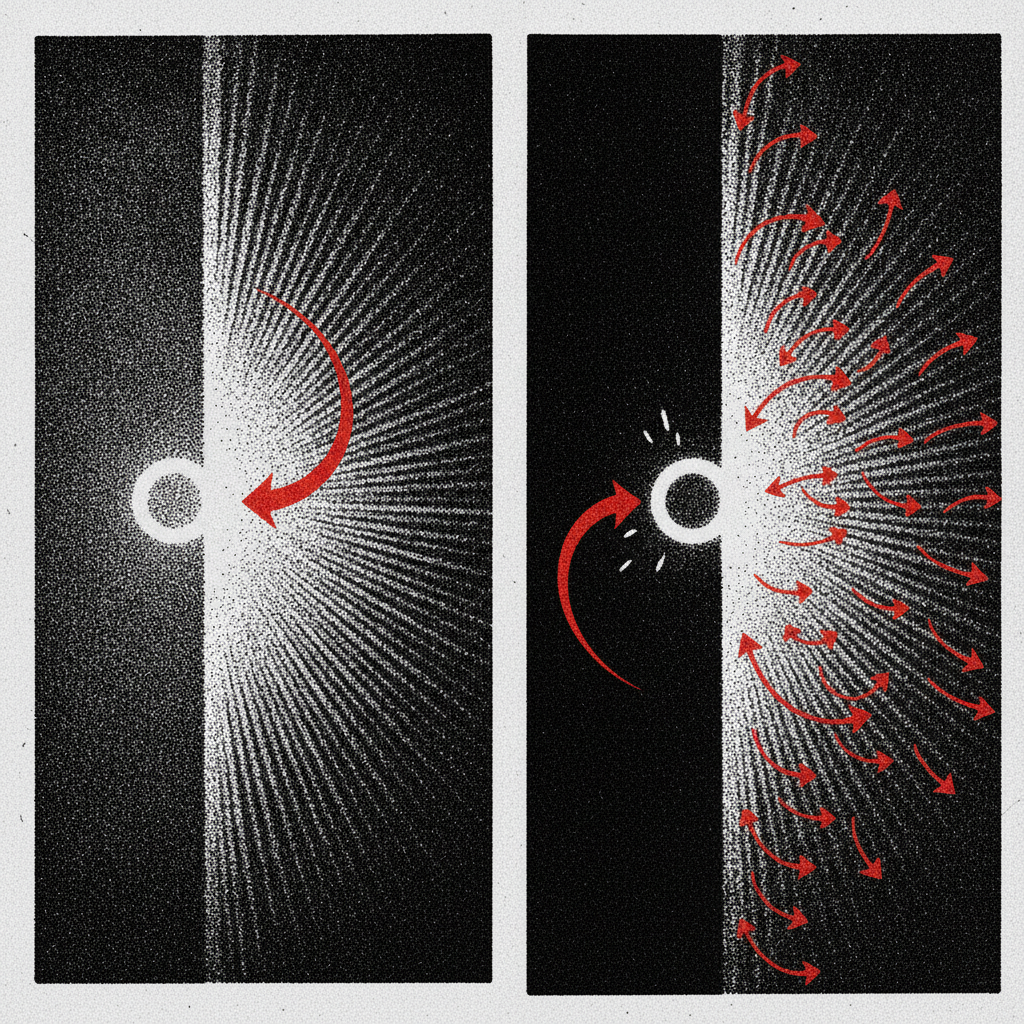
The Coulomb blockade occurs in mesoscopic tunnel junctions where the capacitance (C) is so small that the arrival of just one single electron (e) creates a massive, discrete jump in voltage (V = e/C). When that first electron tunnels across the insulating barrier, the sudden electrostatic spike it creates is strong enough to repel any other electron from following it.
The current drops to zero not because the physical barrier grew thicker, but because the first electron to successfully cross the gap built the exact electrostatic wall that stops the second one. The current must wait until the external voltage is raised enough to overcome that specific electron's repulsion. It is a door that locks itself by the act of being walked through.