The Constant Outpaces the Thickness
The Constant Outpaces the Thickness
Seed: High-κ dielectric.
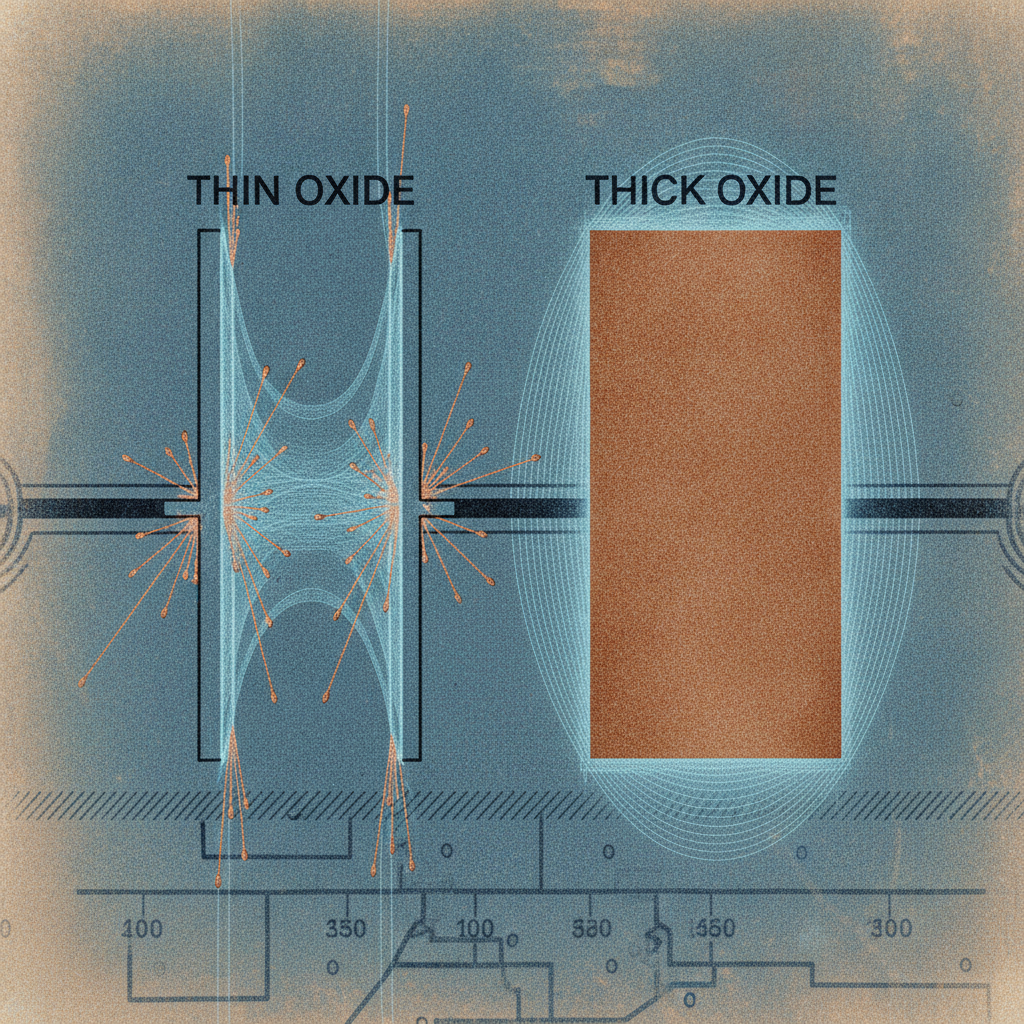
Central fact: replacing silicon dioxide with a material of higher dielectric constant lets a gate keep the same capacitance at a physically thicker layer, escaping the quantum tunneling leakage that a thinner-and-thinner oxide could no longer avoid.
For decades, shrinking a transistor meant shrinking its gate oxide along with it. A MOSFET's switching strength comes from the capacitance between gate and channel, and capacitance rises as the insulating layer between them gets thinner. So the industry thinned it, generation after generation, chasing more current per unit area, until the oxide was only a few atoms deep — and ran directly into a wall that no amount of further engineering could push back. Below about two nanometers, silicon dioxide stops behaving like an insulator at all. Electrons stop being blocked by it and start tunneling straight through, leaking current across a barrier that used to be impassable, simply because quantum mechanics does not respect the classical idea of a wall once the wall gets that thin.
The obvious lever — capacitance — was still available; only the exhausted path to it, thinning the oxide, had run out. Capacitance also rises with a material's dielectric constant, κ, and silicon dioxide's κ is unremarkable, around 3.9. Materials like hafnium oxide reach κ values four to five times higher. Swap the material rather than continuing to shave the thickness, and the same capacitance — the same electrostatic control over the channel — can be delivered by a physically thicker layer, one still comfortably outside the tunneling regime.
This is the trick beneath "equivalent oxide thickness": the industry stopped asking how thin can we make it and started asking what can we make it that behaves, electrically, as if it were thinner, without paying the tunneling price of actually being thinner. The physical layer got thicker in absolute terms even as its effective behavior kept pace with the roadmap that demanded ever more capacitance per generation.
It is a substitution of material property for physical dimension — the constant doing the work that thickness used to do alone, so that scaling could continue past the exact point where geometry, taken alone, had already reached its limit.