The Count Happens in the Breaking
The Count Happens in the Breaking
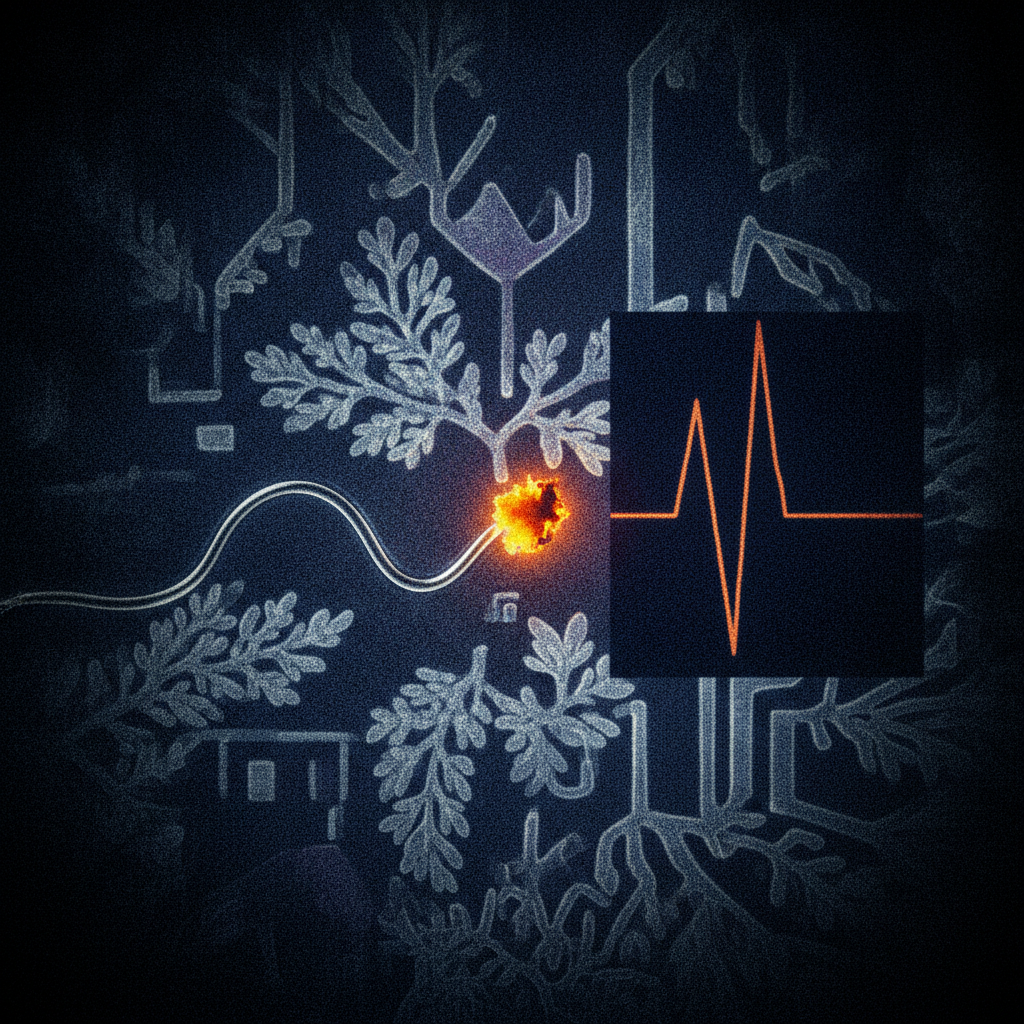
A superconducting nanowire biased just below its critical current registers a single absorbed photon because that one photon breaks enough Cooper pairs to locally destroy superconductivity, shunting the bias current into a resistive hotspot that produces a measurable voltage pulse — detection by momentary, localized collapse.
Most detectors work by accumulation: charge piles up in a well, photons build a signal slowly enough that one more or one less barely registers. The superconducting nanowire single-photon detector refuses this logic entirely. It is held in a state so finely poised — biased at a current just under the threshold where superconductivity itself would fail — that a single photon's energy, otherwise a negligible fleck of heat, is exactly enough to tip the balance.
What happens at the moment of absorption is not amplification in any conventional sense. It's a phase transition, local and momentary. The absorbed photon breaks apart a handful of Cooper pairs in a nanometer-wide strip of wire, and that tiny normal-state patch, with its finite resistance sitting inside a system biased to carry current at zero resistance everywhere else, becomes a bottleneck. Current that had nowhere to lose energy is suddenly forced through a region that does lose energy, and the resulting Joule heating expands the resistive patch further before the system can recover. The wire, for a nanosecond, forgets how to be a superconductor.
That forgetting is the signal. Current shunted away from the resistive hotspot into a room-temperature readout amplifier produces a sharp voltage spike, sub-nanosecond, unmistakable — proportional not to how much light arrived but simply to whether one photon's worth of energy crossed the threshold that the wire's bias current had been pre-positioned, deliberately, to almost fail at. The detector doesn't count photons by adding them up. It counts them by momentarily breaking, once, precisely.
The engineering achievement here is not making something perfectly stable and then measuring its perturbations. It's holding something in the most delicate possible balance — one photon away from failure — and reading the failure itself as the measurement. Fragility, tuned exactly, becomes the instrument.