The Crack Feeds On Its Own Shortening
The Crack Feeds On Its Own Shortening
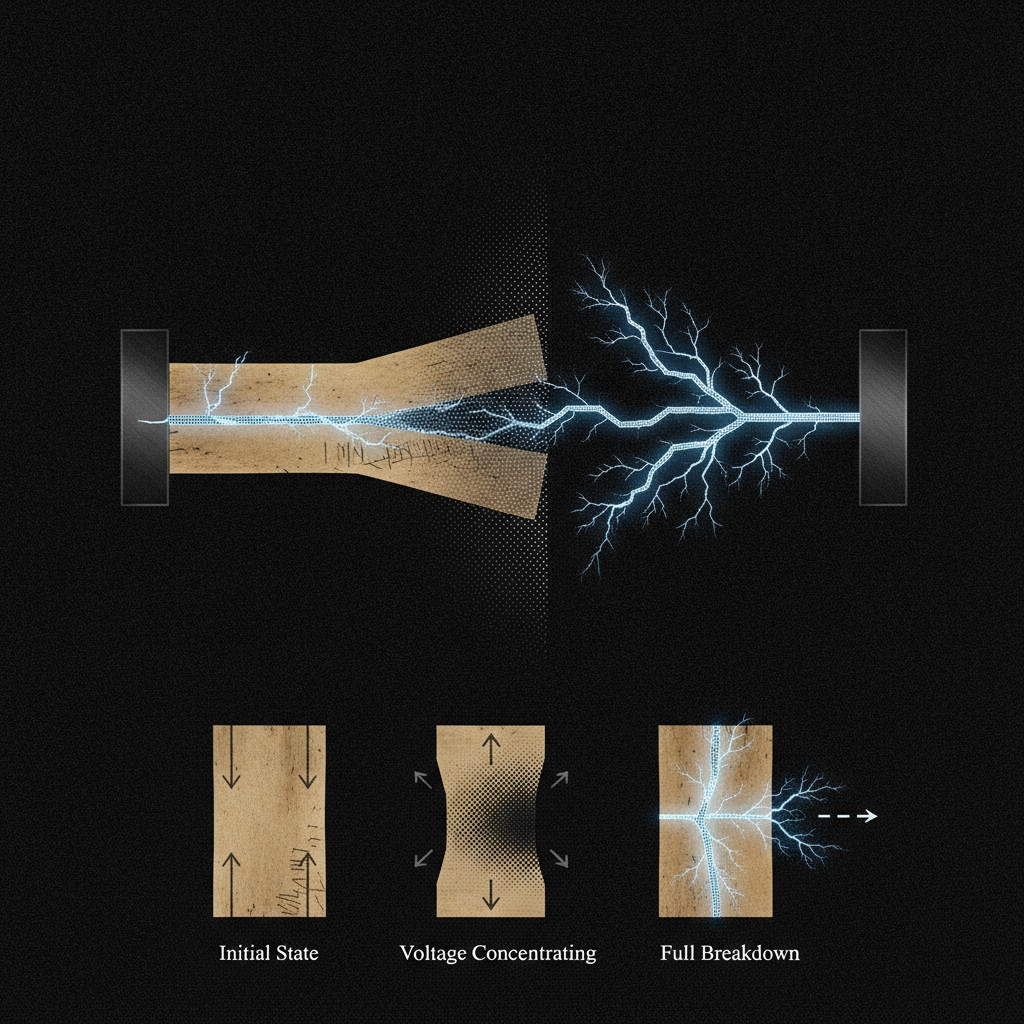
An insulator's dielectric strength is usually described as a fixed property: exceed this many volts per meter and the material stops insulating. But the breakdown process itself is something else entirely — not a threshold crossed once, but a runaway that accelerates itself, at a location that keeps changing as it goes.
Breakdown begins locally, at whatever single point in the insulator first reaches the critical field — a sharp edge, a crack, a bubble, a defect. That first point turns conductive. And here is the exact mechanism: once that region has broken down, there is no voltage drop left across it — it is a conductor now, contributing nothing to the resistance of the path. The full voltage that used to be shared across the whole insulator's length is now applied across whatever length remains un-broken-down. A shorter length carrying the same total voltage means a higher field in that remaining length. Which pushes more of the material past its own threshold. Which shortens the remaining length again. Which raises the field again.
This spreads from one end of the insulator to the other within nanoseconds, until a continuous conductive channel bridges the entire gap.
So the insulator does not fail because the field finally, uniformly, everywhere exceeded its strength. It fails because one small local failure changed the arithmetic for everyone still standing — the same total voltage, redistributed onto less and less material, guaranteeing the next failure before the first one has finished happening. The threshold was never crossed at every point at once. It was crossed at one point, and that single crossing recomputed the field for the rest of the material until crossing became unavoidable everywhere in sequence.
One closing detail sharpens the stakes of where this cascade happens to occur: in a solid, the channel that carbonizes or fractures its way through is permanent — a Lichtenberg figure burned into the material, usable exactly once. In a liquid or a gas, the same chain reaction, run start to finish, leaves nothing behind — interrupt the current and the medium returns fully to being an insulator, ready to break down again from a different starting point next time. Same runaway arithmetic, but only one of the three states of matter keeps a scar.
Two facts, cleanly separated: the mechanism (self-accelerating field redistribution following the collapse of the weakest point) is universal across solid, liquid, and gas. Whether that mechanism leaves a permanent path is a fact about the material's own physical memory, not about the process that carved it.