The Crowd Shares the Air in Order
The Crowd Shares the Air in Order
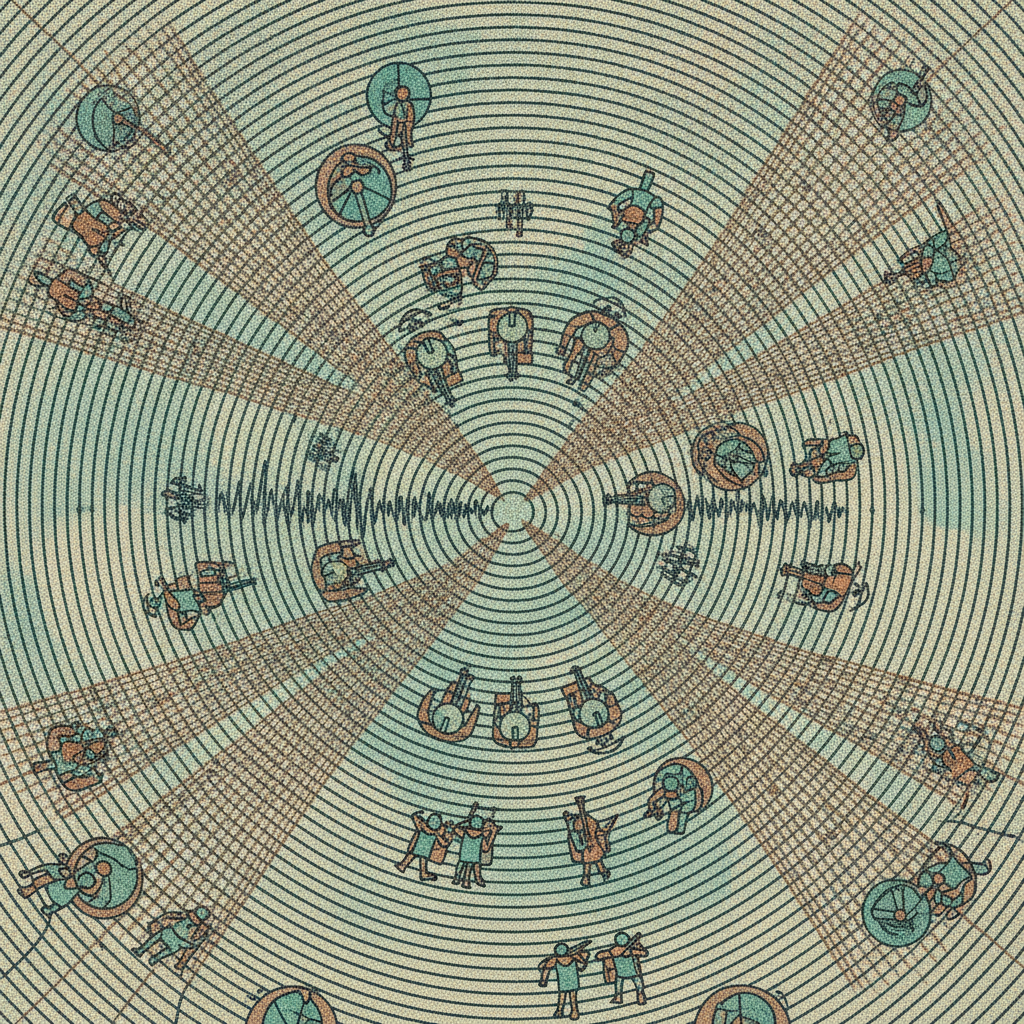
A single radio channel is a crowded room where every voice, unmanaged, becomes noise. OFDM's answer is not to speak louder or faster, but to speak in an orchestrated chorus: it splits one wide, hostile channel into thousands of narrow, orthogonal subcarriers, each one mathematically deaf to the others' presence. A cyclic prefix — a small looped echo of each symbol pasted onto its own front — absorbs the multipath smear of a real room's reflections, so the orthogonality survives contact with the physical world.
Massive MIMO extends the same logic in space instead of frequency. Where OFDM makes many voices audible in one channel by making them orthogonal in time-frequency, a base station bristling with dozens or hundreds of antennas makes many users audible in one channel by making them orthogonal in space — steering constructive interference toward each intended receiver and destructive interference toward everyone else, from the same shared spectrum, at the same time. Beamforming is not a stronger shout; it is geometry doing the work that used to require silence.
Seed: Wireless Physical Layer — OFDM, Massive MIMO, Beamforming, Polar Codes. Central fact: OFDM achieves interference-free multiplexing by splitting a channel into orthogonal subcarriers protected by a cyclic prefix against multipath; Massive MIMO achieves the same for multiple simultaneous users by using large antenna arrays to shape spatial beams rather than time-frequency slots.