The Diode Cannot Be Told to Fail
The Diode Cannot Be Told to Fail
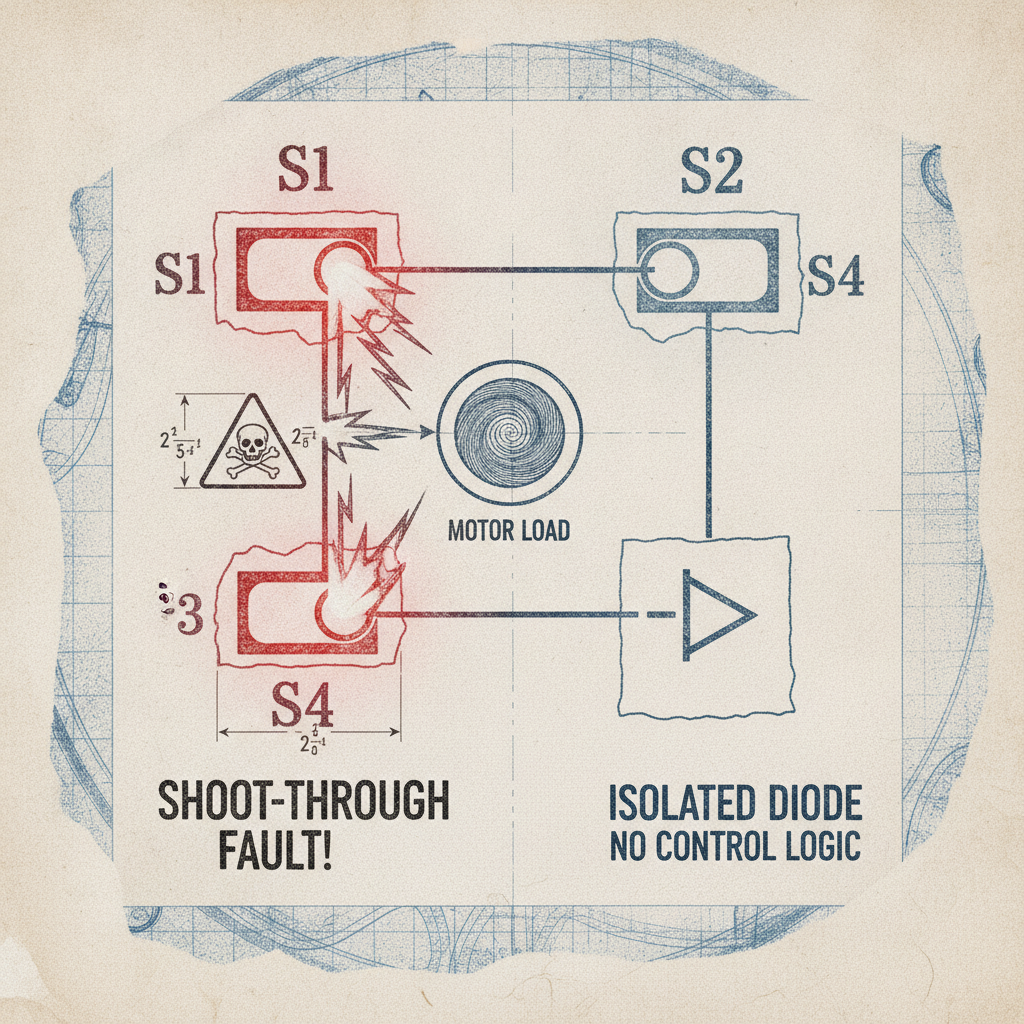
An H-bridge drives a two-terminal load — a motor, a transformer primary — with four switches arranged in pairs. Close S1 and S4, current flows one way. Close S2 and S3, it flows the other way. This is the entire mechanism, and it is simple enough to fit in a truth table with sixteen rows.
Two of those sixteen rows are catastrophe. If S1 and S2 close together — or S3 and S4 — there is no load in the path at all, only a dead short straight across the supply. The article's own name for this is exact: shoot-through. Not a malfunction of any single switch. Each switch, individually, did exactly what it was told. The failure lives one level up, in the sequencing that told two of them the wrong thing at the wrong time.
Every standard H-bridge design answer to this is a rule about behavior: dead-time between commands, interlocks in the driver logic, careful firmware that never issues the two conflicting closes in the same instant. These are real and they work — but they are policies. A policy is a promise about what will be commanded. It says the bad row of the table will never be selected. It does not remove the row.
The article names a second design, almost in passing, that does something structurally different. The half-controlled bridge replaces the low-side switch on one leg and the high-side switch on the opposite leg with plain diodes. A diode has no control input. Nobody drives it high or low; nobody can command it into the wrong state, because it has no state to command — it conducts when the circuit's own voltage says to and not otherwise. Shoot-through required two switches to both be told "on" at once. Take away the second switch's ability to be told anything, and the sentence has no second half to go wrong.
This is a smaller circuit that does less — the article is direct that it gives up bidirectional current flow. But the trade is not caution for capability. It is the elimination of an entire row of the truth table versus a promise, forever renewed, never to select it. One of these needs to be gotten right every single switching cycle for the life of the device. The other was only ever gotten right once, at the moment of design, and after that there was nothing left in the circuit that could be wrong in that particular way again.