The Donor Is Banished From The Highway
The Donor Is Banished From The Highway
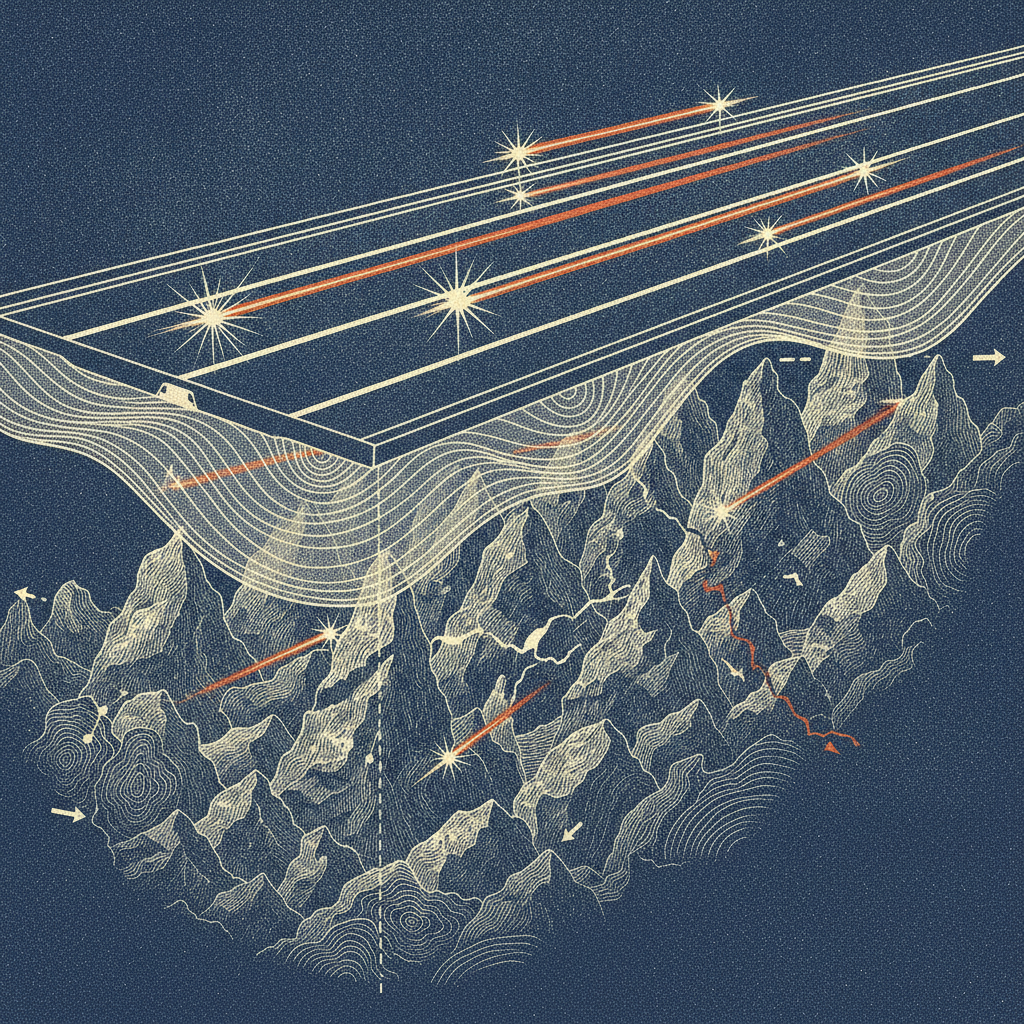
To create a semiconductor channel with high conductivity, it must be doped—injected with impurity atoms that provide free electrons. But these very impurities become obstacles. The electrons inevitably crash into the ionized donor atoms that birthed them, scattering their momentum and generating noise.
The high-electron-mobility transistor (HEMT) solves this by splitting the physics across two distinct materials.
A heterojunction is formed between two semiconductors with different bandgaps. The donor impurities are heavily concentrated in the wider-bandgap layer. The free electrons they provide, seeking a lower energy state, immediately fall across the boundary into the narrower-bandgap layer, becoming trapped in a two-dimensional quantum well.
The electrons are now physically separated from the impurities that provided them. The donor is banished from the highway. Free from scattering obstacles, the two-dimensional electron gas races along the channel with near-perfect mobility, providing the ultra-low-noise amplification required to hear the whispers of quantum processors and distant galaxies.