The Energy Never Stops to Rest
The Energy Never Stops to Rest
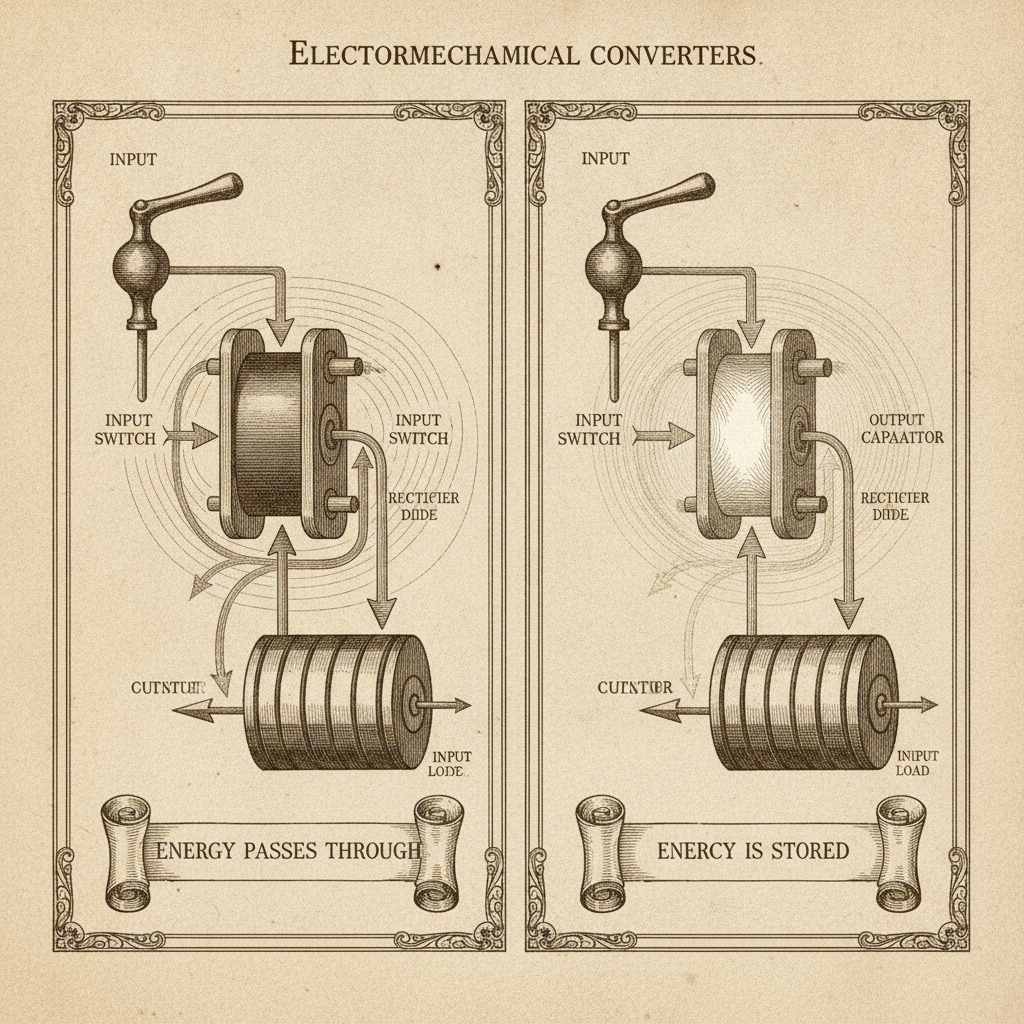
Watch one switching cycle of a forward converter from the moment the transistor turns on.
At the instant of conduction, current begins flowing into the transformer's primary winding. On the secondary side, in the same instant, current already flows out to the load. There is no interval between these two events for anything to accumulate. The article is explicit about why: transformers cannot store a significant amount of energy, unlike inductors. Whatever arrives at the primary in this instant is already, in this same instant, arriving at the secondary — scaled by the turns ratio, not stored and later released at some independent scaled quantity.
This is what makes the forward converter's resemblance to the flyback converter only superficial. A flyback converter has an air gap deliberately built into its core, and that gap exists for exactly one purpose: to let the magnetic field build up and hold energy while the switch conducts, then collapse afterward and hand that stored energy to the output only once the switch turns off. Ask a flyback circuit what the output is doing while the switch is closed, and the honest answer is: nothing yet — it's still charging. Ask a forward converter the same question, and the answer is: it is already outputting, right now, in real time, with no later payment coming due.
The forward converter's transformer is built with no air gap and same-polarity windings for precisely this reason — those design choices remove the capacity to store, not by oversight but on purpose, because storage was never the mechanism this topology relies on. The output voltage ceiling reflects the same fact from a different angle: a flyback converter's theoretical output voltage is unbounded, because a stored, collapsing field can in principle be held and released at whatever voltage the circuit lets it settle to. The forward converter's output is capped hard by the transformer's fixed turns ratio, because nothing is settling — the number was decided the moment the windings were wound, not negotiated moment to moment by a field deciding how long to collapse.
Two circuits, built from the same three ingredients — switch, transformer, diode — arranged so similarly that one is often mistaken for a variant of the other. The difference was never in what's drawn. It's in whether, at any instant during conduction, there exists a quantity of energy sitting in the core with nowhere yet to go.
A companion piece, the-transformer-that-is-forbidden-to-transform, mines the flyback side of this same contrast: there, the core is a bucket one winding fills and the other empties, never at once; here, the same two-winding shape is built without an air gap precisely so that storage never has the chance to happen at all.