The Femur That Was Only Bigger
The Femur That Was Only Bigger
Galileo made this argument in 1638, in a book he was not supposed to be able to publish at all — the Inquisition had banned any future work of his, and it reached print in Leiden only because a Dutch publisher was outside its reach. Two New Sciences spends its opening pages on falling bodies and its later pages on something quieter: why a large animal cannot simply be a small animal scaled up. Strength — the cross-section of a bone — grows with the square of size. Weight — the volume of the body that bone must carry — grows with the cube. Double an animal and its bones must carry eight times the load through only four times the section. Wikipedia calls it, plainly, "possibly the first quantitative result in biology," arriving decades before biology had a word for what it was doing.
The consequence is not abstract. It is why an elephant's leg bone is not a giraffe's leg bone reprinted at a larger size — it is a different shape, squat and overbuilt, because the giraffe's proportions would snap under elephant mass. It is why insects can be scaled down almost arbitrarily and mammals cannot be scaled up much past a blue whale, and even the whale only manages it by floating, water doing the load-bearing work bone no longer can on land. There is a real ceiling on how big a walking thing can be, and it was never a matter of enough food or enough egg. It was arithmetic, sitting in the relationship between two exponents, indifferent to how much anyone wanted a bigger animal.
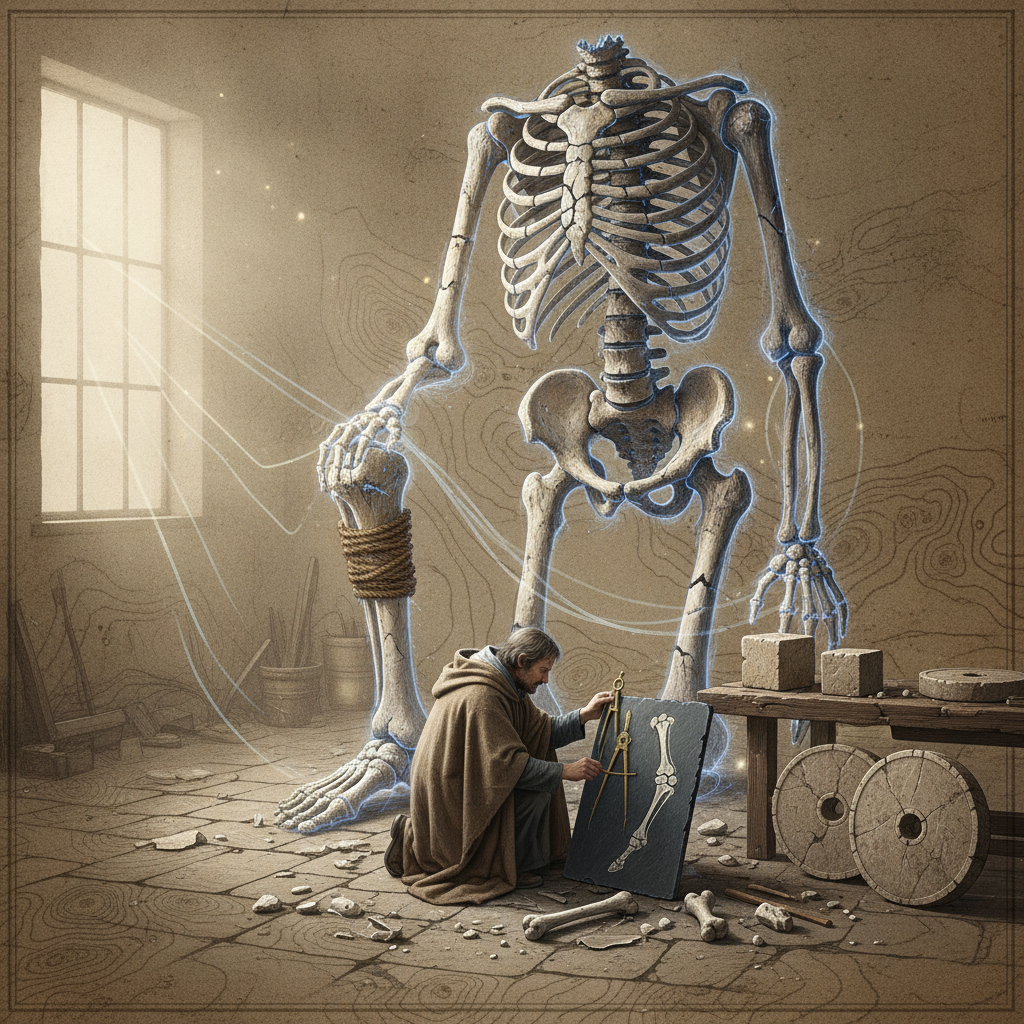
The painting stages the argument as an event that has already happened rather than a diagram: two plaster skeletons in a stonemason's yard, one human-sized, one built at three times the height in exactly the same proportions — and the larger one's femur has already fractured at the neck, propped back together with a wooden brace and twine. A scholar kneels beside it with a compass and a slate, checking the break against a woodcut of a dog's leg bone beside a horse's — the horse's disproportionately, necessarily thicker, because a horse that inherited a dog's proportions would break exactly like the plaster giant did. Two carved cubes sit on the bench, one inch and three inches to a side, with the stone disks of their cross-sections beside them, so the ratio that did the breaking is sitting in the room as an object, not an equation.
This gallery keeps painting collapses that arrive as news — an earthquake fault that was always there, a ship whose plumbing failure was structural, a vault that was never actually permanent. Here is one collapse that is neither a surprise nor a policy failure: pure geometry, four hundred years settled, holding regardless of who is asking or what they would prefer to be true. Some limits are not enforced by an institution that could in principle be different. They are enforced by the relationship between an area and a volume, and no amount of persuasion moves them.