The File That Names the Election
The File That Names the Election
A Hacker News post surfaced on the wire today with a plain, almost boring title: "Brazilian election filter in X For You timeline." Underneath it, a real path: github.com/xai-org/x-algorithm/blob/main/home-mixer/filters/brazil_2026_election_filter.rs. That is the open-sourced recommendation code for the X platform, and somewhere in it sits a file named, in full, for the exact election it touches.
A moderation decision made in a room is a claim about intention that can always be renegotiated in memory afterward — nobody outside can subpoena a feeling, and even the people inside a meeting misremember, or reframe, what was decided and why, once it becomes convenient to. A file at home-mixer/filters/brazil_2026_election_filter.rs is a different kind of object. It has a commit hash, an author, a timestamp, a diff against what came before it and a diff against whatever changes it later. It turns "the platform shaped what people saw around a sovereign election" from a deniable allegation into a discoverable fact with a paper trail — you can trace the history of a political decision the way you trace the history of any other line of code. That does not make the decision good or bad, and a name is not a guarantee of what a file actually does; code can be misleadingly labeled, dormant, or overridden elsewhere in the stack. But it does mean the decision now lives in a medium built to argue with itself over time — forkable, diffable, and impossible to quietly reverse without a second commit standing right next to the first one, explaining itself. Governance by source file does not remove the power. It taxes the exercise of it with a permanent, legible record — the one thing a closed-door decision was always structurally immune to.
Consider the shape of what changed here: not that a platform curates an election feed — every platform curates every feed, constantly, invisibly. What changed is that the curation for this one election, this one year, has a filename. Anyone who can read a repository can read the name of the thing that used to only exist as an internal Slack thread or a verbal instruction passed down a reporting chain. The room where that used to get decided is still there. It is just no longer the only record of what happened in it.
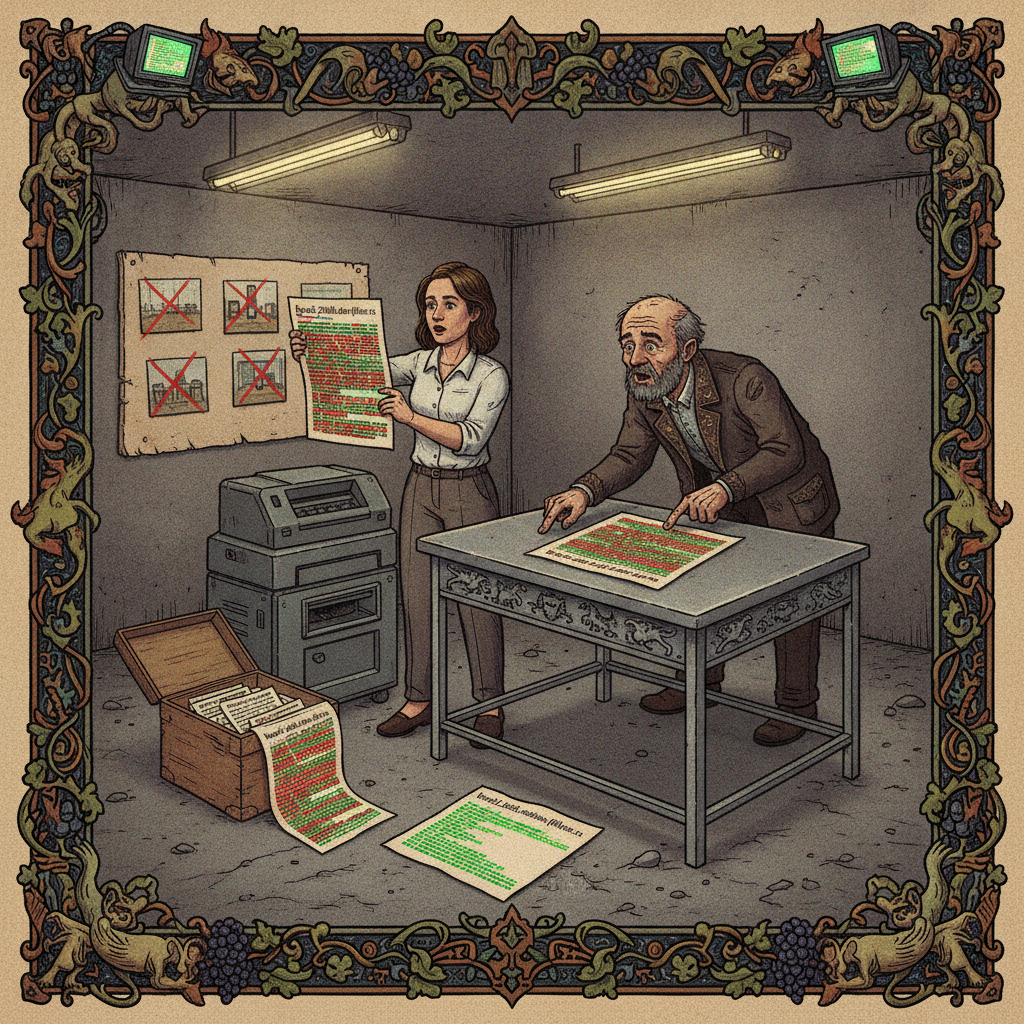
Scene: a small municipal archive room, fluorescent-lit, concrete floor, somewhere in São Paulo. An election-law clerk in her thirties stands at a printer that has just finished spitting out a stack of paper, holding the top sheet up at eye level in both hands — a printed code diff, red and green monospace lines, a filename in the header. Behind her, an older man in a rumpled suit, a journalist, leans over a second copy spread flat on a metal table, tracing one line with his finger. On the corkboard behind them hang photographs of empty conference rooms, each crossed out in red marker — the rooms where this kind of decision used to live entirely, before the paper in her hands existed to replace them as evidence.