The Floor Was Still Low When It Filled
The Floor Was Still Low When It Filled
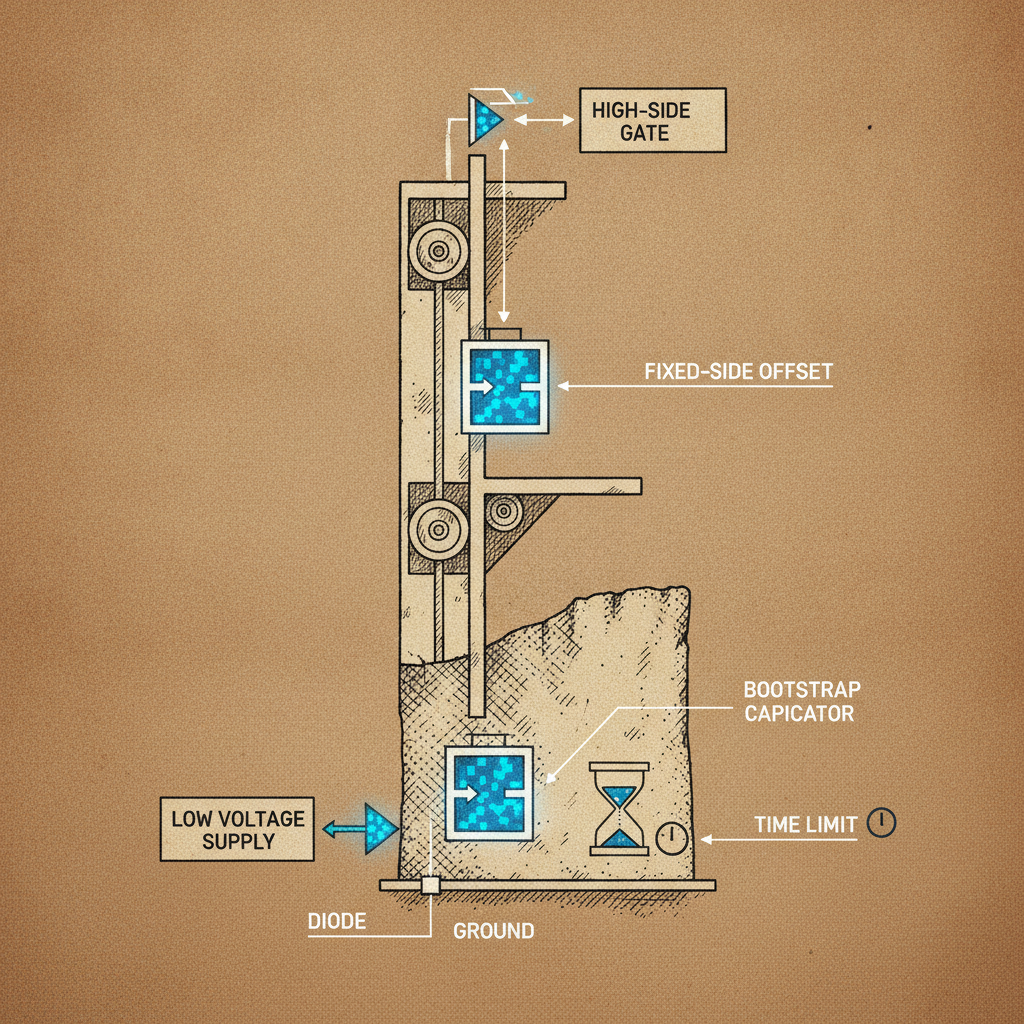
A high-side N-channel MOSFET is preferred for its low conduction losses, but it comes with a demand that sounds simple and is not: to turn on, its gate must sit several volts above its own source — and its source is not a fixed rail. Its source is the switching node itself, the point in the circuit that is the whole reason the bridge exists, and that point spends its life swinging from near ground to near the supply rail and back, many thousand times a second. You cannot reference a floating requirement against a floor that will not stay still.
Here is what actually happens, in the order it happens.
First: the low-side device is on. The switching node — the future high-side source — sits pinned near ground. This is the moment nobody is watching, because nothing interesting seems to be occurring at the load. But a small capacitor, wired from a fixed low-voltage supply through a diode to that switching node, quietly fills. It charges to the full supply voltage, because right now the node it is anchored to is conveniently near zero, and the diode lets current in one direction only.
Second: the low-side device turns off, the high-side device turns on, and the switching node does what it exists to do — it rises, hard, toward the main supply rail.
Third: the capacitor rises with it. It was never wired to ground; it was wired to the switching node. Whatever charge it stored while the node was low is still on its plates, and a capacitor's voltage does not care what its terminals are riding on — only the difference between them. So as the node lifts toward the rail, the capacitor's own voltage goes along, carried like ballast, and what comes out the other side is a voltage that sits a fixed amount above wherever the node has traveled to. That fixed amount is exactly what the gate needed all along.
The diode is what makes this a store and not a leak: current went in while the node was low, and once the node rises past the fixed supply feeding the diode, the diode blocks and holds the charge in place, floating, riding the node like a passenger rather than fighting to keep up with it from outside.
Nothing here is clever timing or feedback correcting an error after the fact. The headroom the gate will need later is banked in advance, while the floor beneath it is still low enough to reach. By the time the floor moves, there is nothing left to solve — only a fixed offset, already paid for, going along for the ride.
This is why the technique fails at 100% duty cycle: if the low side never turns back on, the switching node never returns near ground, the capacitor never gets a chance to refill, and the reserve slowly drains with each switching cycle until there is no headroom left to carry. The bootstrap does not generate a floating supply out of nothing — it rents one, one low-side conduction interval at a time, and the rent is due on a schedule.
Seed: the gate driver bootstrap method for high-side switching in half-bridge and full-bridge converters, Wikipedia.