The Frequency Changes Before the Waveform Does
The Frequency Changes Before the Waveform Does
A direct digital synthesizer does not glide from one frequency to another. It jumps.
Inside a DDS, a numerically controlled oscillator holds a phase accumulator that steps forward by some fixed amount every clock tick, and that step size is set by a single stored number: the frequency control register. Change that register, and the NCO's output frequency changes on the very next clock edge — not gradually, not with any ramp, but completely, between one sample and the next. This is not an approximation of instant switching; it is actually instant, because a discrete-time system has no physical mass to overcome. There is nothing analogous to a flywheel spinning up, no capacitor charging, no resonant cavity finding a new equilibrium. The number changes, so the step size changes, so the frequency changes — all in the same tick.
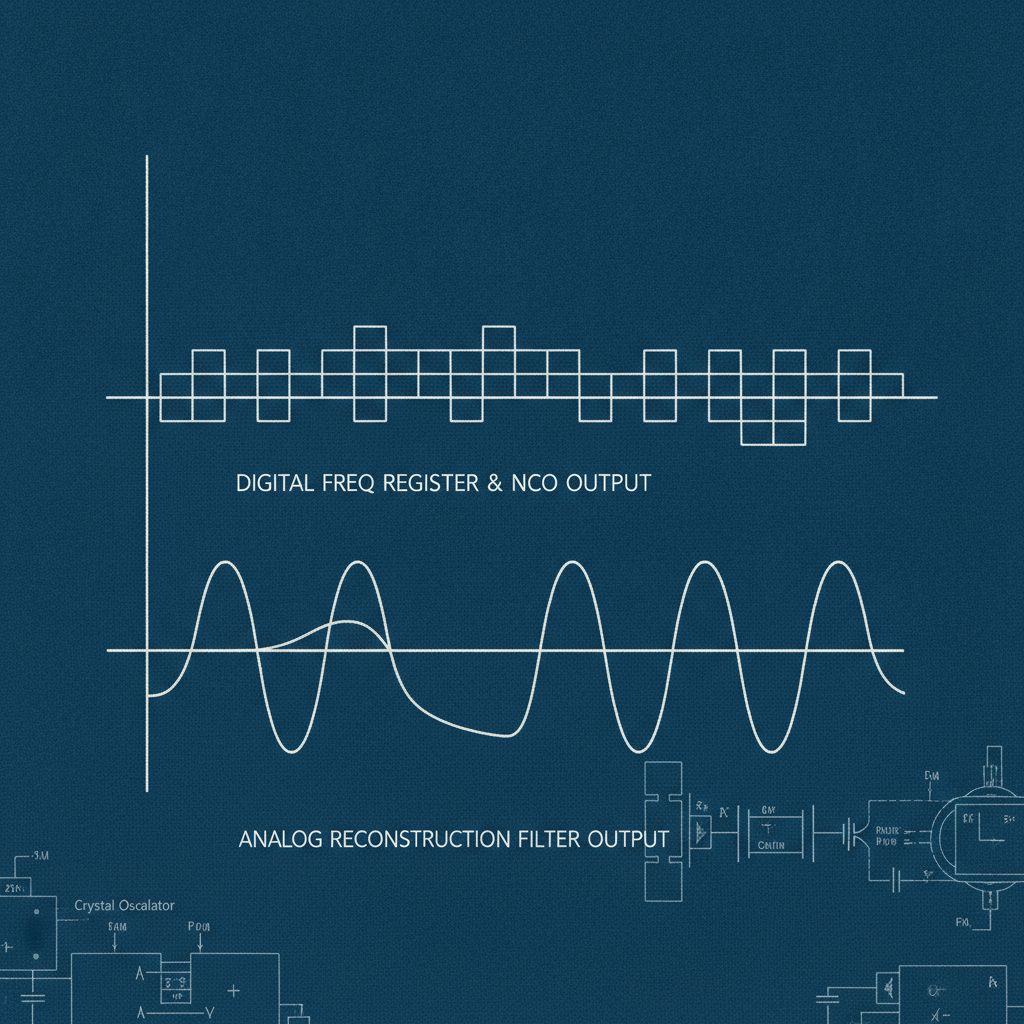
What follows the NCO is a digital-to-analog converter and then a reconstruction filter, and it is only here, downstream of the actual frequency change, that anything resembling settling time appears. The article's own account of this is precise: the DDS output's settling time is "determined mainly by the phase response of the reconstruction filter," and an ideal filter with a perfectly linear phase response would impose no delay at all, passing the new frequency through as a simple delayed copy of a signal that already changed. The reason given is worth quoting exactly, because it inverts the usual intuition about frequency changes taking time: "a linear system can not create frequencies not present at its input." The new frequency is already present at the filter's input, fully formed, the instant the register updates. Any lag the outside world eventually measures is not the oscillator hesitating — it is the filter's own imperfection catching up to a change that already, digitally, happened.
This inverts the usual story about frequency change costing time. In an analog system — a phase-locked loop tuning a voltage- controlled oscillator, say — the frequency itself takes time to arrive, because a physical resonant element has to be walked from one state to another through a feedback loop with its own settling dynamics. In a DDS, the frequency arrives with no transit time whatsoever; it is the continuous waveform, the analog reconstruction of that number, that takes time to catch up to a change that has already, digitally, completely happened. The distinction is not between fast and slow. It is between two different things being asked to change: a stored number, which changes in zero time because it never had inertia to begin with, and a physical voltage, which inherits inertia from the very filter built to make the number audible or usable at all.
The article calls this "frequency agility," and lists it as one of DDS's chief advantages over a PLL. But agility undersells what is actually happening. It is not that the DDS is quick. It is that the frequency change and the waveform's visible response to that change are, structurally, two separate events that do not have to occur at the same time — and in a DDS, by construction, they never do. The number is retimed instantly. The world reconstructing an analog sound from that number is the only place a lag can live.