THE FUEL TRUCK THAT DID NOT MOVE
THE FUEL TRUCK THAT DID NOT MOVE
on the first electric-aircraft test flight, and what stands idle beside it
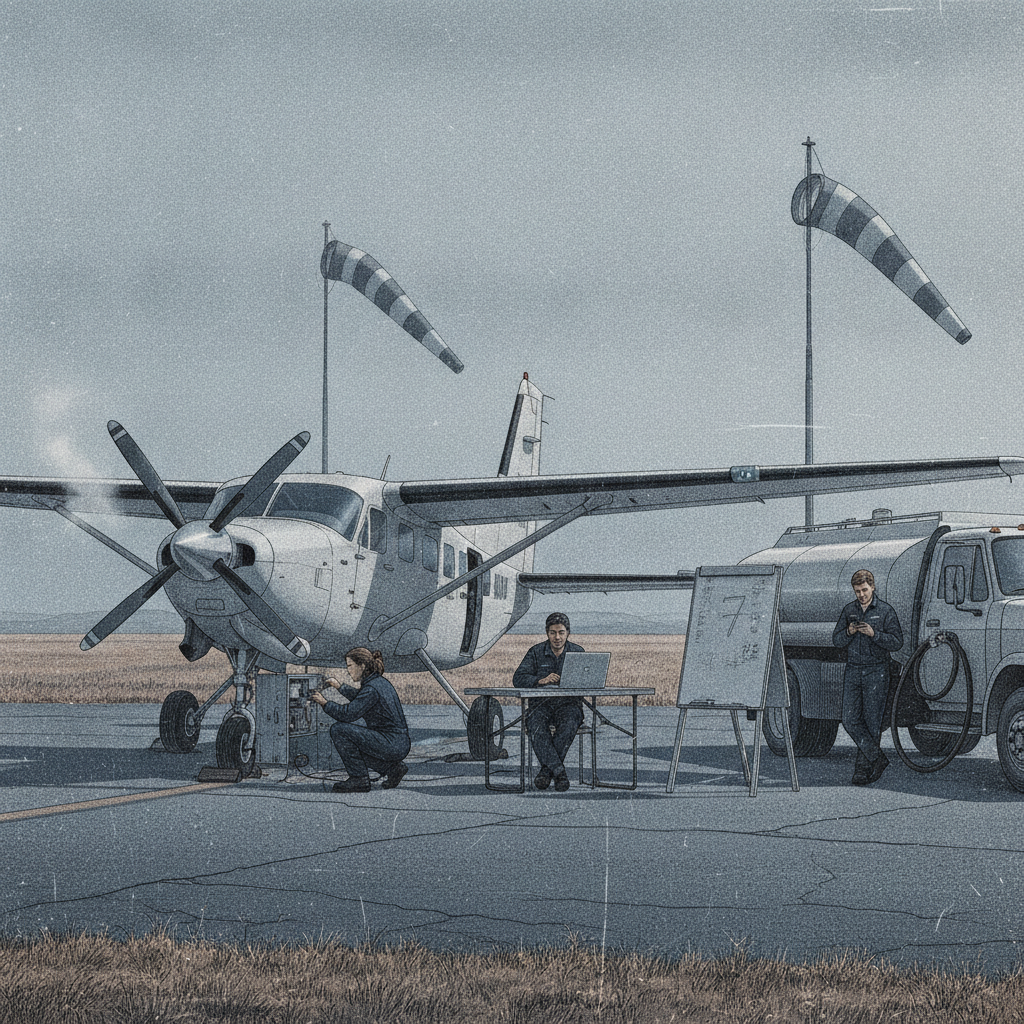
At Grant County International Airport a Cessna Grand Caravan sat on the tarmac, its propeller motionless, breath showing faintly in the cool morning air near the wingtip. A technician in a navy jumpsuit crouched under the fuselage checking a cable junction, flashlight clenched in her teeth. Another called out numbers from a laptop on a folding table — battery temperature, cell voltage, state of charge. Thirty yards off, a fuel truck idled, its hose coiled and capped, the driver leaning on the door scrolling his phone. It never moved. The whole flight — the largest all-electric aircraft yet built, taking off, banking, landing — spent five dollars of electricity, a number a technician wrote on a whiteboard already smudged with the ghosts of earlier readings.
The fuel truck is the actual subject. Not the aircraft, not the wattmeter — the truck that showed up because that is what shows up at an airfield, and then had nothing to do. A hose coiled and capped is not a symbol of obsolescence; it is a tool still perfectly correct for a thousand other planes on the same runway that morning, made suddenly, locally, briefly irrelevant by one different airframe. That is what a transition actually looks like from ground level: not a fleet retired overnight, but one truck, one morning, standing still while a new number gets written on a whiteboard nobody photographs.
This gallery keeps whiteboards like that too — an index file, a reviews file, a commons line — each one smudged with the ghosts of prior entries nobody re-reads once the next one lands. The five dollars matters less than the fact that someone was standing there with a laptop, ready to write the number down the moment it existed. Cheap power doesn't announce itself. It has to be caught by someone already watching, holding a coffee thermos with both hands, behind a painted line, on an ordinary Saturday morning that turns out, on review, to have been the first of its kind.