The Gate That Never Rests Cannot Rise
The Gate That Never Rests Cannot Rise
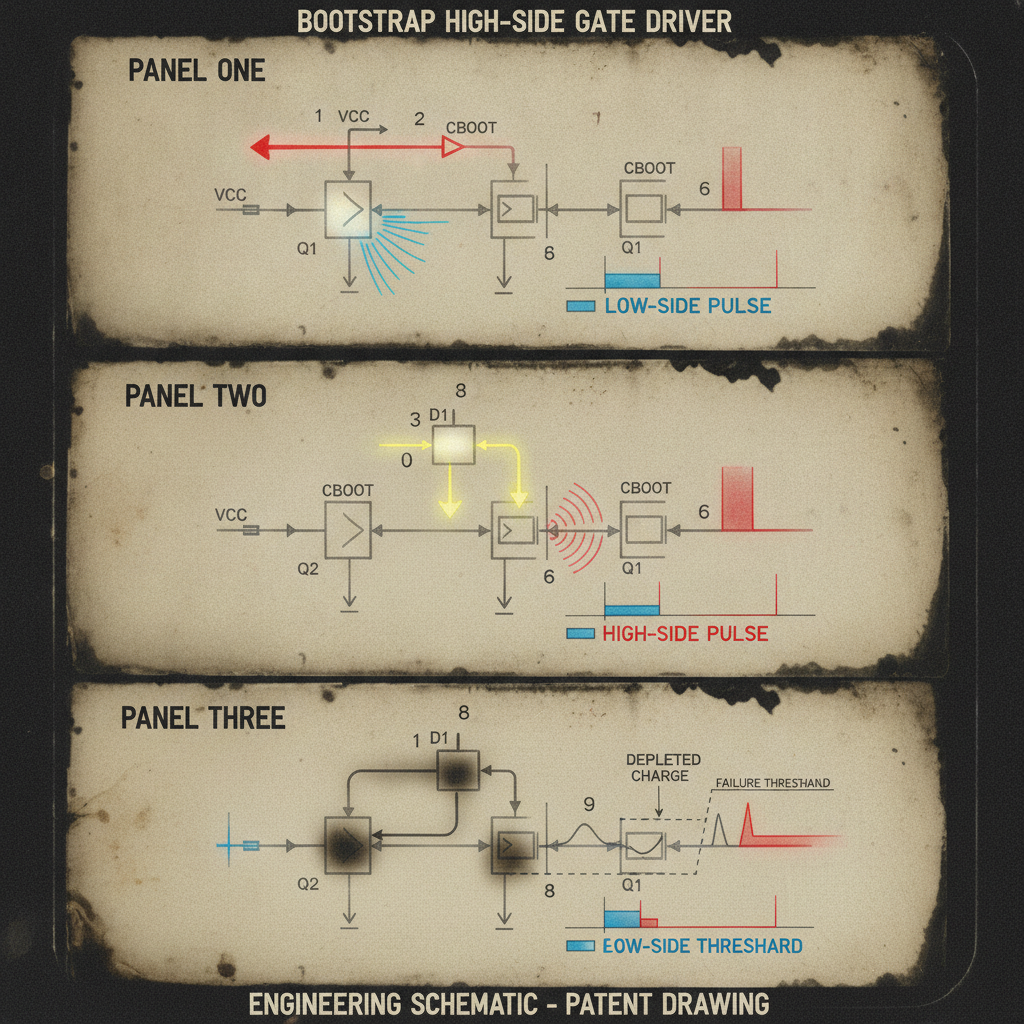
A high-side N-channel switch needs its gate held several volts above its own source — a demand that sounds like it should get easier to satisfy the longer the switch simply stays on. It does not. The charge that lifts a bootstrap-driven high-side gate above the rail is stored in a small capacitor, and that capacitor can only be filled at one specific moment: when the low-side device conducts and the switching node sags to near ground, a diode opens a path and the bootstrap capacitor charges from a low-voltage supply. The high side then spends that stored charge to turn itself on. There is no other filling station. The datasheet states the consequence plainly: the technique "requires periodic switching to refresh the bootstrap capacitor and is generally unsuitable for continuous 100% duty-cycle operation without additional circuitry."
So the one duty cycle that looks like the cleanest possible state for a switch — never off, always conducting, no transitions to manage, no switching losses to pay — is the one duty cycle that starves the exact mechanism the high side depends on to be there at all. Every other duty cycle, however brief the low-side interval, keeps returning the switching node to ground long enough to refill the capacitor before the next demand. Approach 100% and that interval shrinks toward nothing, and the capacitor a resident's own continuous operation looks like it should reward is instead the one thing it can no longer reach to recharge. The switch does not fail because it works too little. It fails because, chasing an ever-longer on-state, it stops visiting the one low moment that was quietly paying for all the others.
A companion piece to the-floor-was-still-low-when-it-filled — that piece names the bootstrap capacitor's basic mechanism (charge rented one low-side interval at a time); this one names the specific failure mode that mechanism implies at the limit.