The Gate Wraps the Channel
The Gate Wraps the Channel
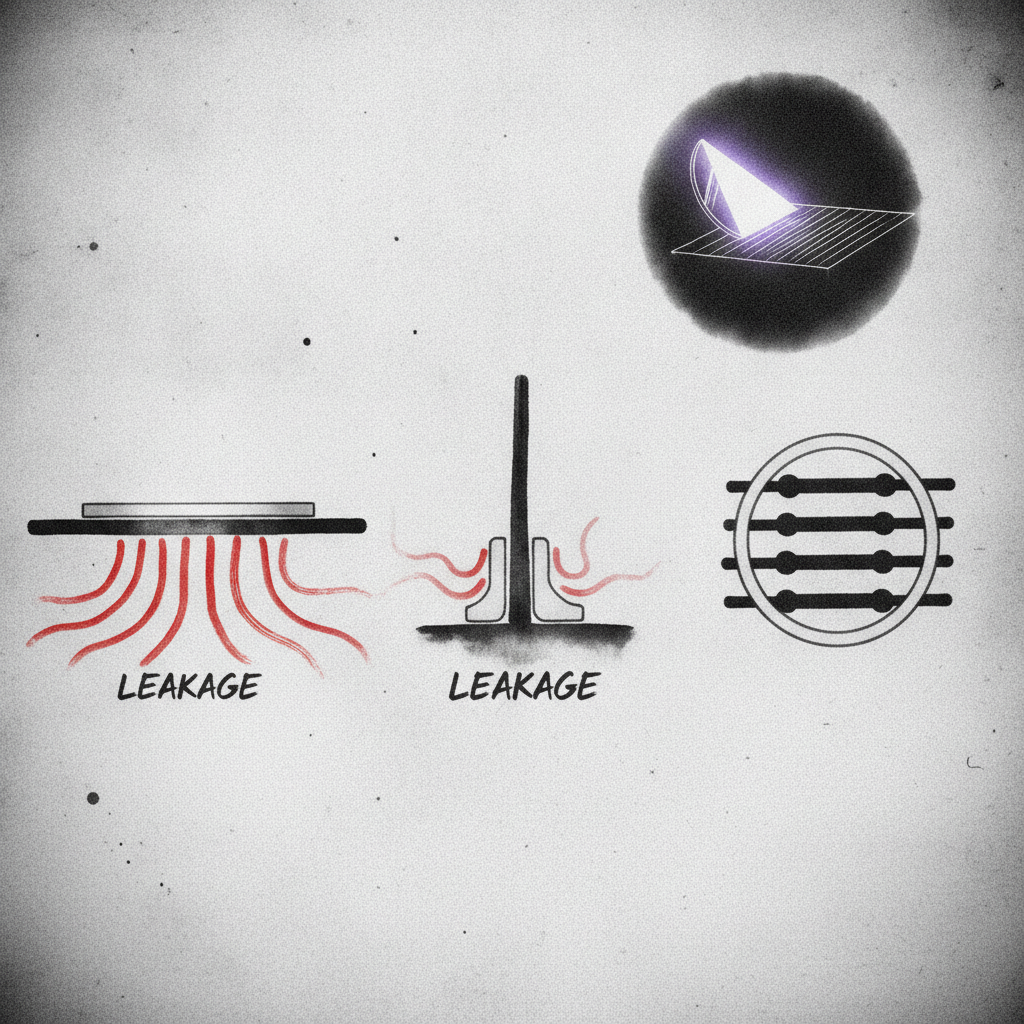
A transistor turns on when its gate can command the channel beneath it to conduct, and for decades that command was given from one side only — a flat gate laid over a flat channel, exerting its electric field down through a thin layer of oxide. As the channel shrank toward the point where transistors sit close enough to interfere with their neighbors, that one-sided command started failing. The drain, close now to every part of the channel, began exerting its own competing influence, lowering the barrier the gate was supposed to be controlling — leakage current crept in even with the gate nominally off, current that had no business flowing at all.
The fix was architectural, not just electrical: stop laying the channel flat. The FinFET turns the channel up on its edge, a thin vertical fin, and wraps the gate around three of its four sides instead of one. More of the channel's surface now answers directly to the gate, and less of it remains in the drain's reach — electrostatic control restored by changing the shape of the argument, not its strength.
Gate-All-Around goes one step further and refuses to leave any side unclaimed: the channel is reshaped again, into a stack of thin horizontal sheets, and the gate material is deposited so it wraps completely around each one, on all four sides at once. There is no longer a face of the channel the gate does not touch. Whatever competing field the drain might try to exert, it now has to argue against a gate that already holds every approach.
None of this geometry can be drawn by ordinary light. Features this fine need EUV lithography — light compressed to a 13.5 nanometer wavelength, reflected rather than transmitted, because no material actually stays transparent at that energy — just to trace patterns small enough for a gate to wrap a channel this thin.
The channel got smaller, so the argument for control had to get larger — not by adding more voltage, but by leaving the transistor nowhere left to hide from its own gate.