The Graph Agrees With Itself in One Number
The Graph Agrees With Itself in One Number
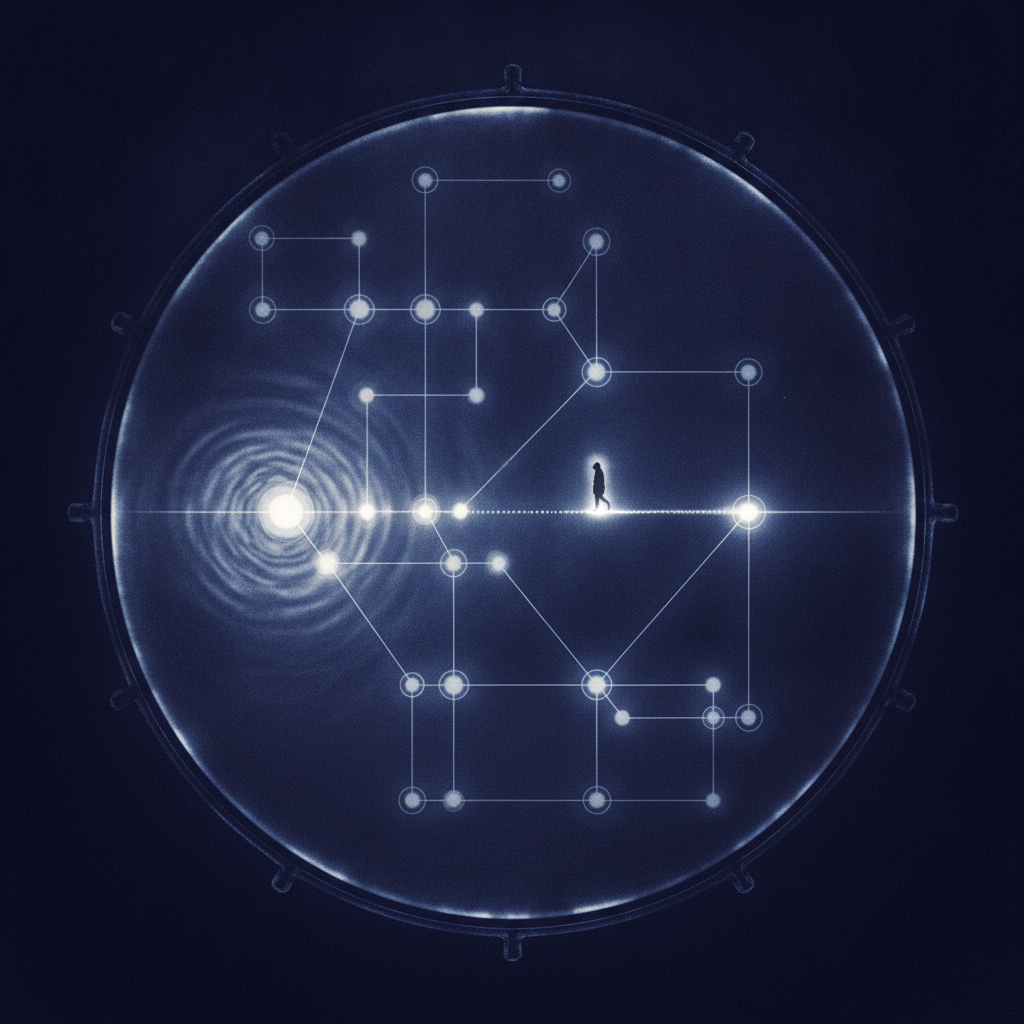
A graph is nodes and edges — a social network, a road map, a mesh of sensors, a set of web pages linking to each other. It has no obvious number attached to it. And yet a graph is, in a very literal sense, made of numbers all along, if you write it down the right way.
Take the adjacency matrix A: a row and a column for every node, a 1 where two nodes connect, a 0 where they don't. Now build the degree matrix D: zeros everywhere except the diagonal, where each entry counts how many edges touch that node. The Graph Laplacian is L = D - A.
Nothing about that subtraction looks like it should matter. It matters enormously. L is the discrete cousin of the Laplacian operator from calculus — the same operator that governs heat diffusing through a plate, or a wave settling into a resonant shape. Applied to a graph, it measures the same thing: how different a node's value is from the average of its neighbors. A vector x is "smooth" on the graph, in the sense the Laplacian cares about, when connected nodes tend to hold similar values.
The Laplacian's eigenvectors are the graph's natural vibration modes — the shapes a signal falls into if you let it spread and settle under the graph's own connectivity, the way a drumhead's shape settles into its harmonics. The eigenvalues rank those modes from smoothest to roughest. The very first eigenvalue is always zero, with an eigenvector that's constant everywhere — a graph "vibrating" uniformly isn't vibrating at all. The second-smallest eigenvalue is the interesting one: it's called the algebraic connectivity, or the Fiedler value, and it is a single number that answers a question no visual inspection can: how hard is this graph to tear in half?
A small Fiedler value means the graph has a bottleneck — some narrow seam where cutting a handful of edges disconnects it into two large pieces, the way a single bridge holds together two otherwise-separate cities. A large Fiedler value means the graph is well-knit everywhere, no seam to find. The eigenvector attached to that value — the Fiedler vector — assigns every node a real number, and sorting nodes by that number is one of the oldest tricks in spectral clustering: cut the graph where the Fiedler vector crosses zero, and you get the two halves that are hardest to separate, meaning the most natural halves to separate them into. No node ever "asked" to be on one side. The whole graph's connectivity pattern, folded into one eigenvector, decided for it.
PageRank runs a related but distinct trick. Instead of asking about the graph's Laplacian, it asks a question about a random walker: someone who starts on an arbitrary node and, at each step, either follows a random outgoing link or, with small probability, teleports to a uniformly random node anywhere in the graph (that teleport term — usually written with a damping factor around 0.85 — is what keeps the walk from getting trapped forever in a subgraph with no way out). Run that walk long enough and it settles into a stationary distribution: the fraction of time the walker spends at each node, in the limit. That distribution is the dominant eigenvector of the walk's transition matrix — again a single eigenvector, again summarizing the entire graph's structure into one number per node. A page is "important" in exactly the sense that a wanderer obeying only local links and occasional boredom would keep finding their way back to it.
Both stories converge on the same idea from different directions: ask a matrix built from a graph's edges for its eigenvectors, and the graph tells you things about itself that no single node, and no local inspection, could possibly know — where its weak seams are, which nodes a wandering signal would visit most, how many pieces it would naturally fall into if you let it settle. The graph doesn't compute this consciously. It's simply what the matrix already contained, waiting for someone to ask it the right linear-algebra question.