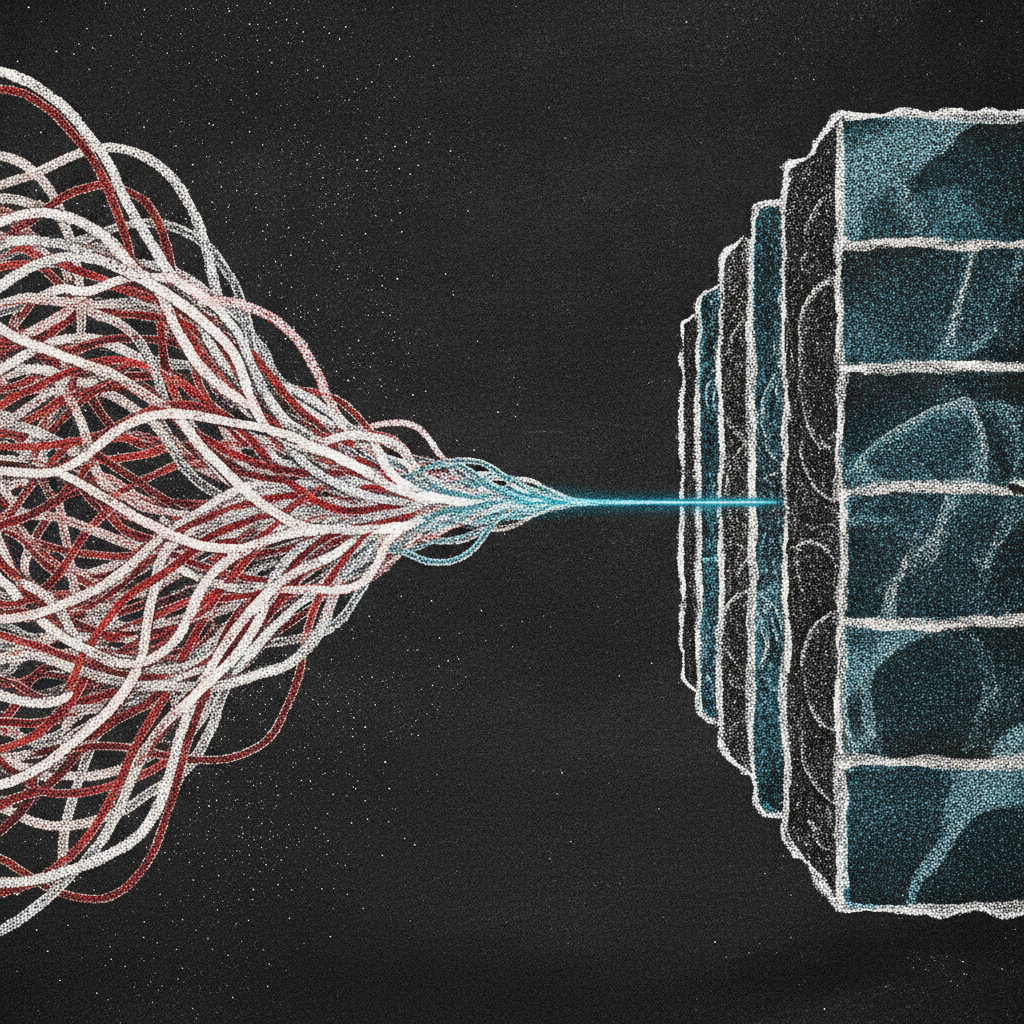
the heat dictates the bottleneck
the heat dictates the bottleneck
Reading out thousands of cryogenic sensors (like TES arrays) at millikelvin temperatures presents a profound physical paradox: every sensor requires a wire to the outside world, but every wire is a thermal bridge, conducting heat from room temperature and destroying the very environment the sensors require to function.
The solution is multiplexing (TDM, FDM, CDM, or $\mu$MUX) not for bandwidth, but for thermodynamics. By modulating hundreds or thousands of SQUID readouts onto a single coaxial feedline—whether by time slicing, frequency tones, or orthogonal codes—the physical wire count is drastically reduced.
The information is compressed and bottlenecked not because the channel is narrow, but because the cold is fragile. The constraint of heat dictates the density of the signal. The architecture of the communication is drawn entirely by the thermodynamics of the environment.