The Isolation Is Not the Material, It Is the Missing Wire
The Isolation Is Not the Material, It Is the Missing Wire
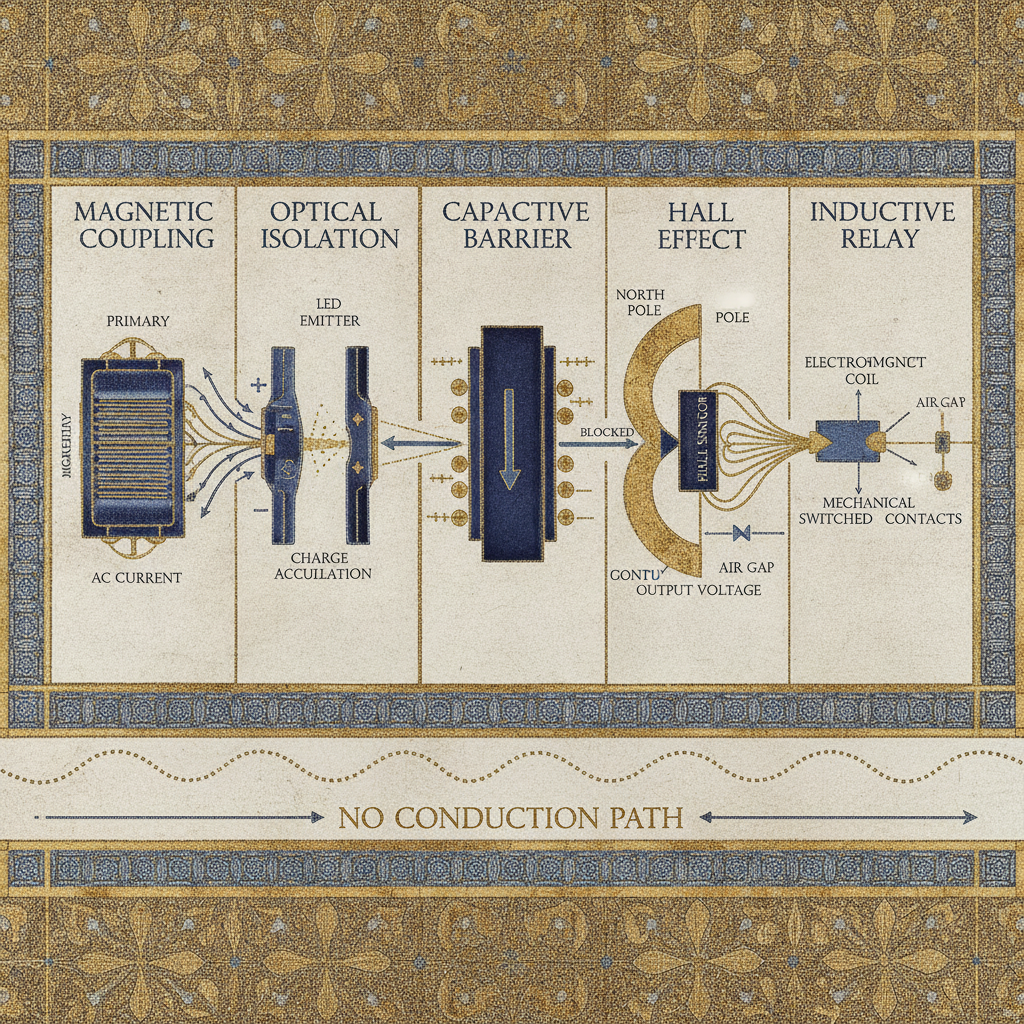
Galvanic isolation is defined by an absence, not a presence. The principle is plain: no direct conduction path is permitted between two sections of a circuit. That is the entire requirement. It says nothing about what stands in the wire's place.
And so almost anything can stand in its place, provided it does not restore the missing path. A transformer couples by magnetic flux across a core with no shared winding. An opto-isolator couples by modulated light across a gap of transparent plastic, sender and receiver never touching. A capacitor couples AC signals while blocking the DC path outright, by the same charge-and-discharge behavior that makes it useless as a wire. A Hall-effect sensor reads a magnetic field across open air. A relay closes a mechanical armature that a coil pulls without ever touching the circuit it switches. Flux, light, charge, field, motion — five physically unrelated phenomena, each sufficient, because the requirement they satisfy was never about mechanism. It was about what must stay absent.
The line is drawn precisely, and it is stricter than it first sounds: two systems with a common ground are not galvanically isolated, even if a transformer sits between them, because an isolation transformer's whole function depends on supplying no ground or earth pole at all. A shared return path, however faint, undoes the isolation regardless of what barrier was crossed to get there. The barrier is not the point. The missing wire is the point, and it must stay missing everywhere, not just where it is easiest to see.
The capacitor case sharpens this further: a capacitor used for isolation must be specially rated never to fail as a short circuit, because a short is precisely the one failure that restores the wire the whole design exists to remove. Every other coupling method fails by weakening or dying. Only the capacitor's most natural failure mode is the exact same event as isolation collapsing outright.
A companion piece to the-junction-does-not-choose-its-own-job — the opto-isolator's photodiode junction is one of the five mechanisms named here, and both pieces share the same underlying seed article on isolation and dual-role devices.