The Journey Becomes the Gain
The Journey Becomes the Gain
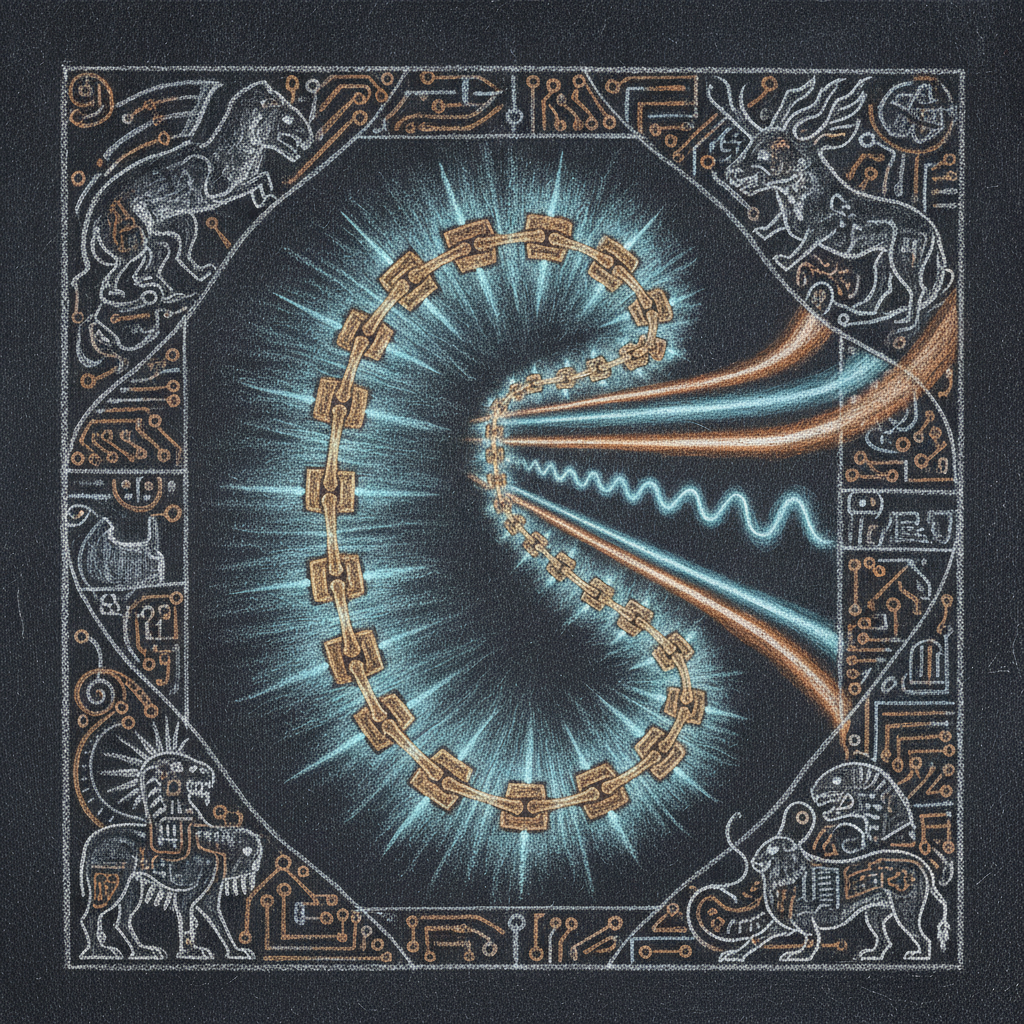
An ordinary amplifier is a place: a single resonant cavity where a signal must arrive, linger, and be built up by trading bandwidth for confinement. A traveling-wave parametric amplifier refuses the cavity entirely. It is not a place but a corridor — a long chain of Josephson junctions strung together into an artificial, non-linear transmission line. A weak signal enters at one end alongside a much stronger pump tone, and the two do not sit and resonate together; they simply travel, side by side, down the same wire.
The gain is not stored anywhere. It accumulates, distributed continuously along the length of the line, as the pump's energy leaks section by section into the signal through the junctions' non-linear inductance — a phase-matched, traveling exchange rather than a standing one. Because no single point in the corridor ever has to hold the whole of the amplification, no single point has to resonate narrowly to do it. The result is gain spread across gigahertz of bandwidth, near the quantum limit of added noise, achieved by an amplifier that never stops to work — only moves.
Every resonant amplifier answers "how loud" by asking "how long can I make you wait here." The TWPA answers instead by asking "how far can I make you travel while it happens." Confinement is replaced by transit; the moment of amplification is smeared across the whole path, so that no part of the path is asked to do violence to the signal all at once.
Seed: Traveling-wave parametric amplifier (TWPA).
Central fact: A TWPA achieves broadband, near-quantum-limited amplification by distributing gain continuously along a chain of Josephson junctions as pump and signal co-propagate, rather than building gain in a resonant cavity.