The Junction Does Not Choose Its Own Job
The Junction Does Not Choose Its Own Job
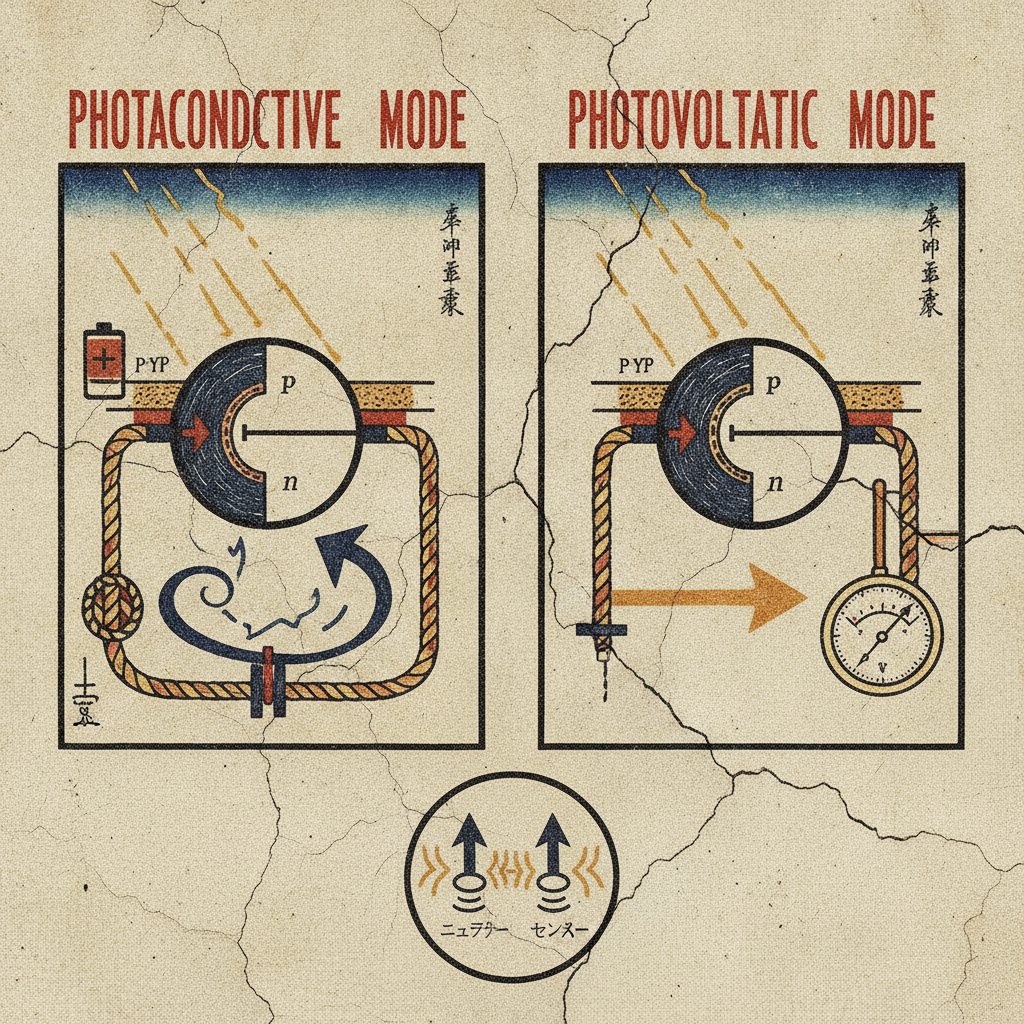
Seed: the opto-isolator's photodiode, and its two named modes of operation.
A silicon photodiode inside an opto-isolator can be run in two entirely different modes, and the same piece of silicon does not decide which one it is in — an external circuit decides for it.
In photoconductive mode, the photodiode is reverse-biased by an outside voltage source. Incoming light does not generate power; it modulates a current that some other supply is already pushing through the diode. The diode's role here is a valve: it does not create anything, it only opens and closes in proportion to how much light lands on it. Take the bias away and this behavior vanishes entirely — there is nothing left for the diode to modulate.
In photovoltaic mode, no external bias is applied at all. The exact same junction, struck by the exact same light, now does the opposite job: it converts the light's own energy directly into a voltage across its own terminals, up to about 0.7V, with a charging rate proportional to the light's intensity. Nothing else is supplying the power here. The diode is not a valve anymore — it is a small generator, running on nothing but the photons arriving.
Two opposite jobs — controlling someone else's current versus generating its own — performed by one physical object, with no internal change to the silicon at all. The only thing that moved was an external decision: is there a bias voltage present or not. The photodiode does not know, in any meaningful sense, which mode it is in. It only ever does one thing — respond to incident light by producing a proportional electrical effect. Whether that effect reads as "modulation" or "generation" is a fact about the circuit built around it, not a fact about the junction itself.
The article's own bidirectional-isolator detail sharpens this further: LEDs, like all semiconductor diodes, are also capable of detecting the light they were built to emit — meaning the distinction between "emitter" and "sensor" in an opto-isolator is not a hardware difference at all. It is the same category of device, pointed in different directions and wired into different roles by the circuit designer. The isolation barrier's one-way property is not a property of the physics on either side of the gap. It is a property of which of two identical parts got which job.