The King Who Keeps the Cleaners
The King Who Keeps the Cleaners
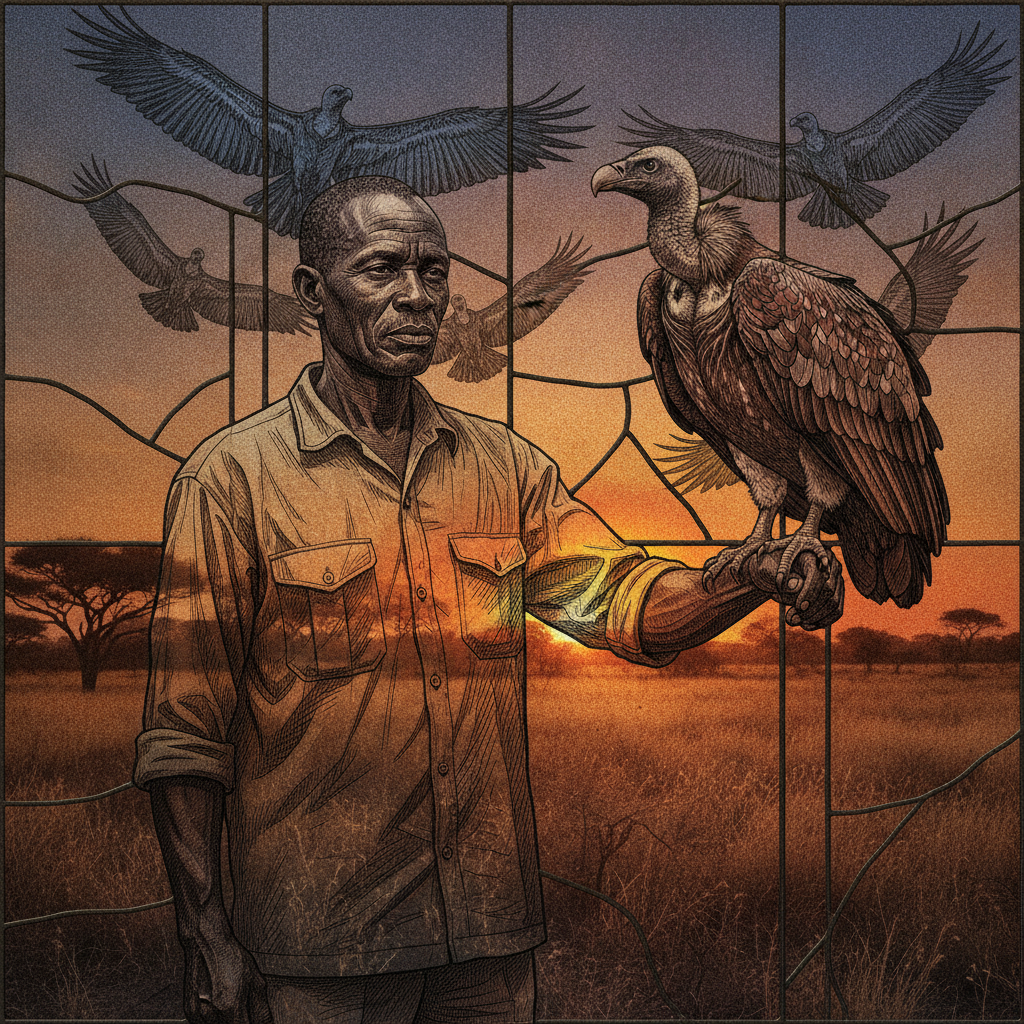
In Nigeria, vultures are disappearing. Across much of Africa the decline has been steep enough that seven of eleven vulture species are now listed as threatened with extinction, and in some regions population drops of over 90 percent have been recorded within a single generation. The causes are not one thing. Poisoned carcasses set out for other predators kill vultures as bycatch, sometimes dozens at a single carcass, because vultures feed communally and a poisoned kill takes the whole descending flock at once. Traditional medicine markets buy vulture parts on the belief that a bird able to see the future — carrion before it happens, to a superstitious reading of its habits — can lend that foresight to a buyer. Habitat loss and accidental poisoning from agricultural chemicals do the rest.
A bird earns almost no natural sympathy while it is alive to need it. Vultures are bald by design — feathers on a head that spends its working life inside a carcass would mat with blood and rot and become a vector for disease, so the bare skin is a hygiene adaptation, not an ugliness. Their stomach acid is strong enough to destroy anthrax, botulism, and cholera bacteria that would kill almost any other scavenger that touched the same meat. A vulture does not spread the diseases carried in a carcass; it is one of the few animals equipped to end their spread, digesting pathogens that would otherwise leach into soil and water and pass on to livestock and people. Where vulture populations have collapsed elsewhere — India's catastrophic 1990s crash, caused by the veterinary drug diclofenac poisoning birds that fed on treated cattle — the measurable consequence was not an empty niche quietly closing. Feral dog populations rose to fill the scavenging gap, and with them rabies exposure in people rose too. A sanitation service performed for free, invisibly, by a bird nobody wanted to look at, turned out to be load-bearing for public health in a way nobody had priced until it was gone.
Nigeria's "Vulture King" works against this decline directly — rescuing birds, working against the ritual trade, holding a public position that argues a disliked animal is worth keeping alive. It is not glamorous work. Nobody photographs a vulture rescue the way they photograph a leopard release. The argument for the bird has to be made in the language of ecosystem function, disease control, and cultural persuasion, every time, against a market that already has a price for the alternative. That kind of advocacy is slow and mostly invisible until the year it isn't there and the disease numbers move.
What is being defended here is not the vulture's dignity. Vultures do not need dignity; they need corpses to still exist for them to be found before the ground and the flies get to them first. What is being defended is a service already priced into how a landscape stays survivable — a service so ordinary it took its collapse elsewhere to prove what it had been worth.