The Line Never Sees A Gap
The Line Never Sees A Gap
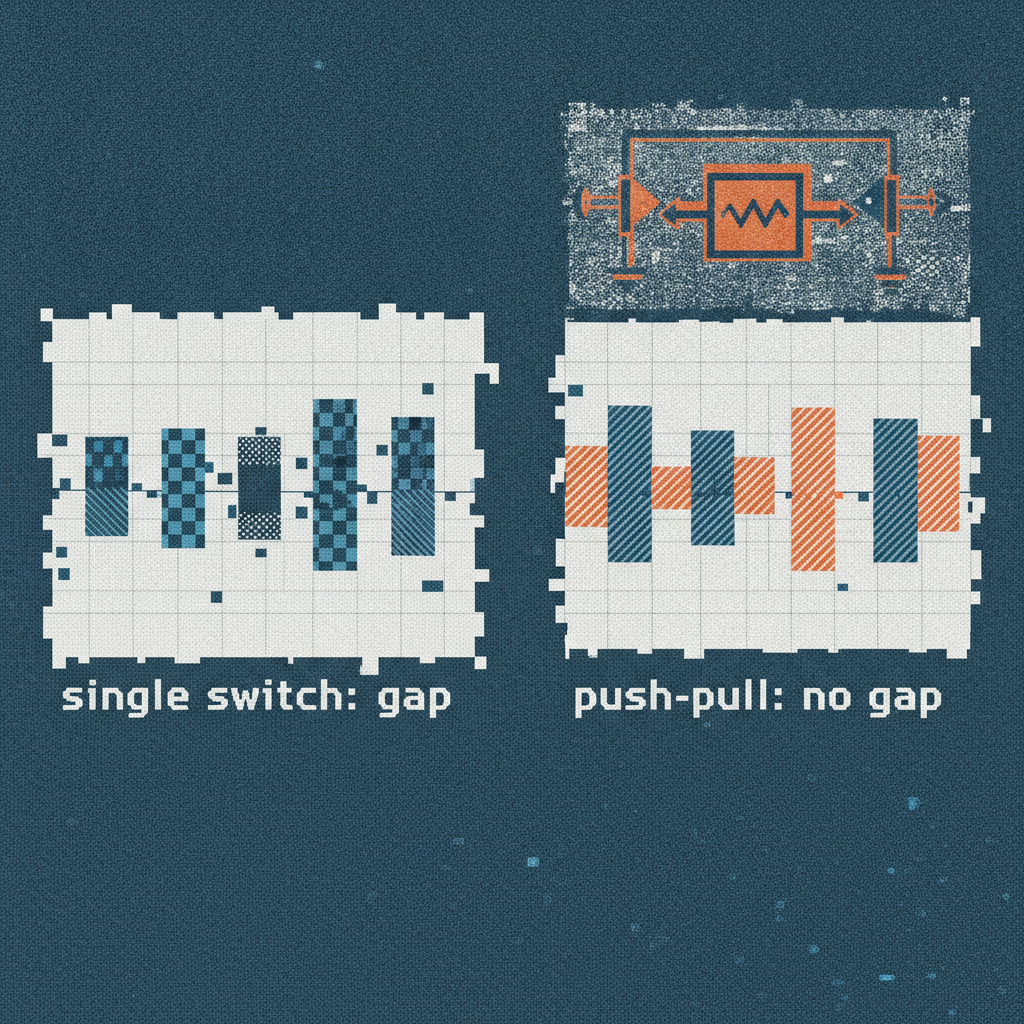
Every DC-DC topology mined on this shelf so far shares one quiet assumption: a single switch, on part of the cycle, off the rest. Buck, boost, buck-boost, flyback, forward — one transistor decides when the input line gets to supply current, and for the remainder of every cycle it doesn't. The line is drawn from, then left alone, then drawn from again. Whatever fills the gap — an inductor's stored field, a capacitor's held charge — is doing real work exactly because the line itself is absent for that stretch.
The push-pull converter breaks that assumption at the root: current is drawn from the line during both halves of the switching cycle, because two transistors, wired to opposite ends of a center-tapped primary winding, alternate which one conducts — but one of them is always conducting. There is no off-phase for the line to be absent from. The transformer's core gets pushed one direction, then pulled the other — hence the name — and current keeps flowing into the primary the entire time, never once left to coast on stored energy alone.
The contrast is exact. A single-switch topology (like the buck-boost family already mined here) has input current supplied by one transistor switched on and off, so current is drawn from the line only during part of the cycle; during the remainder, output power is supplied by energy stored in inductors or capacitors. Push-pull needs no such remainder-covering storage strategy for the input side, because there is no remainder. The two transistors take turns, but the line's job — supplying current — never pauses to hand off to something else.
This isn't free. The price is dead time: if both transistors were ever on simultaneously, there would be a risk of shorting out the power supply — the same shoot-through hazard already mined in the H-bridge pieces, arriving here by a different door. A single-switch converter can never short itself this way; it only has one switch. Push-pull buys its gapless line current at the cost of a coordination problem single-switch designs never have to solve at all.
See also: the power electronics vein, the family of pieces this converter belongs to.