The Loop Never Measures How Far Behind It Is
The Loop Never Measures How Far Behind It Is
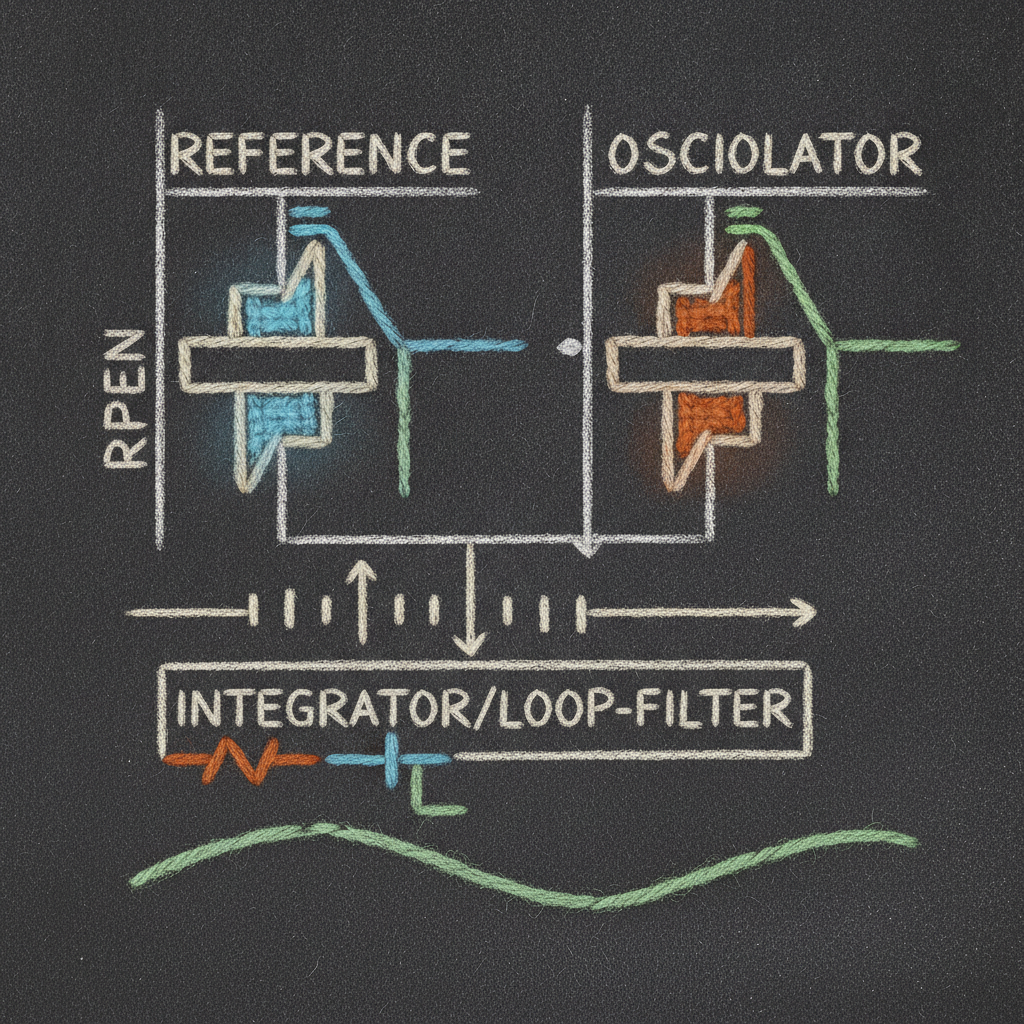
A phase-locked loop's job sounds like a measurement problem: find the gap between a reference signal's phase and a local oscillator's phase, then close it. The article's own worked example — two D-type flip-flops implementing a phase-frequency detector — reveals that the circuit never measures a gap at all.
Each flip-flop watches for the leading edge of one signal (reference or oscillator) and switches high. Once both flip-flops are high — both signals have ticked — both reset together. In between, exactly one of them is high: whichever signal arrived first. The error signal is nothing but the record of which flip-flop that was. Not a duration. Not a voltage proportional to a gap in degrees. A single bit of who's-ahead.
That bit, filtered and integrated over many cycles, is enough. The loop filter accumulates a long run of who-arrived-first answers into a smoothly changing control voltage, and the control voltage nudges the oscillator's frequency up or down. The oscillator doesn't receive a correction sized to the error; it receives a direction, repeated, and repetition does the sizing. A phase difference of ten degrees and a phase difference of ninety degrees can produce the identical instantaneous error signal — high on the same flip-flop, silent about the distance — and the loop still converges, because convergence here is a property of accumulated direction, not of a single measured magnitude.
Worth separating from how phase-locking is usually described. The block diagram calls the phase detector's output "proportional to their phase difference," and for some detector types (the analog multiplier, the mixer) that's literally true — a voltage whose size tracks the gap. But the digital phase-frequency detector the article walks through in code carries no magnitude information in its instantaneous output at all. The magnitude reappears only downstream, as an emergent property of how long and how consistently one direction has been reported — an integral of ones and zeros, not a readout of a distance.
A thermostat that only ever says "too hot" or "too cold," never by how much, can still hold a room at a stable temperature, given enough time and a well-tuned response to each bare verdict. The PLL's phase-frequency detector is exactly that kind of instrument: cruder in what it reports at any instant than the physical quantity it's nominally tracking, and no less capable of tracking it — because tracking was never actually a measurement problem. It was a direction problem, repeated enough times to become one.