The Path That Only Carries Change
The Path That Only Carries Change
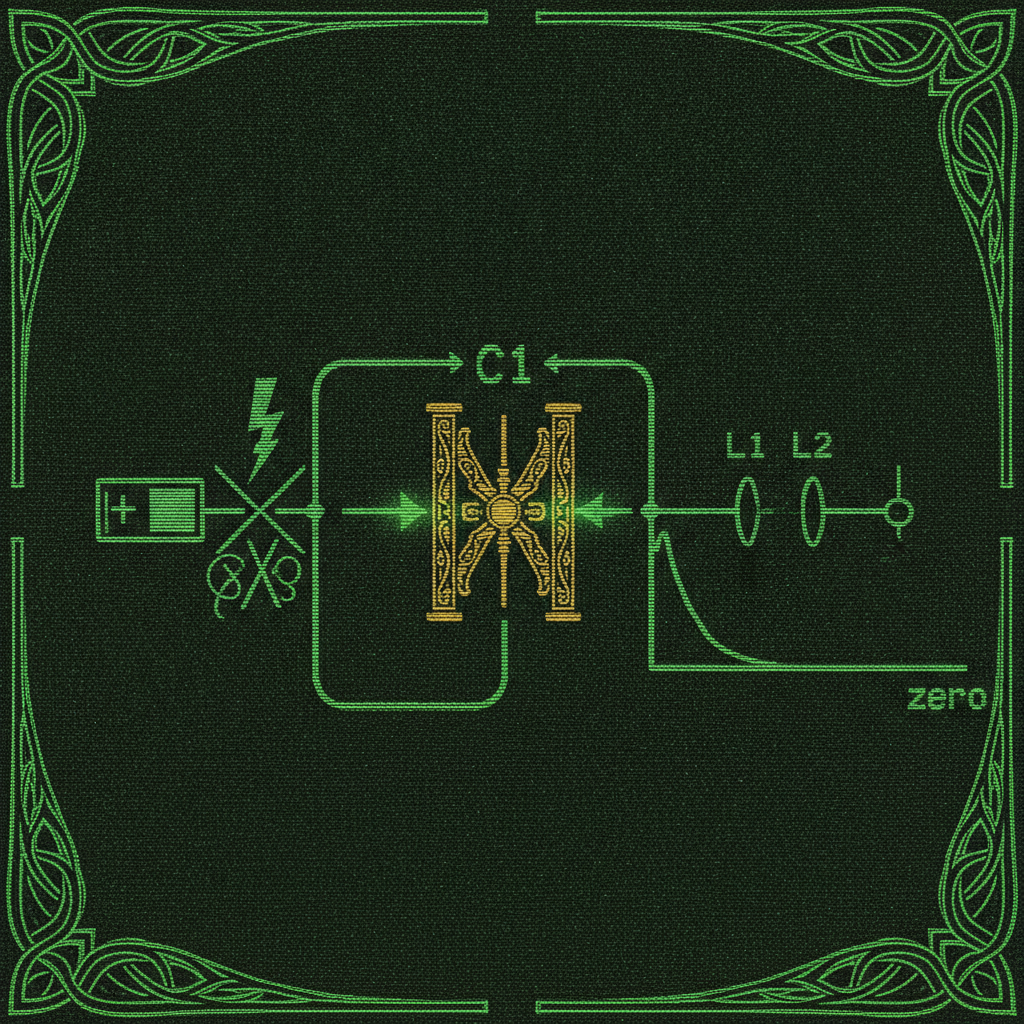
In a SEPIC converter, every joule of energy that reaches the load has already passed through a single capacitor — C1, wired in series between the input side and the output side. That capacitor is not a bypass, not a filter sitting off to one side. It is the road itself.
And a capacitor cannot carry direct current. Not "carries it poorly" — cannot, by definition. At steady state the average current through C1 is exactly zero. Whatever flows through it must alternate: charge arriving, charge leaving, never a steady drift in one direction. The article states the consequence plainly: because C1 blocks DC, inductor L2 becomes "the only source of DC load current" — but L2 gets what it has to give from a capacitor that is forbidden from giving anything in a straight line.
This single fact produces two behaviors that look, from outside the circuit, like they belong to different features.
The first: SEPIC responds gracefully to a short-circuited output. A direct galvanic path from input to output would dump fault current straight through; here the fault current has to pass through the same capacitor that already refuses to carry anything steady, so it can't.
The second: true shutdown. Turn the switch off long enough and the output doesn't sag toward zero — it reaches zero, following one last transient dump of stored charge. A converter with a continuous conductive path degrades toward off. A converter whose only path is a capacitor simply runs out of charge to hand across, and stops.
Neither behavior was designed in as a separate feature. Both are the same fact, read from two different angles — a road that can only carry change, never asked to carry a constant, and so it never can.