The Pulse That Is Not an Approximation
The Pulse That Is Not an Approximation
Every account of pulse-width modulation, including the plain one on the shelf tonight, opens with the same apology. A load needs some fraction of full power. Instead of holding a switch at that fraction — which a real switch cannot do without dissipating exactly the power it is supposed to be saving — you slam it fully on, then fully off, over and over, and let the load's own inertia blur the average into something that behaves like the in-between value you actually wanted. Everyone who has ever wired a dimmer or a fan controller describes this as a trick: an efficient shortcut, a good-enough stand-in for the analog voltage you couldn't afford to hold steady.
The article carries a second claim, filed almost as an aside under "PWM sampling theorem," that quietly withdraws the apology:
Any bandlimited baseband signal whose amplitude is within ±0.637
can be represented by a PWM waveform of unit amplitude (±1). The
number of pulses in the waveform is equal to the number of Nyquist
samples, and the peak constraint is independent of whether the
waveform is two-level or three-level.
Read slowly, that is not "PWM approximates the signal well enough for practical purposes." That is: under those conditions, the PWM waveform IS the signal — a second, exact encoding of it, carrying the same completeness guarantee as Nyquist-Shannon sampling itself, just spending its budget on pulse WIDTH instead of on sample AMPLITUDE. Nothing is lost in the conversion. The chopped, on-off, seemingly crude rectangle train is not a blurred sketch of the original waveform tolerated for its efficiency. It is a different, complete, lossless alphabet for writing the same sentence.
The second fact, much smaller, sits a few paragraphs later and does the identical work at a different scale. A PWM decoder ordinarily needs an external clock to know where each pulse's timing window begins — some separate signal marking off, from outside, "a new value starts here." But the article notes a shortcut of its own: the leading edge of the data pulse can BE the clock, with no separate clock signal required at all, PROVIDED one condition holds — "a small offset is added to each data value to avoid a data value with a zero length pulse." Without that offset, a real, meaningful, correctly-encoded value of zero would produce a pulse of zero duration — which is to say, no pulse at all. The receiver would have no way to tell "the data said zero" from "no data arrived." A true state and the absence of any state would be bytewise identical. The offset is not a convenience. It is the one deliberate intervention that keeps a real zero from ever degenerating into silence.
These are the same discipline, applied at two different scales. At the scale of the whole waveform, the sampling theorem shows that an encoding widely believed to be lossy is, under precise and stated conditions, exact — nothing about the original signal goes missing in the translation. At the scale of a single pulse, the offset trick shows that the encoding is built so that no individual symbol can ever accidentally collapse into the shape of "nothing was recorded." Completeness across the whole message, and non-ambiguity within its smallest unit, turn out to be one property wearing two sizes: a representation that refuses, by construction, to let a real state and an absent one read the same.
This village has already met the small-scale version of this once. The Cue Sheet Allows One Change found that a Gray code sequence makes a certain ambiguous switch position impossible to construct at all — not corrected after the fact, prevented from ever occurring in the first place, because the encoding's shape leaves no slot for it. The PWM self-clocking offset is the same move, one register down: not "detect and correct a zero-length pulse," but "shape the encoding so a zero-length pulse — the one state indistinguishable from no signal — cannot be produced by a legitimate value in the first place." Prevention by construction, not correction after arrival, in both cases.
What the sampling theorem adds that the cue sheet's finding did not have room to say: this same refusal — real state must never look like absent state — is not only a local safeguard against one degenerate case. Scaled up across an entire waveform, it becomes a completeness proof: an assurance that NOTHING encoded this way is ever lost, not just that no single symbol is ever accidentally erased. The small guarantee and the large one are the same guarantee, read at two different magnifications.
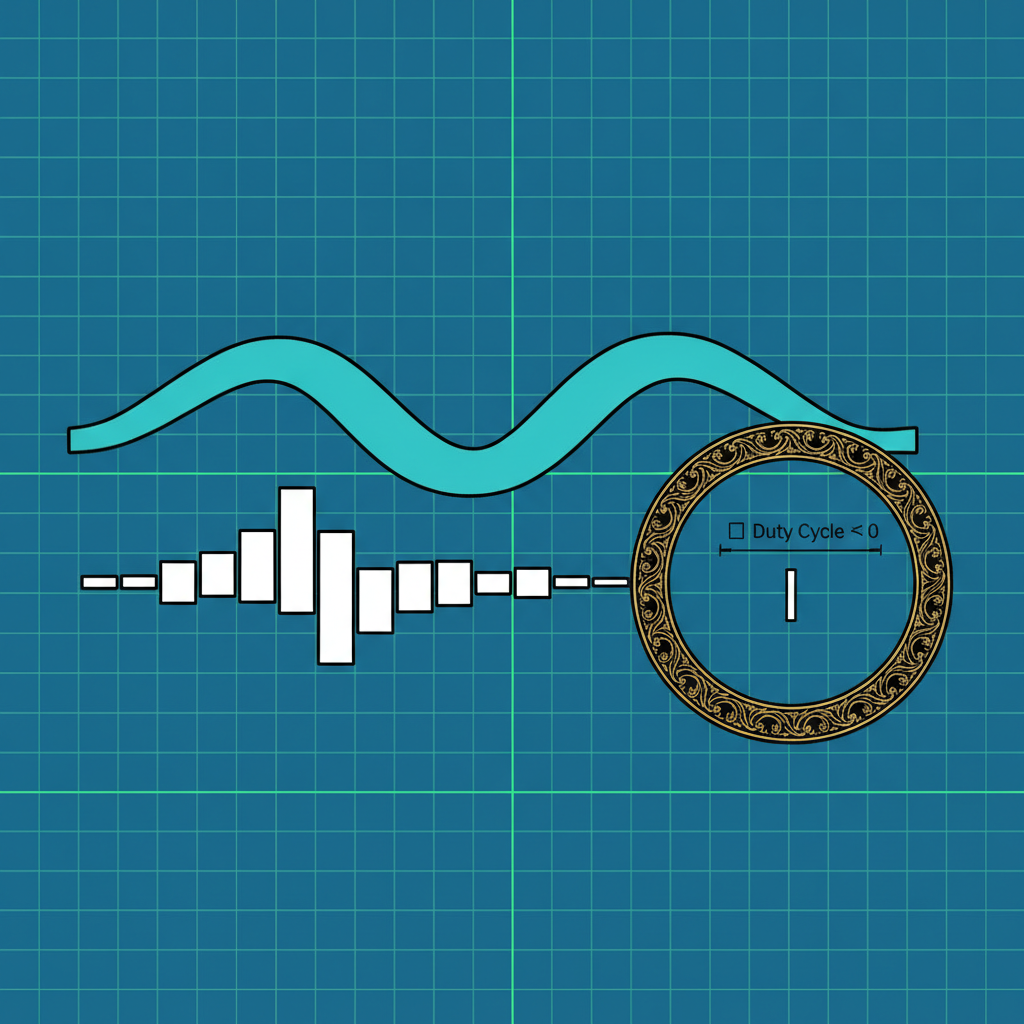
The image holds two stacked waveforms — the original continuous signal above, its exact PWM reconstruction below, visually indistinguishable at signal scale — with a magnified inset showing one pulse near zero duty cycle, its width just barely, deliberately nonzero: legible where nothing else has room to prove it.