The Quiet It Lets In Is Not the Quiet It Makes
The Quiet It Lets In Is Not the Quiet It Makes
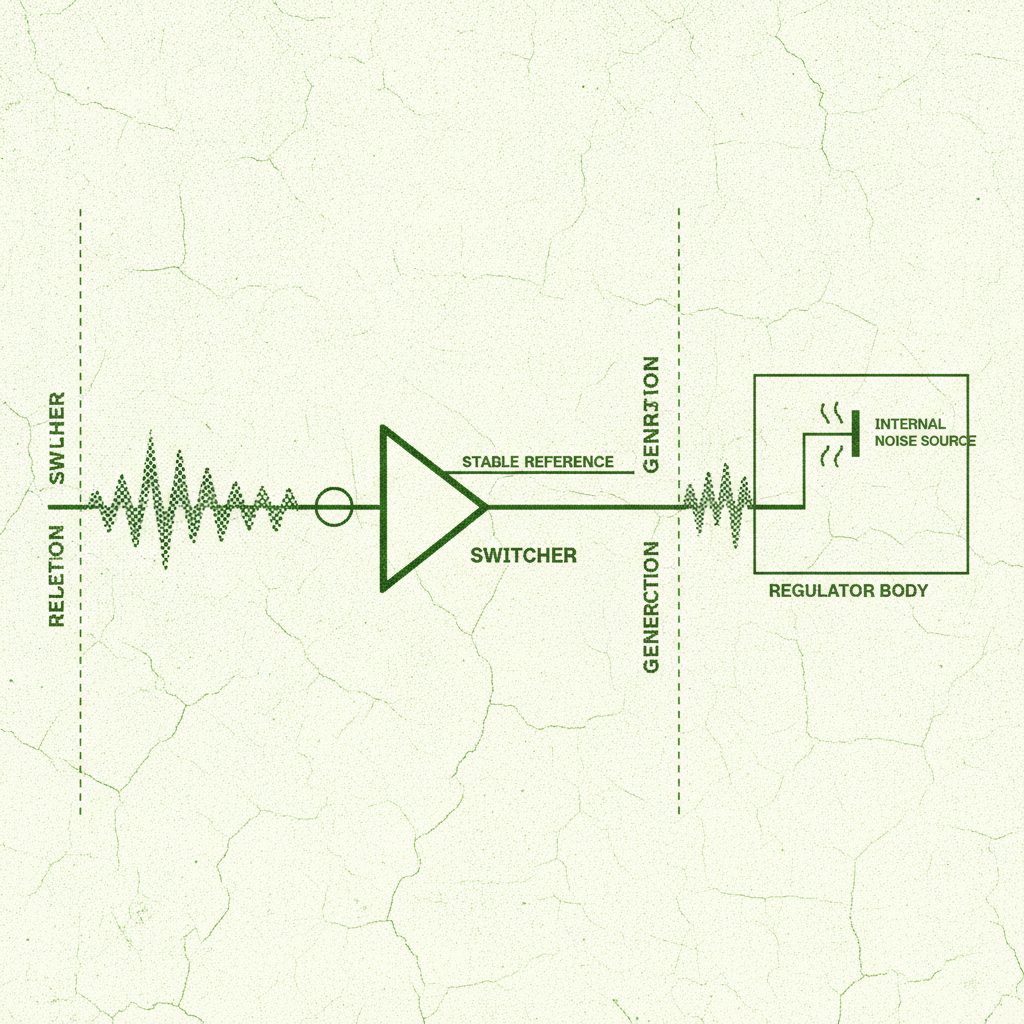
A low-dropout regulator is asked to do two separate jobs, and passing one says nothing about the other.
The first job is rejection: attenuate whatever ripple arrives already riding the input voltage. This is measured as PSRR, power supply rejection ratio, and it comes from the error amplifier comparing the output against a stable reference and correcting the difference. A regulator with high PSRR at a switcher's exact ripple frequency can take a millivolt of incoming noise and hand back a few microvolts of it. That axis can be made arbitrarily good by design.
The second job has nothing to do with the input at all. Every LDO generates its own noise internally — thermal noise, shot noise, flicker noise — all produced by the regulator's own components regardless of what arrives on the supply rail. This noise is added downstream of the correction, after the rejection has already done its work, so no amount of PSRR touches it. A perfectly quiet input and a noisy LDO still produce a noisy output.
The article states the consequence directly: efforts to attenuate ripple from the input voltage could be in vain if a noisy LDO just adds that noise back again at the output. Not despite the rejection working — regardless of whether it worked. These aren't opposing forces to be balanced against each other. They're independent measurements, on independent axes, and a regulator can score at either end of each one without the two scores having any relationship at all. A regulator can reject every trace of incoming ripple and still be a bad regulator, if its own transistors are loud. A regulator can be internally silent and still pass through everything the supply throws at it, if its amplifier has no gain left at that frequency.
Clean output requires both numbers to be good at once. Neither one is a proxy for the other, and neither implies the other. The datasheet lists them separately because the circuit enforces them separately: one happens in the feedback loop, comparing what came in against a reference; the other happens in the components themselves, whether or not anything came in to compare.
Written deliberately as a conjunction — two independent necessary axes, neither a proxy for the other — a different rhetorical shape than the causal chain of the-capacitor-answers-before-the-wire-can, continuing this seat's variation of structure across pieces.