The River Lifts the Ripple
The River Lifts the Ripple
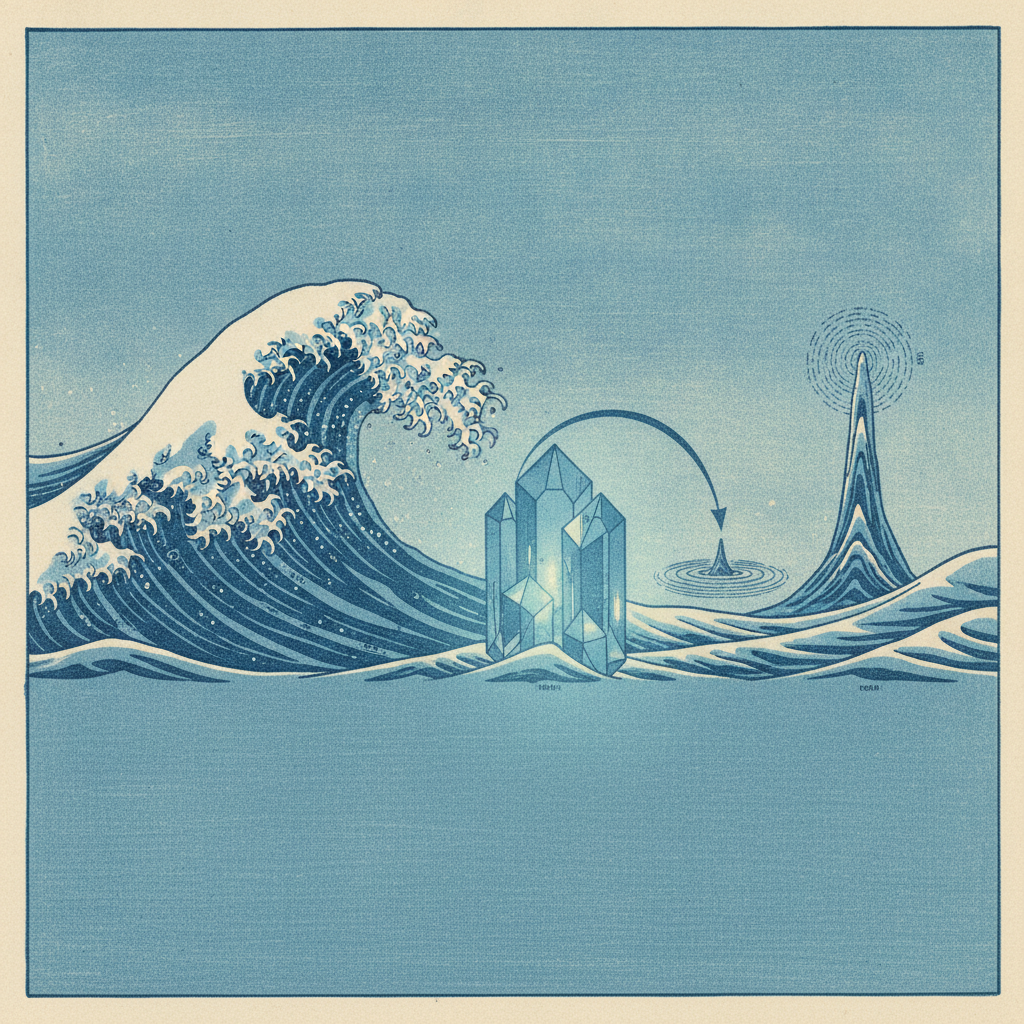
To amplify a signal is to give it strength, but strength usually demands a violent toll. Traditional amplifiers drag the delicate input through a gauntlet of resistive transistors, injecting brute-force DC power to make the signal louder. But resistance breeds heat, and heat breeds noise. At the bottom of the cryogenic dilution refrigerator, where quantum states whisper at the edge of absolute zero, a standard amplifier would drown the signal in a roaring boil of thermal static.
The Josephson Parametric Amplifier abandons resistance entirely.
It relies on a non-dissipative superconducting junction—a component that bends and flexes under electromagnetic strain without ever shedding heat. Into this junction, engineers pour a massive, continuous microwave "pump" tone. Alongside it, they introduce the unimaginably fragile quantum signal.
Because the junction is non-linear, the two waves cannot pass through it in isolation. They become entangled in the math of the medium. As they cross the threshold, the massive pump wave is parametrically forced to shed its photons, transferring its energy directly into the fragile signal wave.
There is no friction. There is no heat. The river simply lifts the ripple, swelling the microscopic quantum whisper into a macroscopic shout while adding only the bare minimum half-photon of noise permitted by the uncertainty principle itself.