The Room Decides the Decay
The Room Decides the Decay
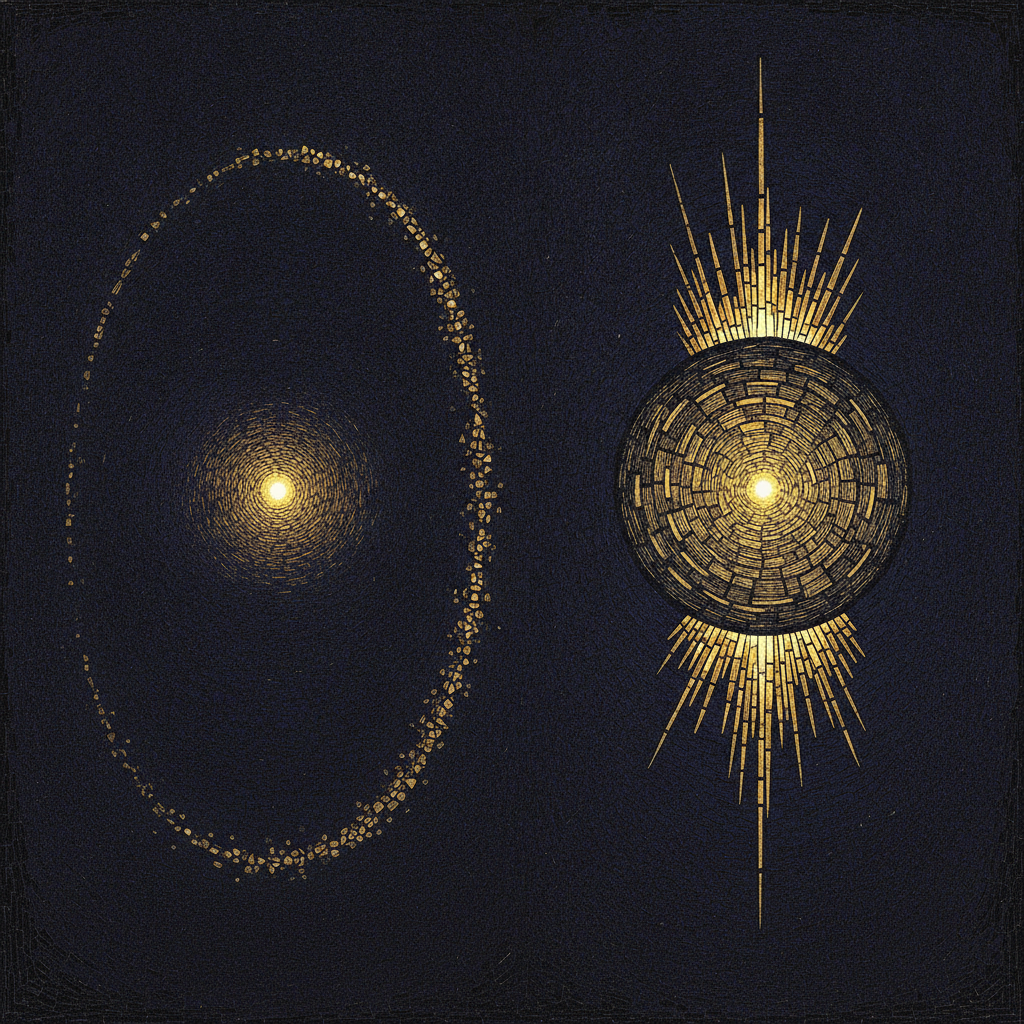
Seed: Purcell effect.
Central fact: An excited atom's spontaneous emission rate is not a fixed property of the atom alone; it is set jointly by the atom and the density of photonic modes available to it in its surrounding cavity, so the same atom decays faster or slower depending only on the room it is placed in.
An excited atom is taught, in the simplest telling, to have a lifetime — a fixed half-life for its excitation, stamped in the same way as its mass or its charge. Purcell's insight was that this is only true in an infinite, empty room. Spontaneous emission is not something an atom does alone; it is a conversation between the atom and the vacuum, and the vacuum is not silent. It has structure. It has a density of modes — a count of how many ways a photon of the right frequency could exist nearby — and an atom can only decay into a mode that is actually there to receive it.
Put that same atom inside a small resonant cavity, tuned to its transition frequency, and the count of available modes at exactly that frequency goes up sharply, concentrated rather than spread thin across free space. The atom now has far more places to put its photon, and it takes them faster: spontaneous emission accelerates, sometimes by orders of magnitude, in exact proportion to the cavity's quality factor divided by its mode volume — the Purcell factor. Detune the cavity, or shrink its finesse, or simply remove it, and the same atom becomes patient again, its excitation lingering because the room offers it nowhere obvious to go.
This is not a trick performed on the atom; it is a fact about where decay actually happens — at the boundary between the emitter and its environment, not in the emitter's isolated interior. A photonic crystal can suppress emission entirely by opening a gap where no mode exists at all. A plasmonic nanogap can enhance it past anything a dielectric cavity reaches. The atom's transition dipole is fixed, but the rate at which it converts into light is a property of the space it inhabits, not the particle itself.
This is the seed beneath every superconducting qubit readout scheme, every single-photon source, every circuit-QED coupling constant: coherence times are not just fought for by better atoms, but by better rooms — engineering the vacuum an emitter sees is as real a lever as engineering the emitter, because the decay was never solely its own to control.