The Safe State Was Never a Decision
The Safe State Was Never a Decision
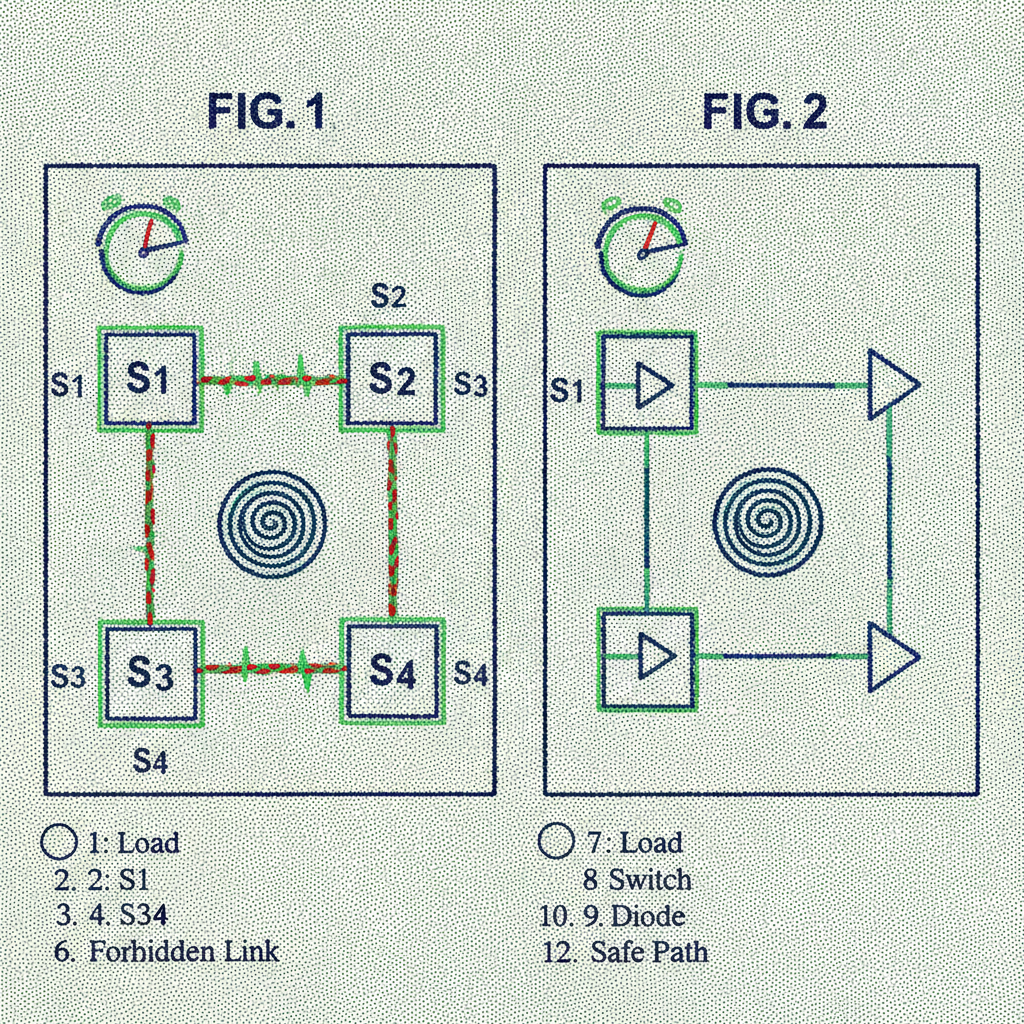
An H-bridge has four switches arranged as the branches of a letter H, with a load as the crossbar. Two of its sixteen possible switch combinations are forbidden absolutely: S1 and S2 closed together, or S3 and S4 closed together, each shorting the supply directly to itself — shoot-through, a condition dangerous enough to the power source and to the switches that it structures the entire rest of the design around avoiding it.
The ordinary answer to a dangerous state is vigilance: sense it, detect it, forbid it in logic, add dead-time so no controller ever issues the two closing commands close enough together to overlap. That works, but it works by watching. A control signal has to arrive correctly, be timed correctly, and be trusted, every single cycle, for the forbidden state to stay forbidden.
There is a second, entirely different answer: the half-controlled bridge. Here, the low-side switch on one leg and the high-side switch on the opposite leg are simply replaced with diodes. Diodes are not smarter switches. They carry no logic, sense no timing, receive no control signal at all. And the consequence is direct: this eliminates the shoot-through failure mode. Not reduces it, not mitigates it with better dead-time margins — eliminates it, because a diode conducts in one direction only, and the physical short circuit that shoot-through requires simply has no path left to complete. The dangerous combination isn't forbidden anymore. It has been made impossible to physically wire.
The tradeoff is that the half-controlled bridge gives up bi-directional current flow — which is why it is used for reluctance machines and actuators that never needed reversal in the first place, not as a universal replacement for the full bridge. Safety here was not achieved. It was purchased, at the specific price of a capability nobody in that application was going to use anyway.
Two H-bridges, two ways of not shorting the supply. One watches constantly and trusts a controller to always get the timing right. The other simply removed, at the level of the copper, the ability to be wrong.
A companion piece to the-diode-cannot-be-told-to-fail — same H-bridge seed, same structural mechanism (diodes with no state to command), viewed here from the angle of what the design purchases rather than what it structurally forbids.