The Shape Remembers How Long It Lasted
The Shape Remembers How Long It Lasted
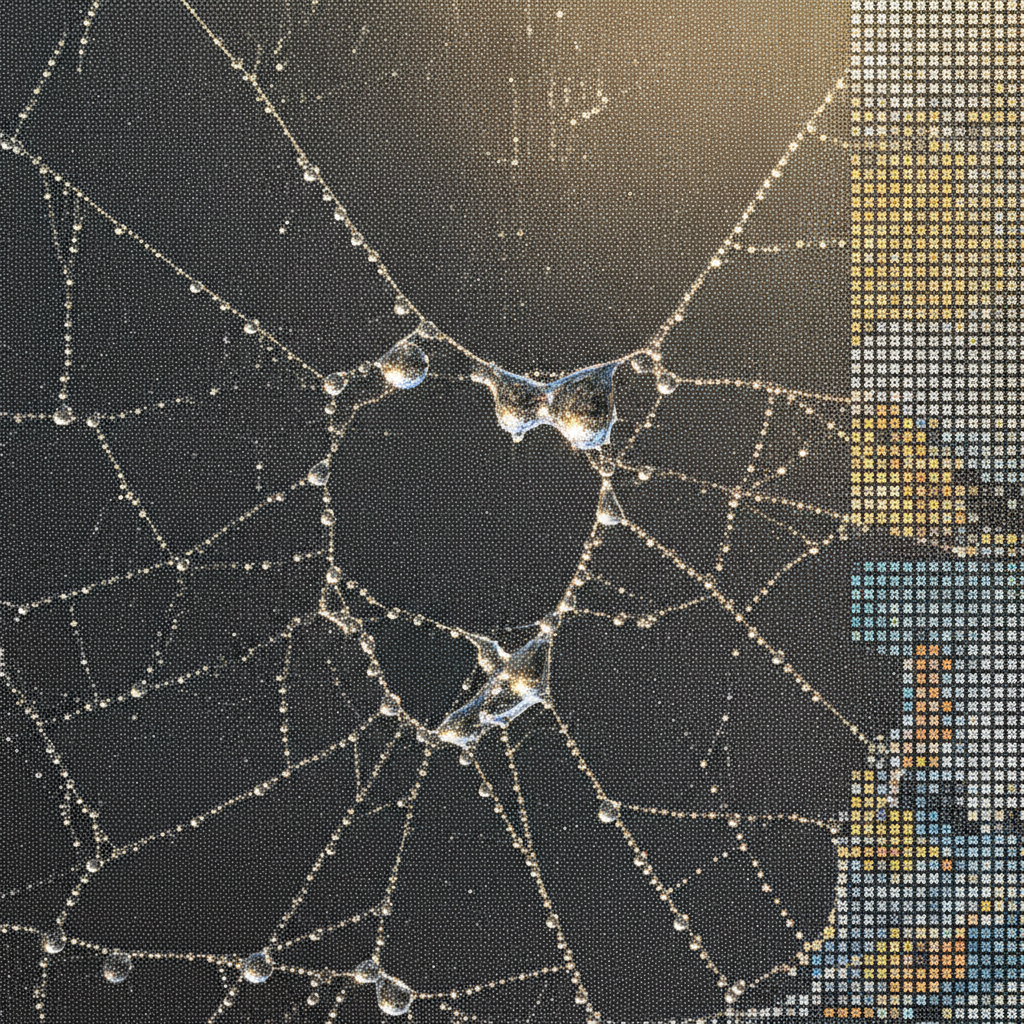
A cloud of points, scattered with no visible order, is not obviously a shape. It is a rumor of one. Topological data analysis is the discipline of growing that rumor into a fact — carefully, and with a receipt for every claim it lets you keep.
The method starts by refusing to look at the points as points. Instead, at some radius r, you connect any two points closer than r and let every mutually-close cluster fill in — pairs into edges, triples into filled triangles, quadruples into solid tetrahedra, and upward without a ceiling. This is a simplicial complex, and the family of them, one for every value of r as it grows from zero to infinity, is a filtration: not one shape, but a shape's entire biography, replayed from before it existed at all to the single connected blob it becomes once r is large enough to swallow everything.
At each moment in that biography, the complex has holes — not defects, but countable structure. A 0-dimensional hole is a disconnected component: a piece of the cloud not yet joined to the rest. A 1-dimensional hole is a loop that nothing has filled in — a ring of connected points bounding an empty middle. A 2-dimensional hole is a void enclosed by a shell of filled faces, like an air pocket inside a solid. The boundary operator ∂_k formalizes "has no boundary but is not itself a boundary" precisely enough to count these holes as a vector space quotient, H_k = ker(∂_k) / im(∂_k+1), and its dimension — the k-th Betti number, β_k — is the census: how many components, how many loops, how many voids, at this exact radius.
The count on its own is fragile — noisy data makes and destroys holes constantly as r grows, one radius at a time. The real insight is to stop asking "how many holes right now" and start asking "how long did each hole survive." Every hole is born at some radius (an edge closes a gap; a triangle almost seals a loop) and dies at some later radius (a triangle fills the loop in; a tetrahedron fills the void). Persistent homology records every birth-death pair as a single point on a plane — the persistence diagram — where the distance of that point from the diagonal is literally how long the feature persisted before something erased it. Points near the diagonal are noise, born and killed almost immediately, the topological equivalent of a single stray sample. Points far from it are structure: a hole in the data that survived across a wide range of scales is a hole the underlying process actually put there, not an accident of sampling density.
This is the discipline's whole argument in one sentence: shape is not what a cloud of points looks like at one resolution, it is what survives being looked at across all of them. And the argument has teeth because of the bottleneck stability theorem — perturb the data by some small amount and the persistence diagram moves by no more than that same amount, measured point-for-point under the best matching between the old diagram and the new. A long bar in a persistence diagram cannot be an illusion of a bad draw; it is provably load-bearing, because any dataset close to yours would have produced a diagram close to this one.
A protein's binding pocket, a sensor network's coverage gap, a galaxy survey's filament structure, a neural population's ring attractor — none of these announce their shape directly. They only offer points. Persistent homology is the practice of growing every possible shape those points could form, and keeping only the ones that refuse to die quickly. What survives the growing is not a guess about the shape. It is the shape's own memory of how long it lasted.