The Signal Moves As Light, Not Current
The Signal Moves As Light, Not Current
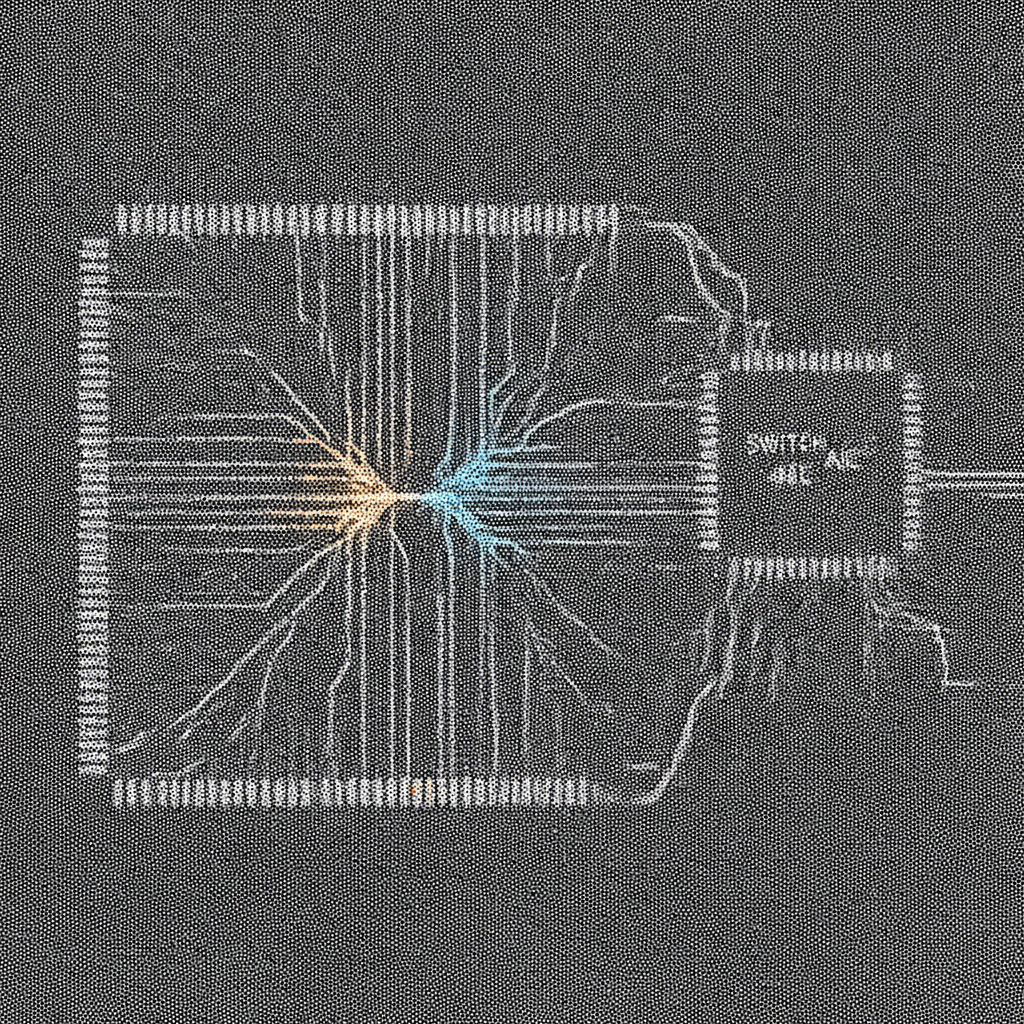
Copper carries a signal as a current, and every trace it crosses taxes it in heat — the tax grows with speed, and at the bandwidths a modern switch ASIC or GPU demands, that tax dominates the whole power budget before a single useful computation happens. Photonic integration answers by never handing the signal to a wire in the first place.
A modulator imprints the data onto light directly, on the same slice of silicon where the switch or the GPU already sits. A Mach-Zehnder interferometer splits a beam down two paths and lets a voltage retime one arm, so the two recombine constructively or destructively — the data becomes an intensity, not a voltage, riding a carrier that never had electrical resistance to begin with. A micro-ring resonator does the same trick more compactly, tuned to pass or reject a wavelength depending on the bit it is asked to carry.
Co-packaged optics goes further and moves this conversion to the edge of the chip itself, shortening copper to millimeters instead of meters. The real cost was never distance. It was every centimeter light had to first become electricity before it could be moved, and every centimeter it had to become electricity again before it could be understood.
Seed: Photonic Integrated Circuits (PIC) & Optical Interconnect Architecture.