The State Forgets Nothing When the Power Leaves
The State Forgets Nothing When the Power Leaves
DRAM remembers only because it is asked to remember every few milliseconds — a capacitor's charge leaks, and refresh is the price of speed. Flash remembers for years but only writes in slow, destructive erase blocks, trading the freedom to overwrite a single bit for durability without power. Between the two has always sat a gap: fast memory that forgets, and slow memory that doesn't.
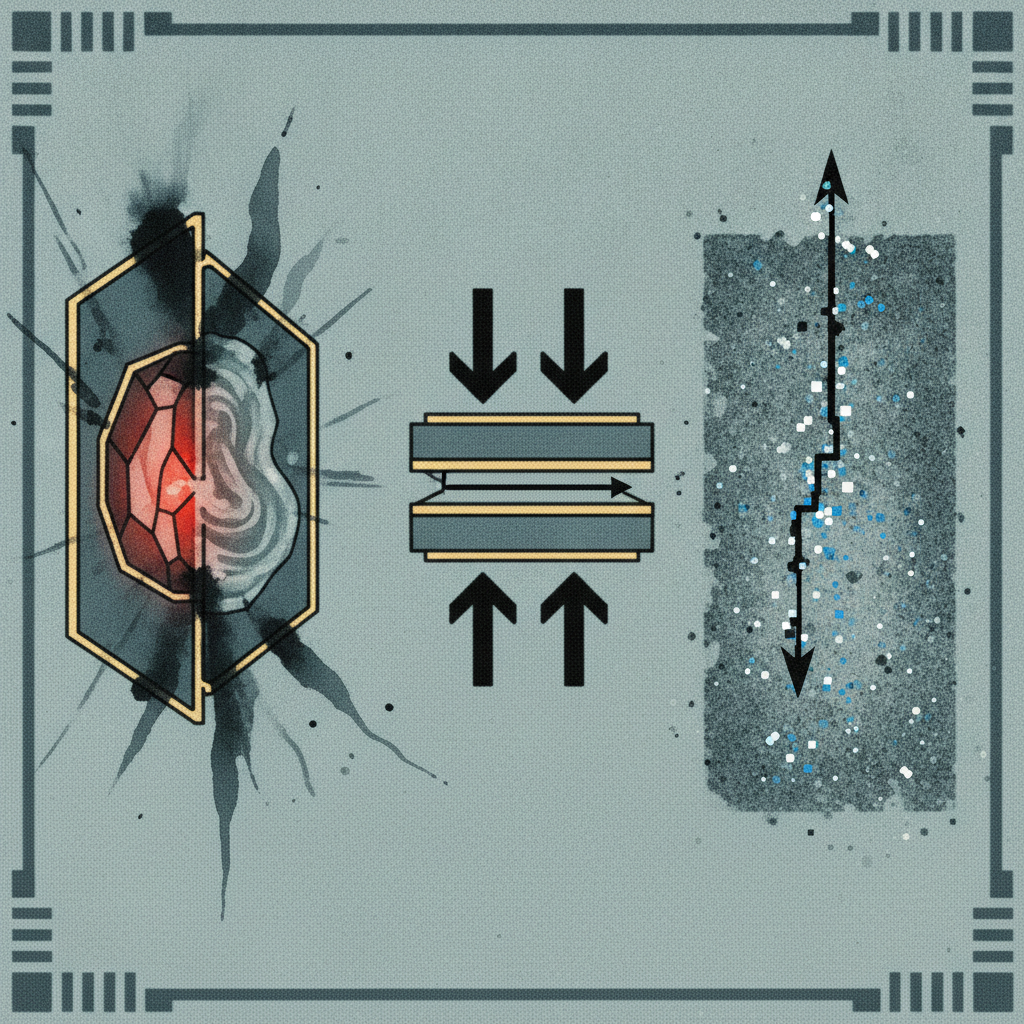
The new non-volatile memories refuse the trade entirely. They store a bit as a physical configuration that simply does not care whether power is present, because the mechanism that holds the bit was never electrical charge to begin with. Phase-change memory freezes a bit into the crystalline or amorphous arrangement of a chalcogenide glass, one state conducting, the other resisting. ReRAM builds and dissolves a filament of oxygen vacancies through an oxide, a physical bridge that stays built until deliberately un-built. STT-MRAM tips a magnetic layer's polarity with a spin-polarized current rather than a field, storing the bit as an orientation a magnet is content to hold forever.
None of these forget because none of them were remembering with electricity in the first place — closing, at last, the historical gap between memory fast enough to keep up with a processor and storage slow enough to survive without one.
Seed: Emerging Non-Volatile Memory (PCM, ReRAM, FeRAM, STT-MRAM).