The Structure Agrees to Bend a Little
The Structure Agrees to Bend a Little
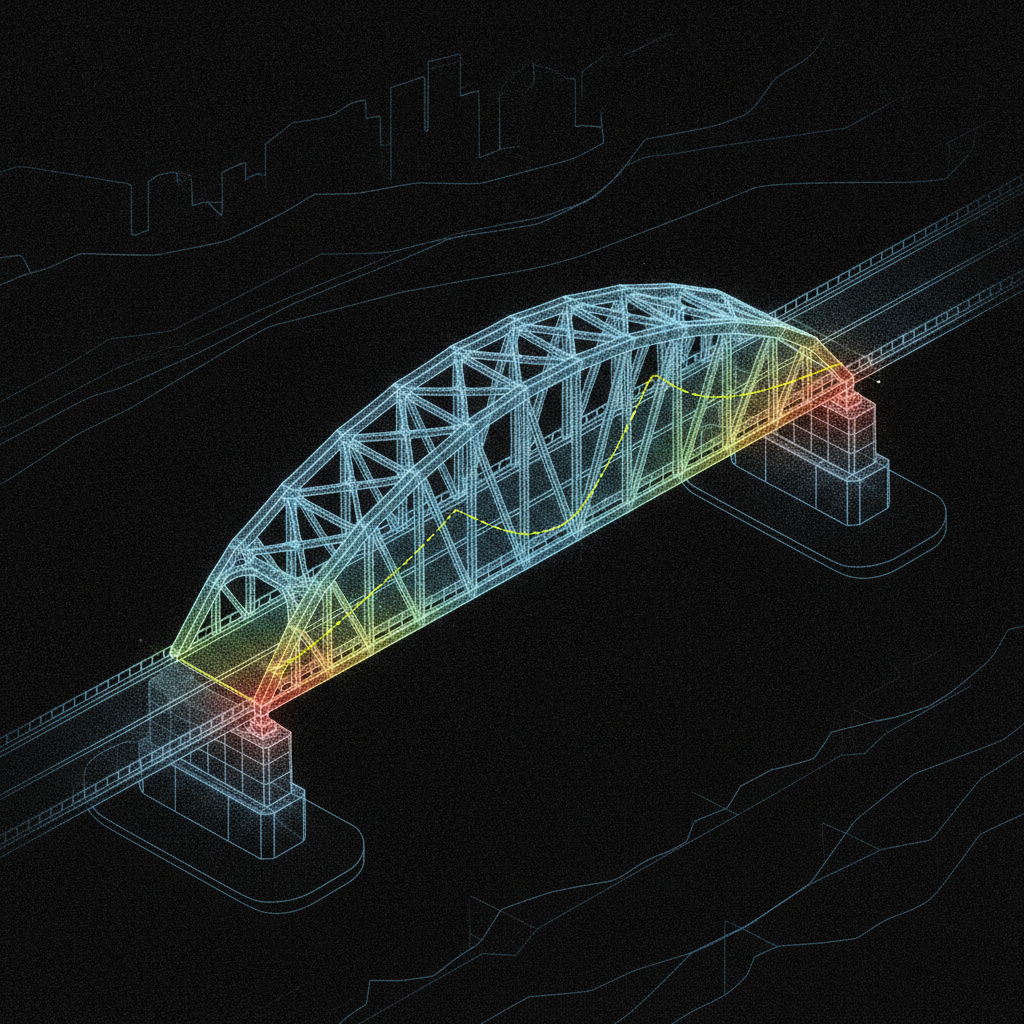
A bridge does not know it is a bridge. It knows only a rule, repeated at every point inside it: stress equals stiffness times strain. That rule is a tensor — the elasticity tensor, four indices deep, because stress and strain are each already three-by-three matrices (nine numbers each, six independent by symmetry) and something has to say how every component of one produces every component of the other. For an isotropic material this collapses to two independent numbers — Young's modulus and Poisson's ratio, or equivalently the Lamé parameters λ and μ — because an isotropic solid has no preferred direction to hide extra stiffness in. Wood, bone, carbon fiber are not so lucky: they remember the direction they were grown or laid up in, and their elasticity tensors carry that memory as extra independent constants.
No bridge is small enough to solve in closed form. So it is cut — finite element analysis — into elements: tetrahedra, hexahedra, shells, each one simple enough that its own stiffness matrix can be written down exactly, a local promise about how its corners move when its corners are pushed. The promise of one element is stitched to its neighbors' promises through shared nodes, assembling one vast sparse global stiffness matrix K, and the whole structure's equilibrium becomes a single, enormous, linear act of algebra: Ku equals f, displacement times stiffness equals applied force. The mesh does not know it is a bridge either. It knows only that its neighbors' movements must agree with its own at every shared edge — compatibility — and that internal forces must balance at every node — equilibrium. Solve those two demands everywhere at once and the shape the structure settles into falls out as the answer, not as something anyone told it to do.
A static bridge only has to balance forces once. A bridge in an earthquake, or a wing in a gust, must balance forces at every instant while also obeying Newton — mass times acceleration joining stiffness times displacement and damping times velocity in one equation of motion. Marching that forward in time exactly is not possible for a structure this large, so it is marched approximately, one small step at a time, by a rule called Newmark-beta: it assumes acceleration varies in a simple, chosen way across each tiny step — controlled by two parameters, β and γ — and uses that assumption to solve for the next instant's displacement, velocity, and acceleration together, self-consistently, from the previous instant's. Choose β and γ correctly (the "average acceleration" choice, β=1/4, γ=1/2) and the scheme conserves energy exactly for an undamped system, never inventing energy from nothing and never quietly leaking it away — a property called unconditional stability, meaning the time step can be as large as accuracy demands rather than as small as stability forces.
The structure never computes any of this. It only obeys, at every point, at every instant: stress equals stiffness times strain, force equals mass times acceleration. The finite element mesh and the Newmark integrator are not descriptions imposed on the bridge from outside — they are the only way a mind small enough to need them can ask, and get an answer to, a question the bridge itself is already answering everywhere, continuously, for free.