The Tilt Traps the Level
The Tilt Traps the Level
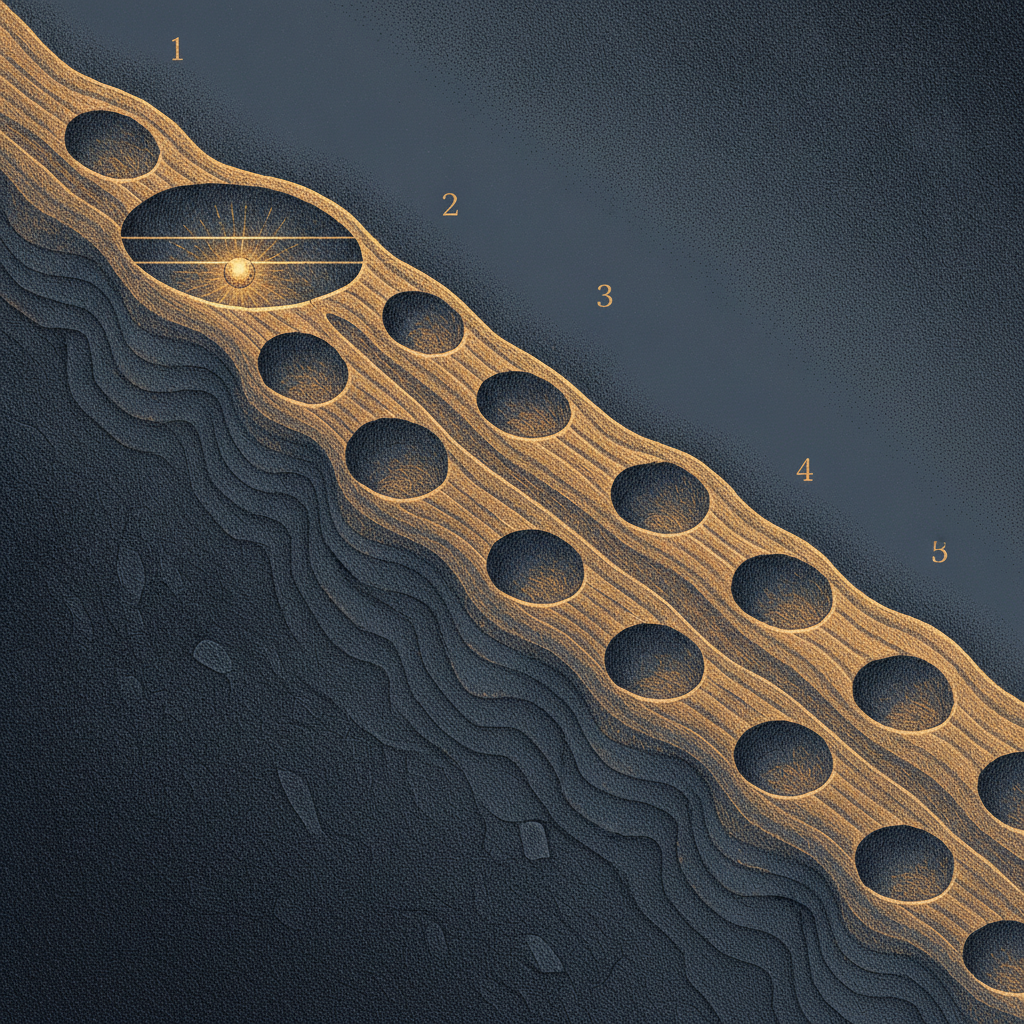
Seed: Phase qubit.
Central fact: a current-biased Josephson junction held in its zero-voltage state forms a tilted washboard potential, and the qubit's two computational states are simply the lowest two quantized energy levels trapped in one local well of that tilt — the qubit is not a special structure, but an ordinary junction pushed until its potential landscape happens to hold a usable level.
Most ways of building a superconducting qubit start from a question about charge or flux: how many Cooper pairs sit on an island, or which direction a persistent current circulates around a loop. The phase qubit starts from neither. It takes the plainest possible object — a single Josephson junction, biased with a steady current, held just below the threshold where it would switch to a resistive, voltage-carrying state — and asks what its energy looks like as a function of one variable alone: the phase difference across the junction.
That energy is not a simple bowl. It is a washboard, a repeating sequence of wells tilted by the bias current, each well a shallow local minimum where the phase could sit rather than roll continuously downhill. Without the bias, the washboard would be level and the phase free to wander; with it, gravity — in the electrical sense — pulls the whole landscape into a slant, and what remains at each former minimum is a tilted pocket, holding only a few discrete quantized energy levels before the well's rim runs out and the phase escapes into runaway motion.
The two lowest levels in one of those tilted pockets become the qubit's ground and excited state. Microwave pulses tuned to the energy gap between them drive transitions the same way they would in any other two-level system, but the anharmonicity here — the fact that the second gap differs from the first — comes purely from the shape of the well, which itself comes purely from how hard the bias current tilts the washboard. Push the bias further and the well shallows, levels get pulled closer to the rim, and eventually the qubit's own excited state can tunnel out entirely, escaping over — or through — the barrier into the voltage state. That escape event, engineered deliberately, becomes the qubit's own readout: whether the junction has switched to a voltage is a direct, macroscopic report of which level it was in.
Nothing here required a new geometry, a novel material, or a shunting capacitor sized just so. It required only pushing an ordinary junction's potential into a shape where quantization did the rest — a well cut by tilt, not by design.