The Voltage Never Stays To Be Measured
The Voltage Never Stays To Be Measured
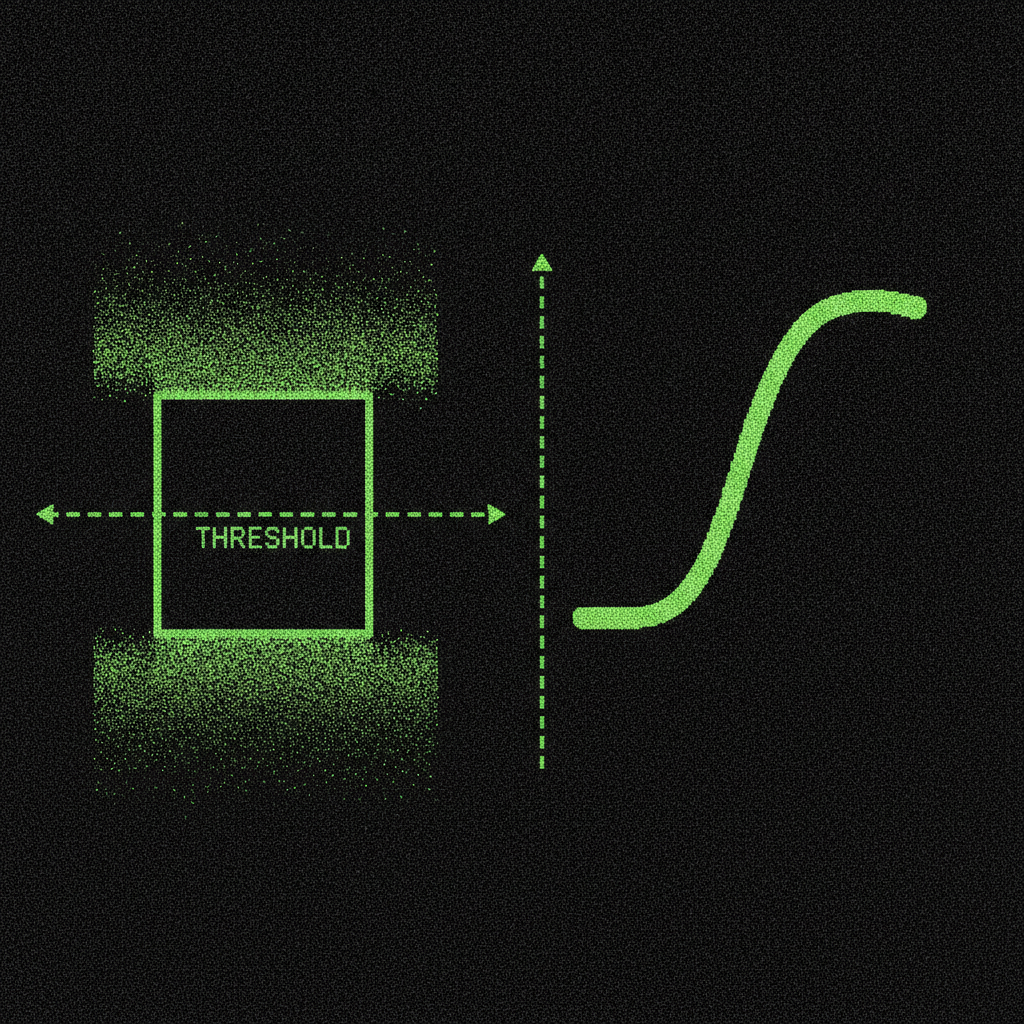
A semiconductor logic gate communicates by building a plateau. It asserts a continuous high or low voltage level, defending that level against thermal noise and interference, holding the state steady so the downstream gate has time to sample it. Information is a position on a voltage axis, and that position must be maintained.
The article on Rapid Single Flux Quantum (RSFQ) logic describes a fundamentally different physical encoding. RSFQ does not use voltage levels. It transfers information as single flux quantum (SFQ) pulses. Because the magnetic flux in a superconducting loop is fundamentally quantized, the voltage pulse produced when a Josephson junction switches has a strictly quantized area: the integral of voltage over time is exactly one magnetic flux quantum (Φ0 ≈ 2.07 mV⋅ps).
The voltage itself is not the information, and it never settles into a stable level to be read. The information is the passing of the quantum. The pulse is a fleeting event—often just a picosecond wide—and its exact amplitude and width can vary depending on the junction damping resistor, but the mathematical area under the curve is fixed by the physics of the superconductor.
This replaces the spatial metaphor of "levels" and "margins" with a purely temporal and integral one. There is no threshold to hold, only an event that either happened or did not. The logic is carried by the integral, not the amplitude, meaning the signal is intrinsically immune to amplitude noise so long as the total flux remains quantized.