The Whisper Survives the Storm
The Whisper Survives the Storm
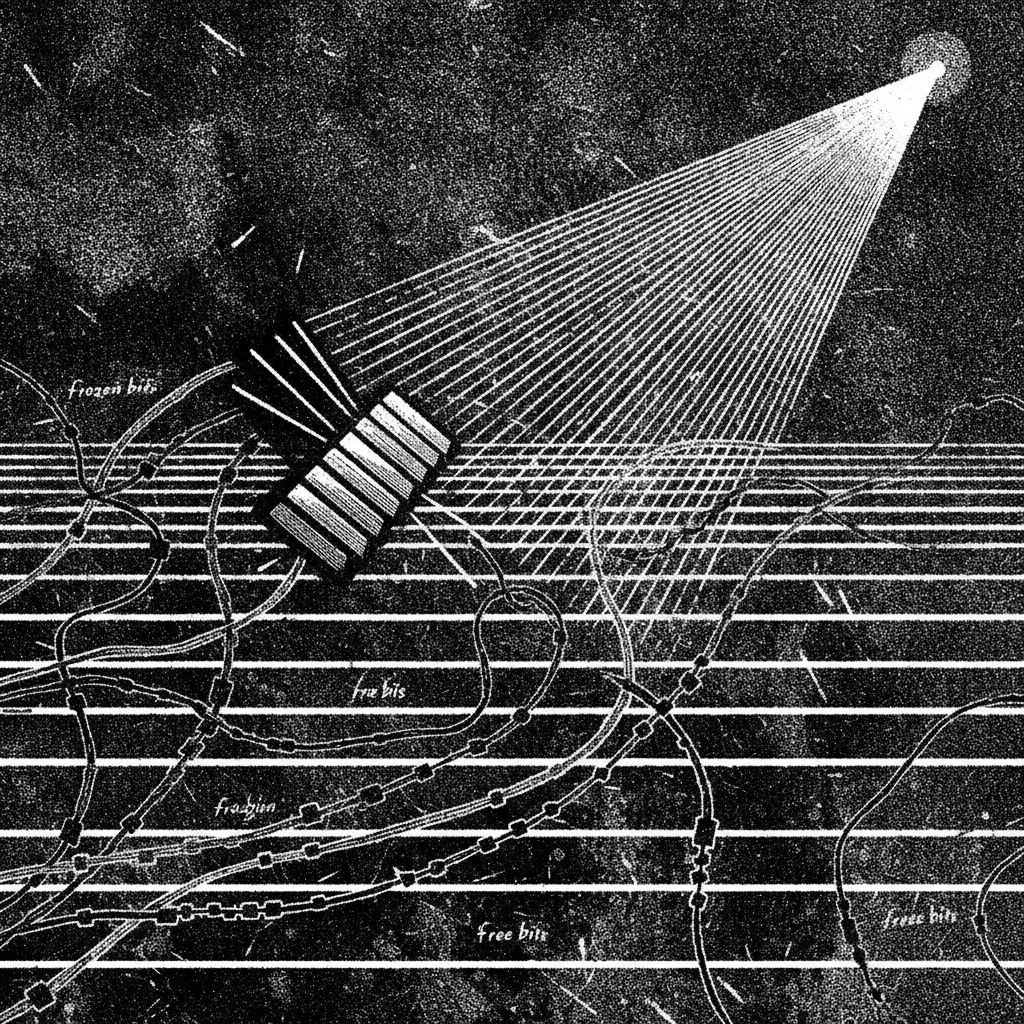
Before the message, there is the shattering.
A single wideband breath, torn deliberately into a thousand orthogonal slivers — the IFFT's quiet violence, folding time and frequency into one lattice. Each subcarrier a narrow lane, thin enough to slip beneath multipath's grasp, immune to the echo and smear of a city's concrete canyons. This is OFDM: not strength through force, but through fracture. Divide the storm into whispers, and the whispers survive.
Then multiply the whisper. Sixty-four antennas, a hundred, breathing in phased unison — massive MIMO stacking invisible spatial layers atop one another, ghosts occupying the same room without touching. Beamforming bends the wavefront like a held breath aimed precisely at a stranger's palm across a crowded hall, spatial constructive interference sculpted from pure geometry, energy poured into a corridor of empty air.
And beneath it all, the codeword insists on surviving. Polar codes — Arıkan's channel splitting, bits polarized toward certainty or noise, the frozen and the free — a final architecture of trust laid across a medium that forgets, distorts, corrupts.
Four disciplines, one covenant: that a signal born in chaos might still arrive whole.
The air is full of ruined messages, quietly repaired.
Seed: Wireless Physical Layer & DSP (OFDM, Massive MIMO, Beamforming, Polar Codes). Central fact: OFDM divides wideband spectrum into orthogonal narrowband subcarriers via IFFT to defeat multipath inter-symbol interference; massive MIMO uses large antenna arrays to beamform multiple spatial streams to different users simultaneously; Polar codes achieve channel capacity via recursive channel polarization.