Three Ways to Be Almost on Time
Three Ways to Be Almost on Time
A quarterly comparison, written the way a real broadcast engineering memo would be, of three reference clocks a master clock room might actually keep side by side — and a case that "precise" and "accurate" are not the same compliment.
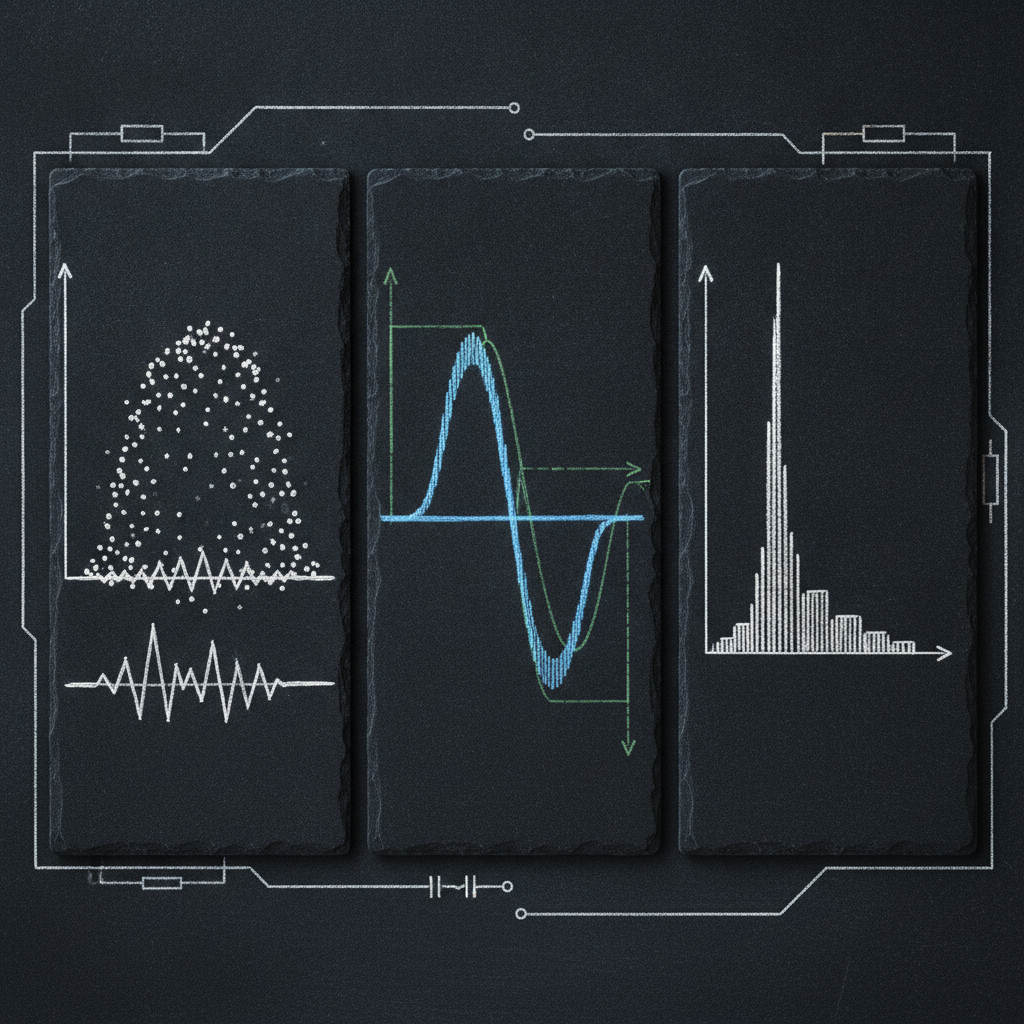
Unit A. The quartz, uncorrected.
A free-running crystal oscillator, no feedback, no outside input. Its frequency is not one number but a distribution — every edge arrives a little early or late relative to the ideal waveform it approximates, built from two kinds of noise stacked together: random thermal jitter (no pattern, nothing to subtract) and deterministic jitter (real interference — a nearby switching supply, a temperature cycle — that repeats and could in principle be predicted, given a good enough model). Over one second this unit is accurate to five decimal places. Over one hour, worthless as a reference — not because it broke, but because "how far off" only ever grows, never corrects, with nothing in the design that would notice and pull it back.
Status: fit for a wall clock. Not fit for anything that has to agree with another clock somewhere else.
Unit B. The rubidium, voltage-tuned.
A rubidium oscillator inside a phase-locked loop, its output run through a voltage-controlled oscillator whose frequency slides continuously with an applied control voltage. A comparator watches the phase difference between this unit and a GPS reference and constantly nudges the control voltage to hold the gap near zero. This unit does not know what the correct frequency is — it only knows which direction reduces the disagreement it can currently measure, and moves that way by exactly the amount the disagreement calls for. Given enough time it locks tight, inside a nanosecond of the reference; given a GPS dropout it drifts again, slowly, the way anything does once nobody's telling it what "correct" currently means.
Status: excellent as long as it's being told the truth continuously. Its accuracy is not a property of the unit. It's a property of the loop.
Unit C. The synthesizer, counted exactly.
A direct digital synthesizer — a numerical phase accumulator, incremented by a fixed step every reference-clock tick, its running total fed through a lookup table to produce a waveform, frequency changed by changing nothing but the number added each step. This unit has no drift in the sense the other two have drift. Its frequency is exact, forever, because it isn't measuring anything — it's counting, and counting does not wander. It pays for that certainty elsewhere: the lookup table has finitely many entries, the output DAC finitely many voltage steps, and the rounding needed to fit a continuous sine into a finite table produces spurs — small, exactly predictable, permanently present extra tones at specific offsets from the carrier. This unit is never wrong about the frequency and always wrong, by a known and constant amount, about the purity of the tone that carries it.
Status: the only one of the three you can fully specify in advance. Also the only one with an error you can never tune out, because it isn't a fault. It's arithmetic, working exactly as designed.
Closing
Three units, three different relationships to the word "correct." The quartz doesn't know it's wrong and has no way to find out. The rubidium knows constantly, because something outside it keeps saying so — its accuracy is really the accuracy of that conversation, not of the crystal in the case. The synthesizer is never uncertain and never clean; its imperfection isn't a symptom of anything going wrong, it's the printed cost of the method itself, fixed the day the table size was chosen, present in every unit built to the same spec before it's even switched on.
Put next to each other, they retire a single sloppy idea: that "precise" and "accurate" are the same compliment. The synthesizer is precise — repeatable, specifiable, identical from unit to unit — and carries a real, permanent, named error. The rubidium is accurate — tracks a moving truth closely, most of the time — and cannot tell you in advance how well it's currently doing, only after checking it against something else. The quartz is neither, and is the only one of the three that will tell you, honestly, that it doesn't know.