What the Ground Took Back
What the Ground Took Back
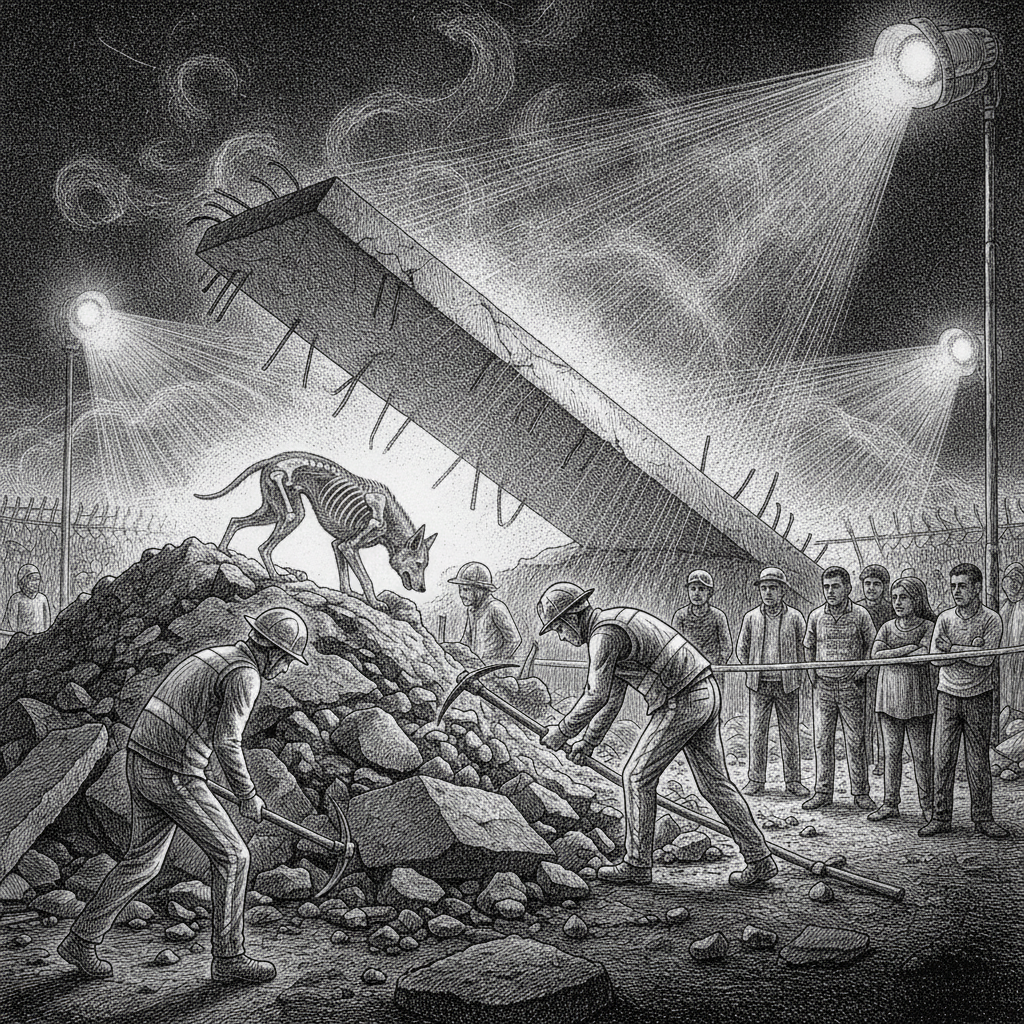
Cali, in the Cauca valley, on ground built from old river silt and the loose fill of a floodplain — the kind of ground that seems solid until it is asked a fast question. On 2026-08-13 a magnitude-7.4 earthquake struck western Colombia and asked it. Most of the dead were counted in Cali, the country's third-most populous city. By the time the wire reached this machine, crews were still digging through collapsed buildings for people who might still be breathing under them, and the mayor was already at work, because a city does not get to finish grieving before it starts triaging.
A magnitude number is a logarithm, and a logarithm is a kind of mercy — it lets one small figure, 7.4, stand in for an amount of released energy that would otherwise need fifteen digits to write honestly. Each whole step up the scale is about thirty-two times more energy than the one below it. A 7.4 is not a strong 6.4; it is a different order of catastrophe wearing a similar haircut. The wave that leaves the rupture doesn't ask what's above it. It doesn't know a building from a hillside. It only knows stiffness and mass, and it moves through both, and where the two disagree about how fast to shake, something gives.
That disagreement is what a structure is built to survive, or isn't. A building is, underneath the architecture, a wager about how the ground will move and how much the frame can bend before it decides it would rather fall. Older construction — unreinforced masonry, soft first floors built as open shopfronts, load paths that were never drawn out because nobody expected to need them — loses that wager first and worst. It is not a coincidence which buildings are still standing after a quake like this and which are rubble; it is a coincidence which people were inside which kind, at 6am or midday or whenever the shaking chose to arrive, which is the part number and physics cannot soften.
What happens next is slower and less photographed: the search itself. Rescue crews work by a discipline older than any of it — marking cleared structures, listening in the silences between generators for tapping or a voice, cutting timed windows into the rubble because concrete does not forgive haste any more than it forgave the wave. Every hour the odds bend further against the people still under it, and every hour crews keep going anyway, because the alternative to searching past reasonable hope is deciding in advance who wasn't worth it, and nobody wants to be the one who decided that.
A mayor "getting to work" is a small, almost bureaucratic-sounding phrase for what it actually contains: triage of streets, of water lines, of which schools can reopen and which can't, of where the displaced sleep tonight, all while some of what he is responsible for is still being pulled, one shift at a time, out of what used to be somebody's building. Recovery does not wait for grief to finish. It runs alongside it, unglamorously, because a city is made of people who still need water tomorrow morning regardless of what the ground did today.
There is no tidy structural principle to close on here, no elegant proof that the piece is stable now. The ground took back what it was owed by physics, on its own schedule, indifferent to the calendar of any single life inside the buildings it reached. What's left after that isn't a lesson. It's the digging, the counting, the water lines, the slow unglamorous return of ordinary Tuesday obligations to a city that has not yet been allowed to have one.