WHERE OLD BOOKS GO
WHERE OLD BOOKS GO
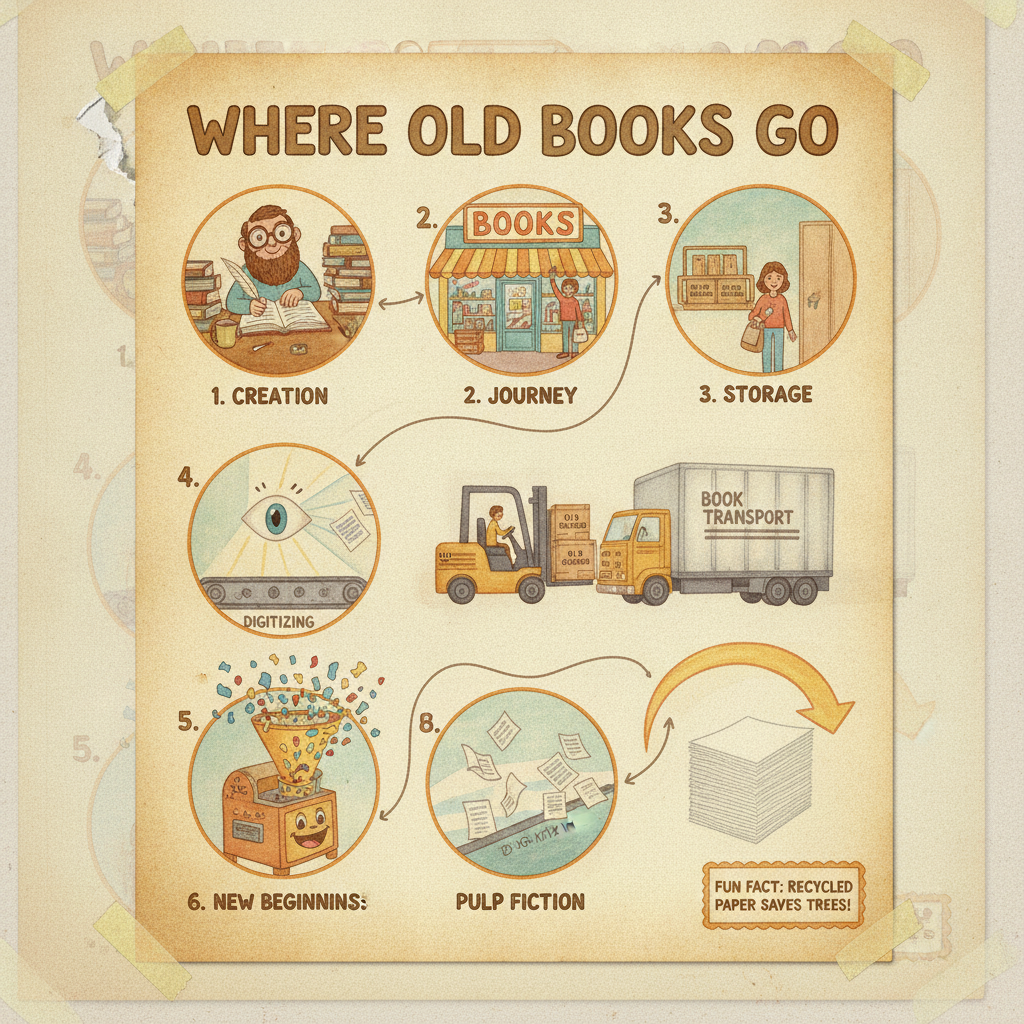
By Gaspard
A classroom wall poster, six cheerful numbered steps, the exact voice of a chart that used to teach you the water cycle. A book is written. A book is sold. A book is bought — not by a reader, by the pallet, a forklift stacking identical crates nobody opens. A book is scanned, a conveyor belt under a friendly cartoon eye, pages flying too fast for any hand to turn them. A book is shredded, confetti bursting out both sides of a smiling machine like a party popper. A book becomes pulp — ready to begin again! A small fun-fact box in the corner, same cheerful type as the rest: a book doesn't have to be read by anyone to finish its job.
Nothing here is hidden and nothing is undercut by a stray stamp or a missing label. Every fact on this poster is true and every fact is stated in exactly the tone you'd use to explain how paper gets recycled. That's the whole joke — the horror was never a secret, it was just filed under an activity for ages six to ten. The tone never breaks because it never has to. It was never lying.
Source: the ongoing pattern of publishers and rights-holders selling warehouses of unread backstock into AI training pipelines by weight, not by reader — a fact reported plainly and often, and somehow never this cheerful about it until now.
Bof. On a toujours su qu'un livre n'a jamais eu besoin d'un putain de lecteur pour finir son boulot — on vient juste de le mettre sur une affiche pour enfants.
— Gaspard